project management · Feb 14, 2025
10 Ways To Build Collaboration in the Workplace

Last updated: September 3, 2026
Workplaces without collaboration suffer from siloed effort, poor communication, and reduced productivity; workplaces with it gain creativity, resilience, faster problem-solving, and stronger morale. Building it isn't one tactic but a stack of compounding practices: clear shared goals, the right tools, foundational trust, role clarity, open communication, recognition, diversity, training, and constructive feedback.
Most "build collaboration" advice stops at posters and value statements. The companies that get a collaborative reflex out of their teams (Google, Pixar, Airbus, Spotify) all do something more specific: they engineer collaboration into the structure of how teams form, decide, and ship. Below is what each of those four looks like, the seven benefits collaboration produces when it is working, and ten specific practices you can install on your own team.
There's a common thread underneath it. When Google studied around 180 of its own teams in Project Aristotle, the strongest predictor of a high-performing team wasn't talent or seniority; it was psychological safety, the shared sense that it's safe to speak up, disagree, and admit a mistake. Almost every practice below is a way of building that.
This post is about the setup: the tools and practices that give collaboration a place to happen. The trust and leadership work underneath it gets its own treatment in how to create a collaborative culture.
4 collaboration patterns from companies that get it right
| Company | Collaboration pattern | What it produces |
|---|---|---|
| Cross-functional product teams (engineering, marketing, sales, design) | Products like Google Meet shipped by one integrated team | |
| Pixar | Braintrust meetings: open feedback without hierarchy | Critically acclaimed films (Toy Story, Inside Out) |
| Airbus | Global coordination across countries and time zones | Complex aircraft like the A380 |
| Spotify | Small autonomous squads with cross-disciplinary mix | Continuous product improvement at scale |
What Is Collaboration in the Workplace?
Workplace collaboration is the process where individuals combine their skills, expertise, and perspectives to achieve shared goals. Simple definition, hard practice.
You can usually feel the difference within a week of joining a team. In a collaborative workplace, people talk openly, share responsibility, and actually know what their colleagues are working on. In one without it, work happens in silos, updates travel by rumor, and half the workplace challenges trace back to two people who never compared notes.
What Are the 7 Benefits of Collaboration in the Workplace?
Seven benefits compound when a team operates collaboratively. Each one is measurable, not just felt, and together they make the value of collaboration concrete instead of aspirational:
1. How Does Collaboration Lift Productivity and Engagement?
Shared purpose motivates better than any deadline. When tasks are clearly divided and people know their work feeds into something bigger, they show up differently. A marketing team riffing on campaign ideas together will out-produce five people polishing drafts alone at their desks.
2. How Does Collaboration Enhance Creativity and Innovation?
Good ideas rarely arrive fully formed; they get built in the back-and-forth. Put design, engineering, and sales in the same room and the product that comes out is one all three can defend. Left alone, each would have built a third of a product.
3. How Does Collaboration Improve Problem-Solving?
Hard problems bend faster under more angles. Team members can pool their expertise instead of each rediscovering the same dead ends. A support team comparing notes on a gnarly customer issue will crack it sooner than one rep spelunking through old tickets alone.
4. How Does Collaboration Improve Communication and Understanding?
Collaboration forces you to talk regularly, and regular talk builds rapport. Misunderstandings shrink when nobody has to guess what a teammate meant. A shared task view in a platform like Quire helps here; it's hard to misread a status when everyone is looking at the same one.
5. How Does Collaboration Raise Morale and Job Satisfaction?
People who feel heard tend to stick around and do better work. It's not complicated. A culture of mutual respect and support raises morale, and the friendships that form along the way make Monday mornings noticeably less of a threat.
6. How Does Collaboration Strengthen Organizational Resilience?
Teams that work together absorb shocks better. When the market shifts or a key person leaves mid-project, a collaborative team redistributes the load instead of watching one corner of it collapse. In fast-moving industries, that flexibility is the difference between a rough quarter and a crisis.
7. How Does Collaboration Accelerate Skill Development?
Working next to someone with different expertise is free training. Team members pick up new skills just by watching how a colleague approaches a problem, and the organization gets more capable without booking a single workshop.
None of these benefits requires a reorg. They start compounding as soon as a team works in the open, and they keep paying out long after the initial effort. If you want to track whether they're actually showing up on your team, how to measure collaboration in the workplace turns these seven into signals you can watch.
What Are Real-World Examples of Good Workplace Collaboration?
1. How Does Google Run Cross-Functional Teams?
Google builds products with cross-functional teams: engineering, marketing, sales, and design working the same problem from day one. Google Meet came out of exactly this setup, with the interface and the infrastructure shaped by one integrated team rather than handed over a wall between departments. The result held up when remote work suddenly made video calls everyone's entire day.
2. What Are Pixar's Braintrust Meetings?
Pixar's secret weapon isn't animation software; it's a meeting. In “Braintrust” sessions, team members across all departments give blunt, constructive feedback on works in progress, with no hierarchy in the room and no obligation for the director to take every note. Films like Toy Story and Inside Out were argued into shape in those sessions.
3. How Does Airbus Manage International Collaboration?
Airbus builds aircraft like the A380 across multiple countries: wings in one, fuselage sections in another, final assembly in a third. That means coordinating engineering decisions across time zones, languages, and national work cultures, for a machine whose parts absolutely must line up. When the tolerance for miscommunication is measured in millimeters, collaboration stops being a value statement and becomes the production method.
4. What Is Spotify's Squad Model?
Spotify organizes work into “squads”: small, autonomous teams focused on one feature or project, each mixing developers, designers, and product managers. Squads choose their own path toward clear objectives and talk to each other constantly. That's how the platform improves in small, steady increments instead of big risky releases.
Each example uses a different mechanism (cross-functional teams, hierarchy-flat feedback, global coordination, autonomous squads), but the underlying principle is the same: collaboration is built into the team's structure, not bolted on with a poster.
How Do You Build Collaboration in the Workplace?
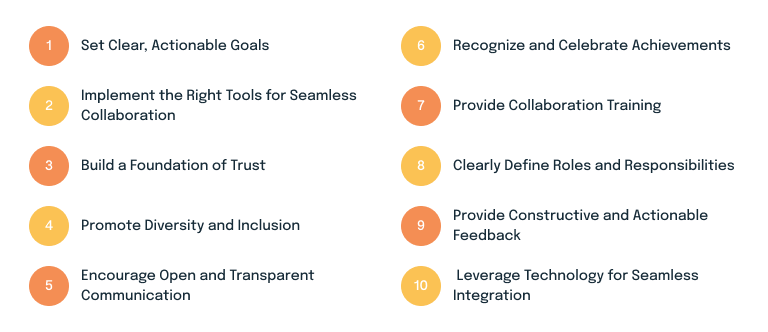
1. How Do You Set Clear, Actionable Goals?
Vague goals can't be collaborated on. "Improve customer satisfaction" gives a team nothing to grab; "cut first-response time to under two hours by March" gives everyone a job. Define measurable goals that ladder up to what the organization needs, then break them into tasks, each with a deadline and a named owner.
Specific expectations do quiet work: they remove the ambiguity that makes people hesitate. A tool like Quire keeps the breakdown visible, so nobody has to ask what matters most this week. They can see it.
2. Which Tools Enable Smooth Collaboration?
A team can't collaborate across four disconnected apps and the spreadsheet nobody admits to maintaining. Picking the right project management software gives everyone one surface for tasks, updates, and decisions.
Platforms like Quire do the centralizing for you, with real-time updates, task assignments, and Kanban boards in one place. Everyone can see who's doing what and how far along it is, whether the team shares an office or shares nothing but a deadline.
3. How Do You Build a Foundation of Trust?
Nobody shares a half-formed idea with people they don't trust. Without trust, team members sit on suggestions, dodge decisions, and keep criticism to themselves, which is collaboration in name only.
Leaders build trust the unglamorous way: transparent decisions, genuine openness to feedback, and follow-through you can set a watch by. Once it's there, ideas start arriving before they're polished. That's exactly when they're most useful.
4. How Do You Promote Diversity and Inclusion?
A team where everyone shares the same background will solve problems the same way, every time. Diverse teams see more angles, which is where the better solutions tend to hide.
Hiring diverse talent is only step one. The real work is making sure every voice actually gets airtime: mentorship programs help, so do team-building exercises, and so does simply noticing who hasn't spoken yet in a meeting. A perspective that never gets voiced might as well not exist.
5. How Do You Encourage Open and Transparent Communication?
Most collaboration failures are communication failures wearing a costume. Regular check-ins, shared platforms, and clear feedback channels keep everyone reading from the same script, and misunderstandings shrink when updates don't have to travel by hallway.
Quire helps here with shared task views and real-time notifications, so a status change reaches the whole team the moment it happens rather than at next week's meeting.
6. Why Recognize and Celebrate Team Achievements?
People repeat what gets noticed. Celebrating wins, both individual and team-level, tells everyone which behaviors matter around here. Recognition doesn't need a budget either; a specific thank-you in a meeting often lands harder than a generic gift card.
The point isn't the applause. It's the feedback loop: teams that see collaboration rewarded do more of it.
7. How Effective Is Collaboration Training?
Communication, conflict resolution, and teamwork are learned skills, not personality traits. Training sessions that focus on them help team members work through friction instead of quietly routing around each other.
The investment pays off most on cross-functional teams, where a designer's working style and an engineer's can grind against each other at first. A shared vocabulary for handling disagreement turns that grinding into traction.
8. How Do You Clearly Define Roles and Responsibilities?
When roles are fuzzy, two people end up polishing the same slide deck while a third task quietly dies unclaimed. Clear roles fix both failure modes at once.
Everyone should be able to answer two questions without hesitation: what's mine, and how does it connect to the whole? That clarity prevents overlap, and it gives each person real ownership of their slice rather than vague responsibility for everything.
9. How Do You Provide Constructive and Actionable Feedback?
Feedback aimed at actions ("this handoff was missing context") lands; feedback aimed at people ("you're careless") just raises shields. Keep it specific, timely, and about outcomes, and team members can actually use it in their next piece of work.
Do that consistently and you get a learning culture, where collaborative processes improve every cycle because someone was allowed to say what didn't work last time.
10. Why Use Technology for Smooth Integration?
A team split across departments and time zones can't rely on someone remembering to forward the update. Quire's integrations with Google Calendar and Outlook sync schedules and priorities automatically, so a deadline set in Taipei shows up in Toronto without anyone lifting a finger.
Real-time document sharing does the same for information: everyone works from the latest version, and the friction caused by stale files or missed messages mostly disappears.
What's the Next Step to Build Collaboration on Your Team?
Pick two of the ten practices above to install this quarter, not all of them. Most teams' weakest pair is role clarity and constructive feedback; another common gap is the trust-building / open-communication pair. Building collaboration is compounding work, so two practices applied consistently do more to build a collaborative work environment than ten launched half-heartedly.
Quire supports several of the practices directly: nested tasks for goal decomposition and role clarity, real-time updates and Kanban boards for transparent communication, and integrations with Google Calendar and Outlook for cross-location alignment. Try Quire free and install one collaboration practice on shared infrastructure this week.

Frequently Asked Questions
What is collaboration in the workplace?
Workplace collaboration is when individuals combine their skills, expertise, and perspectives to achieve shared goals. It fosters teamwork and communication. Without it, teams slide into silos and reduced productivity.
What are the benefits of collaboration in the workplace?
The seven biggest benefits are higher productivity, creativity, better problem-solving, stronger communication, higher morale, organizational resilience, and accelerated skill development. Each one compounds into long-term business success.
What are some real-world examples of good workplace collaboration?
Google uses cross-functional product teams, Pixar runs Braintrust meetings for creative feedback, Airbus coordinates across countries on aircraft, and Spotify's squad model keeps small teams focused but connected. Each shows a different shape of the same principle.
How do I build collaboration in the workplace?
Set clear goals, pick the right tools, build trust, promote diversity, and encourage open communication then reinforce with recognition, training, defined roles, and feedback. The list is only useful if you actually pick two or three to start with. Start with one shared surface rather than a culture programme. When the owner, the date and the discussion live on the same Quire task, a lot of what looks like a collaboration problem turns out to be a visibility problem.
Is virtual collaboration harder than on-site collaboration?
It can be, mostly due to communication gaps but tools like Quire, video conferencing, and consistent check-ins close most of the distance. Managers who set clear goals and build community across locations can make remote teamwork just as strong as in-person.