project management · Feb 21, 2025
Collaborative Brainstorming: 5 Techniques to Try

Last updated: September 3, 2026
Collaborative brainstorming (also called crowdstorming) outperforms individual ideation because diverse perspectives surface options no single person would reach. Five techniques cover most situations: mind mapping for visual organization, brainwriting so quieter members contribute silently first, SWOT for evaluating strengths and weaknesses, reverse brainstorming to expose pitfalls by making the problem worse, and constraint-based brainstorming that forces creativity within limits.
- What Is Collaborative Brainstorming?
- How Does Collaborative Brainstorming Work?
- What Are the 5 Best Collaborative Brainstorming Techniques?
- How Do You Improve Collaborative Brainstorming in Your Team?
- Why Is Quire a Strong Collaborative Brainstorming Tool?
- What's the Next Step for Your Next Brainstorm?
- Frequently Asked Questions
Brainstorming as a group is supposed to surface ideas a single person couldn't reach alone. In practice, it often surfaces the same loudest three voices in the room while everyone else nods. The fix isn't more brainstorming; it's better technique. The five approaches below address different parts of the problem, and the right one depends on what you're stuck on (and who tends to dominate when you aren't using them).
The research backs the technique-over-volume point. According to the Association for Psychological Science, when studies compare the two, brainwriting, where people write ideas down independently before discussing, reliably produces more ideas and higher-quality ones than open verbal brainstorming, largely because it removes the "production blocking" that happens while everyone waits a turn to speak. That's why the techniques below lean on structure, not just enthusiasm.
This post defines collaborative brainstorming, walks through the structured process that separates productive sessions from rambling ones, and covers five techniques (mind mapping, brainwriting, SWOT, reverse brainstorming, and constraint-based ideation) plus practical tips for sessions where quieter team members actually contribute.
5 brainstorming techniques at a glance
| Technique | Best for | Key benefit |
|---|---|---|
| Mind mapping | Visual thinkers, complex problems | See connections between ideas |
| Brainwriting | Mixed-personality teams | Quieter members contribute without speaking first |
| SWOT analysis | Narrowing many ideas to a few | Forces structured evaluation |
| Reverse brainstorming | When stuck on a forward solution | Surfaces pitfalls before they cost time |
| Constraint-based | Resource-bounded projects | Limits spark creative solutions |
What Is Collaborative Brainstorming?
Collaborative brainstorming: a structured group exercise, sometimes called crowdstorming, in which a team generates ideas or solves a problem together instead of individually. The structure is what separates it from a meeting. Without one, a session reliably surfaces the three loudest voices rather than the best thinking in the room.
Unlike solo brainstorming, it runs on collective thinking: each person brings perspectives and skills the others don't have. There's a side benefit, too. Teams that build ideas together tend to trust each other more afterward.
Related: 10 Examples of Collaboration Skills and How to Improve Them — the interpersonal skills, like active listening and giving feedback, that decide whether a brainstorm actually surfaces good ideas.
Crowdstorming widens the circle beyond the immediate team. Pull in people from other departments, or even outside the company, and you get insights your team was never going to produce on its own.
How Does Collaborative Brainstorming Work?
The goal of a session is simple: an open, non-judgmental room where everyone can contribute freely. Teams usually reach for collaborative brainstorming when they're stuck, whether that's a complex challenge, a creative block, or a strategy that needs eyes from more than one department.
A session has three phases. Define the problem first, so everyone is solving the same thing. Then generate ideas with zero criticism allowed; judging comes later. Finally, refine, combine, and evaluate what you've gathered until the practical solutions separate themselves from the merely clever ones.
Picture a support team trying to cut ticket response time. The problem statement takes two minutes. The generation phase produces thirty ideas, from "hire more agents" to "let the docs answer the easy half." The evaluation phase is where the thirty become three, and the three become somebody's next sprint.
To make the process smoother, tools like Quire let teams track, organize, and refine ideas as they surface, so a strong idea from minute three is still a tracked task you can act on a week later instead of a line buried in someone's notes. Teams stay aligned, revisit the discussion when needed, and move forward with the best ideas.
What Are the 5 Best Collaborative Brainstorming Techniques?
Five techniques cover most situations. Each one is paired with the kind of problem it solves best:
1. How Does Mind Mapping Work in Brainstorming?
Mind mapping starts with the central problem in the middle of the page, then branches out to related ideas, which branch again into sub-ideas. You end up with a tree of interconnected thoughts instead of a flat list.
The tree is the point. Seeing ideas spatially exposes connections and patterns a bulleted list hides. Quire's nested task lists work well as a digital mind map: every branch gets captured, and none of it evaporates when someone wipes the whiteboard.
2. What Is Brainwriting and Why Use It?
Brainwriting swaps speaking for writing. Each team member writes down ideas silently, then passes them to the next person, who adds their own thoughts or builds on what's there. The round continues until everyone has touched every idea.
The silence is a feature, not a limitation. Nobody's idea gets steamrolled by the most confident voice in the room, and quieter members contribute on equal footing.
The research cited at the top of this post found brainwriting reliably beats open verbal brainstorming on both idea count and quality, which says something about how much talent hides behind "I didn't want to interrupt."
With Quire, teammates can share and build on written ideas in real time, which makes it a natural surface for brainwriting.
3. How Does SWOT Analysis Drive Brainstorming?
SWOT (Strengths, Weaknesses, Opportunities, Threats) analysis brings structure to the messy middle of a brainstorm: the moment you have twenty ideas and no clue which three deserve to live. Run each candidate through the four lenses and the viable ones separate from the charming-but-doomed.
It's the evaluation step most brainstorms skip, which is why so many sessions end with a full whiteboard and an empty backlog. In Quire, you can break the surviving ideas into tasks, assign them to team members, and track how each evaluation plays out.
4. What Is Reverse Brainstorming and When Does It Work?
Reverse brainstorming flips the question: instead of asking how to solve the problem, ask how to make it worse. It sounds like sabotage. It's actually a diagnostic, because the fastest way to find a plan's weak points is to brainstorm attacks on it.
Every "way to make it worse" is a pitfall your real plan needs to dodge. Categorize and prioritize what surfaces in Quire, so those risks get addressed early, while they're still cheap.
5. Why Does Brainstorming With Constraints Outperform Free Form?
A blank canvas is oddly paralyzing; a tight budget is clarifying. Give the team a constraint (budget, time frame, headcount) and brainstorm inside it. Limits force the inventive answers that "anything goes" somehow never produces.
This works especially well on projects that already have hard restrictions, since the ideas arrive pre-fitted to reality. Quire's deadlines and progress tracking keep the session's output inside the same constraints it was designed for.
How Do You Improve Collaborative Brainstorming in Your Team?
Brainstorms go better when you know how your people think. Here are the 8 types of collaboration styles every team should master.
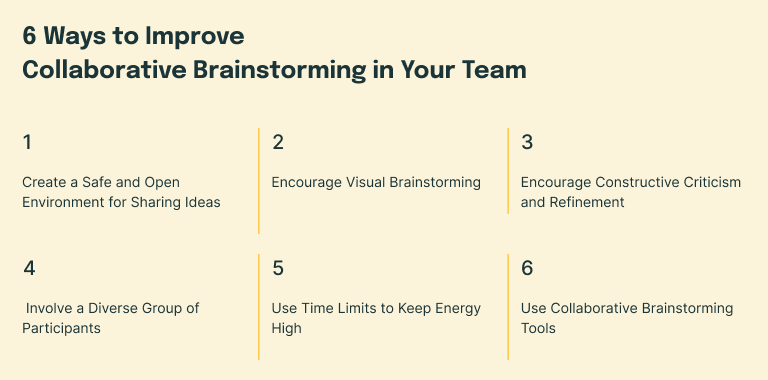
Six practices fix the common failure modes of group brainstorming (loudest-voice dominance, idea fatigue, blank-page paralysis):
1. How Do You Create a Safe Environment for Sharing Ideas?
Nothing kills a brainstorm faster than watching the first slightly odd idea get shot down. Everyone else quietly edits themselves for the rest of the meeting. A safe environment means no idea is too silly or far-fetched, and nobody gets graded on their first draft.
Set the ground rules out loud at the start: every idea is welcome, criticism waits. Repeat them at the start of every session, not just the first one, because one eye-roll from a senior teammate can undo a month of ground rules. It also helps to give people a written channel. In Quire, teammates can drop ideas into the list digitally, which feels far less exposed than announcing them to a full room.
Related: Create a Collaborative Culture in the Workplace — the wider practices that make psychological safety the default, not just a rule for brainstorm sessions.
2. Why Should You Encourage Visual Brainstorming?
Words aren't always the best container for ideas. Mind maps, sketches, and digital whiteboards let teams see relationships between concepts, and seeing tends to spark building: one person's branch becomes another person's starting point. Dedicated whiteboard tools like Miro and FigJam are popular for the free-form sketching stage, though you still need somewhere to turn the sketches into tracked work once the session ends.
Quire gives brainstorms a structured visual surface, with nested task lists for breaking big concepts down and Kanban boards for grouping ideas into themes. Abstract thoughts become plans you can point at, and the good insights stop dissolving into scattered notes.
3. How Do You Encourage Constructive Criticism in Brainstorms?
Generating ideas is half the job; refining them is the other half. Constructive criticism sharpens promising concepts, as long as it stays solution-oriented rather than score-keeping.
One reliable frame: ask “what could make this idea even better?” instead of listing flaws. Feedback phrased as a build invites another build. Quire's comments keep that back-and-forth attached to the idea itself, so the critique and the concept travel together.
4. Why Should Brainstorms Involve Diverse Participants?
The whole point of brainstorming as a group is range. A room full of people with identical backgrounds will produce polite variations of one idea. Mix skillsets, departments, and experience levels, and the assumptions start getting challenged.
Brainstorming a marketing campaign? Pull in someone from sales, someone from support, maybe a designer. Support hears the complaints marketing never sees. With Quire, inviting people across teams into a brainstorming project takes seconds, even when half of them work remotely.
5. How Do Time Limits Keep Brainstorms High-Energy?
Brainstorms have a half-life. Past a certain point, energy drops, idea quality drops with it, and yet the meeting keeps going anyway. A hard time limit fixes this; focus rises when the clock is visible.
Try intervals: 10-15 minutes of idea generation, a short break, then 10 minutes of refining. If the session genuinely needs more, schedule a second one rather than stretching the first; two sharp sessions beat one long slog every time. Quire's reminders can police the intervals, so nobody has to play timekeeper.
6. Which Collaborative Brainstorming Tools Should You Use?
The right tool keeps ideas from dying in the notebook where they were born. Look for capture, organization, prioritization, and real-time collaboration, especially if the team is spread across locations.
Quire covers the full loop: task boards for ideas, categories for sorting, comments and tags for building on each other's thinking, and files attached right where they're relevant. The conversation keeps going long after the session ends.
You don't need all six practices at once. Fix the failure mode your team actually has (usually the loudest-voice problem) and the sessions improve immediately.
Why Is Quire a Strong Collaborative Brainstorming Tool?
Quire doubles as an idea management system: every idea you capture during a session stays a tracked task you can organize, evaluate, and act on later, instead of a line lost in someone's notes. Mind mapping, SWOT, brainwriting; whichever technique you run, the output lands somewhere permanent.
Real-time collaboration means the session works the same whether the team shares a room or three time zones. Share tasks, leave comments, give feedback, and nobody's contribution slips through.
When the session ends, prioritize the keepers, break them into assigned tasks, and track progress. That's the difference between a fun meeting and a productive one.
Want the structure already built? Quire's team brainstorm guide covers the full run: collecting ideas on a board with no judgment, grouping them by theme with tags and swimlanes, scoring impact against effort, then handing every winner one owner and one date. There's a project you can duplicate, so the statuses and tags are waiting before anyone joins the call.

What Collaboration Features Matter Most in a Brainstorming Tool?
The features that actually change brainstorm outcomes are the ones that keep ideas alive after the meeting.
Look for real-time co-editing so no contribution is lost, threaded comments so feedback attaches to the idea instead of a separate chat, a visual surface (nested lists or a Kanban board) for grouping and ranking ideas, and one-click conversion of an idea into an assigned, tracked task.
Quire bundles all of these, including built-in Chat and offline access, so a session moves straight from ideas to owned next steps.

What's the Next Step for Your Next Brainstorm?
Pick the technique above that fits the problem your team is actually stuck on, not the technique you used last time. Run a 30-minute session this week with one ground rule: no idea gets criticized during the generation phase.
Quire holds the output so the session does not end when the meeting does: nested tasks for mind-mapping, real-time comments for brainwriting, Kanban boards for SWOT sorting, and task assignment for converting ideas into tracked next steps. Try Quire free and run your next brainstorm on a surface that survives the meeting.
Frequently Asked Questions
What is collaborative brainstorming?
Collaborative brainstorming (or crowdstorming) is a creative group exercise where team members generate ideas together to solve a problem. It thrives on diverse perspectives that wouldn't show up in individual thinking.
How does collaborative brainstorming work?
Start by defining the problem, run an open idea-generation phase where nothing is criticized, then refine and evaluate ideas to pick the most viable. The structure is what keeps it productive, not chaotic.
What are the best collaborative brainstorming techniques?
Five strong techniques are mind mapping, brainwriting, SWOT analysis, reverse brainstorming, and brainstorming with constraints. Each suits a different kind of problem; pick based on what your team needs to solve.
How can I improve collaborative brainstorming sessions?
Create a safe environment, encourage visual thinking, invite constructive criticism, diversify participants, use time limits, and adopt collaborative tools. Quieter team members especially benefit from written or digital formats. The session is rarely the weak part. The day after is, when good ideas have no owner. Turn each kept idea into a Quire task with an assignee and a due date before people leave the room.
What tool is best for collaborative brainstorming?
Quire works well because it combines real-time collaboration, visual task management, and the ability to convert ideas straight into tracked tasks. The conversation continues long after the session ends.
What is the ideal group size for a brainstorming session?
Five to eight people is the sweet spot: enough range without drowning out the quieter voices. Past eight, split into sub-teams of four or five and merge their ideas afterward.