
features · Apr 10, 2015
Sync your Tasks with Google Calendar

Last updated: September 8, 2026
Quire has four Google Calendar integrations, not one. A link-based one-way sync runs on every plan and shows incomplete tasks that have due dates. Instant Sync adds real-time updates on Professional and up. Two-Way Sync and the Google-to-Quire event sync are Premium and Enterprise. Pick by direction and plan.
- What Google Calendar sync options does Quire offer?
- How do you sync Quire tasks to Google Calendar?
- Which tasks actually show up on your calendar?
- What does Google Calendar Instant Sync change?
- How does two-way sync between Quire and Google Calendar work?
- Can Google Calendar events become tasks in Quire?
- Which Google Calendar sync should you pick?
- How do you remove a Google Calendar sync?
- Do you even need a Google Calendar sync?
- Key takeaways
- Frequently asked questions
You set a due date in Quire on Monday. On Thursday you open Google Calendar to book a meeting, and the deadline is nowhere on the grid.
So you retype it. The date now lives in two places, and one of them will quietly go stale the first time the deadline moves.
Quire's Google Calendar sync exists to stop that, and it is not a single switch. There are four integrations with different directions, different speeds, and different plans behind them. Picking the wrong one is the usual reason a sync feels broken when it is working exactly as designed.
What Google Calendar sync options does Quire offer?
Quire offers four separate Google Calendar integrations: a link-based one-way sync on every plan, Instant Sync for real-time updates on Professional and higher, Two-Way Sync on Premium and Enterprise, and a Google-to-Quire sync that converts events into tasks, also on Premium and Enterprise.
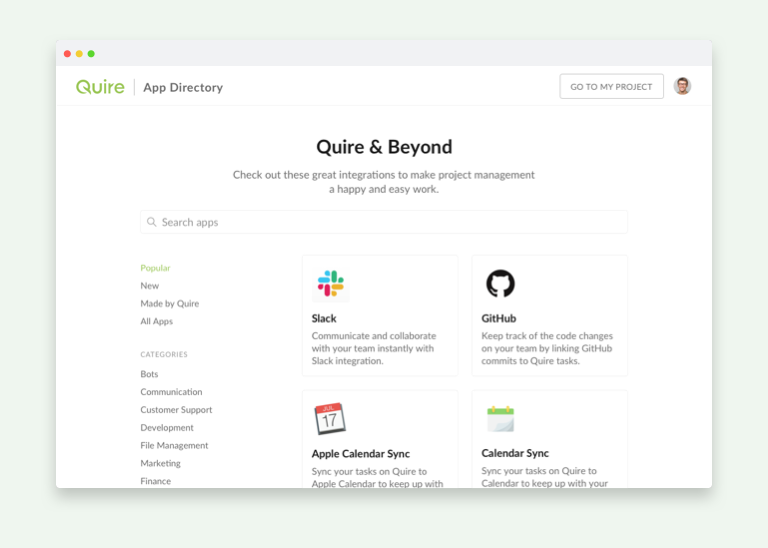
They all live in the same place, the app directory at Quire & Beyond. Here is how they differ.
| Integration | Direction | Plans |
|---|---|---|
| Google Calendar Sync | Quire to Google | Every plan, free included |
| Google Calendar Instant Sync | Quire to Google, in real time | Professional and higher |
| Google Calendar Two-Way Sync | Both directions | Premium and Enterprise |
| Google Calendar Sync from Google to Quire | Google to Quire | Premium and Enterprise |
One-way sync: changes travel in a single direction only. Editing the calendar entry does nothing to the source. Two-way sync: an edit in either tool updates the other.
The standard one-way Google Calendar Sync is on every Quire plan, including free. Instant Sync needs Professional or higher. Two-Way Sync and the Google-to-Quire sync need Premium or Enterprise. Details are on the pricing page.
One rule cuts across all four: a Quire project runs one Google Calendar integration at a time. Set up Two-Way Sync on a project that already had the Google-to-Quire sync, and the older one switches off automatically.
How do you sync Quire tasks to Google Calendar?
The standard one-way sync is the one most teams start with, because it works on the free plan and takes about a minute. It hands you a subscription URL that Google Calendar reads on a schedule.
1. Open the app directory. Go to Quire & Beyond and find the calendar app you want.
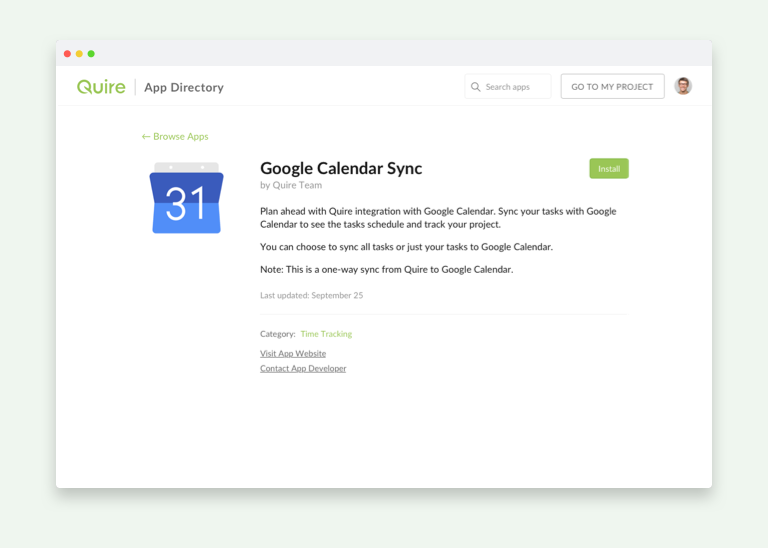
2. Install it. Click Install to connect Quire with your calendar.
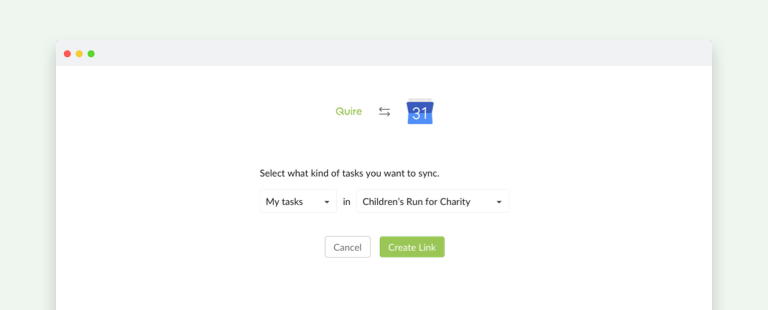
3. Choose what to send. Pick the project, then decide between every task in it or only the tasks assigned to you.
4. Copy the link and subscribe. Quire generates a URL. In Google Calendar, click the + next to Other calendars and choose From URL, which Google's own instructions still describe step by step. Older guides call the same option Add by URL.
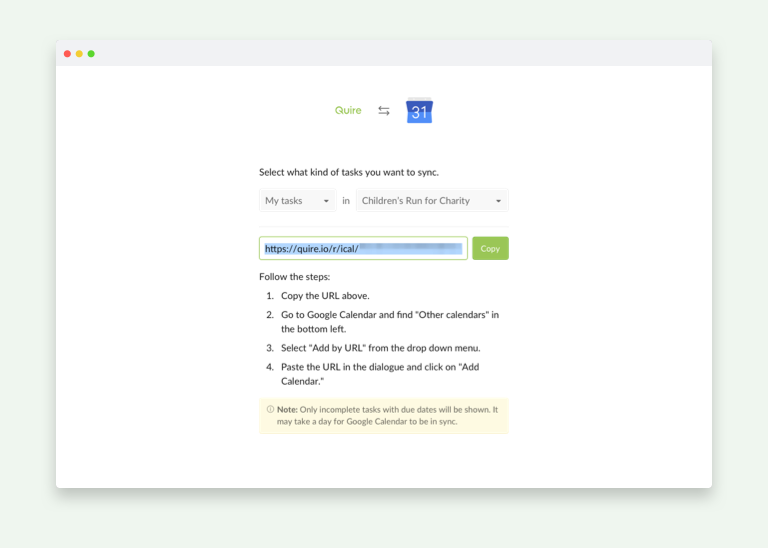
That is the whole setup. Nothing else needs maintaining, and you can create more than one link if different projects belong on different calendars.
Which tasks actually show up on your calendar?
Only incomplete tasks that carry a due date. That single sentence explains most of the "why is my calendar empty" confusion.
A few consequences worth knowing before you go looking for a bug:
- No due date, no calendar entry. Undated tasks stay in Quire.
- Completing a task removes it. The entry clears once the calendar next refreshes.
- You pick the scope at setup. All tasks in the project, or only the ones assigned to you.
- The standard link sync is not instant. Google Calendar may take up to a day to pick up a change.
Recurring tasks behave the way you would hope. The open instance sits on its due date, and when you complete it, the next one takes its place on the calendar without you touching either app.
Related: Introducing Smart Calendar: A New Way to View Your 365 Days, the calendar Quire has built in, if you would rather not leave the app at all.
What does Google Calendar Instant Sync change?
Instant Sync is the same direction as the standard sync, Quire to Google, with the delay taken out. Edit a due date in Quire and Google Calendar reflects it right away instead of on the next refresh.
Setup is shorter because there is no URL to copy. You install the app, sign in to your Google account, authorize it, and select the project you want on the calendar.
Task scope works the same way. Choose all tasks, or choose My Tasks so only the tasks assigned to you reach the calendar. You can also point several Quire projects at one Google calendar, or give each project its own.
Google Calendar Instant Sync is available on the Professional, Premium, and Enterprise plans.
How does two-way sync between Quire and Google Calendar work?
Two-Way Sync is the one people usually mean when they say "sync." An edit in either tool updates the other, so dragging an event to next Tuesday in Google Calendar moves the Quire task with it.
You install the Two-Way Sync app, authorize your Google account, and pick the Quire project that should receive calendar events as tasks. Then you set the scope.
Choosing My Tasks does two things at once. Events imported from Google Calendar get assigned to you automatically in Quire, and only tasks assigned to you appear on the synced calendar.
The last step is pairing. You select which Google calendar goes with the chosen project, customize how tasks are displayed, and save. Different projects can point at separate calendars, or several projects can share one.
Google Calendar Two-Way Sync is available on the Premium and Enterprise plans.
Can Google Calendar events become tasks in Quire?
Yes, and it is a separate integration from Two-Way Sync. The Google-to-Quire sync runs in one direction only, pulling events out of Google Calendar and creating them as tasks in a Quire project.
It suits teams whose commitments start life as calendar invites. Client calls, interviews, and site visits get booked in a calendar first, and this turns each one into something you can assign, comment on, and attach files to.
Setup follows the same shape: install, choose the destination Quire project, authorize your Google account, then pick the task scope. You can split projects across separate calendars or funnel several into one.
The catch is the one-integration rule. If a project already runs Two-Way Sync, the Google-to-Quire sync switches itself off there, because Two-Way Sync already covers that direction.
Google Calendar Sync from Google to Quire is available on the Premium and Enterprise plans.
Which Google Calendar sync should you pick?
Direction first, plan second. Answer one question and the list shortens fast.
- You want deadlines visible next to meetings. The standard one-way sync does this on any plan, free included.
- A day's lag is too slow. Instant Sync, on Professional and higher.
- Your team reschedules in the calendar, not in Quire. Two-Way Sync, on Premium and Enterprise.
- Work arrives as calendar invites. The Google-to-Quire sync, on Premium and Enterprise.
If you are still deciding between calendar-first and task-first tools generally, our roundup of task management software covers how the trade-off plays out across ten of them.
Read more on dragging and dropping tasks straight onto a calendar in Quire, which is often faster than editing due dates one at a time before a sync ever runs.
How do you remove a Google Calendar sync?
Disconnecting takes two steps, and doing only one is the most common mistake.
- In Google Calendar, find the calendar Quire created and click the
xicon next to its name to delete it. - In Quire, open
My Appsin your account settings and revoke the app's access.
Two things are worth stating plainly, because both surprise people:
- Deleting the calendar in Google does not delete anything in Quire. Your tasks and due dates are untouched.
- Revoking access in My Apps alone leaves the calendar visible in Google Calendar. It stops updating, but the stale entries stay on screen until you delete it there too.
Do you even need a Google Calendar sync?
Sometimes not, and it is worth checking before you connect anything. Quire has its own Smart Calendar view, which shows the same tasks with the context a Google Calendar entry cannot carry: subtasks, assignees, tags, comments, and the ability to drag a task to a new date on the spot.
The sync earns its place when the calendar is where you actually look. That usually means Google Calendar holds your meetings, your teammates check it instead of opening Quire, or you want deadlines on the phone widget you already glance at every morning.
If none of that is true, the built-in view is the shorter path, and there is one less connection to maintain.
Related: Quire for Gmail: Turn Your Emails Into Tasks, the same idea applied to the other Google app your work arrives in.
Key takeaways
Quire's Google Calendar support is four integrations wearing similar names. The standard one-way sync is free, link-based, and takes up to a day. Instant Sync is the same trip without the wait.
Two-Way Sync keeps both tools honest in both directions, and the Google-to-Quire sync turns invites into assignable work. The last two are Premium and Enterprise.
Whichever you choose, the same rules apply underneath: only incomplete tasks with due dates travel, one integration runs per project, and disconnecting means deleting the calendar in Google and revoking access in My Apps. Get those three right and the sync stops being something you think about.
Ready to put your deadlines where you already look? Start with a free Quire account and connect your calendar in about a minute.

A calendar sync is worth the setup only if a calendar is the view this project actually needs. Weigh it against the alternatives in gantt chart vs kanban vs calendar.
Frequently asked questions
What Google Calendar sync options does Quire offer?
Four. A link-based one-way sync on every plan, Instant Sync for real-time updates on Professional and higher, Two-Way Sync on Premium and Enterprise, and a Google-to-Quire sync that turns events into tasks, also Premium and Enterprise.
How do you sync Quire tasks to Google Calendar?
Install the Google Calendar Sync app at quire.io/apps, choose which tasks to send, and copy the link Quire generates. In Google Calendar, open Other calendars, choose Add by URL, and paste it in.
Which Quire tasks appear in Google Calendar?
Only incomplete tasks that have a due date. Undated tasks never reach the calendar, and completed ones drop off it. You also set the scope at setup, either the whole project or only your own tasks.
Does Quire support two-way sync with Google Calendar?
Yes, on Premium and Enterprise. Changes flow in both directions, so rescheduling an event in Google Calendar moves the matching Quire task.
Can Google Calendar events become tasks in Quire?
Yes, on Premium and Enterprise. The Google-to-Quire sync imports events into a project you choose. It cannot run alongside Two-Way Sync on the same project.
How do you disconnect Quire from Google Calendar?
Delete the Quire calendar in Google Calendar with the x icon, then revoke the app in My Apps in Quire. Neither step removes any tasks from your project.
