project management · May 18, 2026
Project Management for Growing Teams: A Scale-Aware Playbook

Last updated: October 20, 2026
Project management for growing teams moves through four stages: Improvised (1–10 people, chat and docs), First-Tool (10–25, one PM tool), Multi-Team (25–75, nested hierarchy and cross-team state), and Systematized (75+, portfolio rollup and integrations). Most of the pain traces back to a Stage-2 setup running on a Stage-3 team. Diagnose your stage, don't skip stages, and migrate people before tasks.
- What Is Project Management for Growing Teams?
- The Scale Trap: Why Do Tools That Work at 5 Break at 25?
- The Scale Curve: Four Stages of Project Management for Growing Teams
- A Summary Table, Because Tables Make This Stick
- How Do You Tell Which Stage You're In?
- How Do You Transition Between Stages Without Chaos?
- What Tools Do You Need at Each Stage?
- Key Takeaways
- Frequently Asked Questions
Most project management advice is written as if every team is the same size. Open any "best PM tool" roundup and you'll see the same twenty apps recommended to the solo founder, the ten-person startup, and the fifty-person scale-up, as if those three teams have anything in common besides wanting things to be less chaotic.
They don't. What works at five people is actively wrong at twenty-five, and what works at twenty-five gets crushed at seventy-five. Project management for growing teams is a moving target, which is why your last setup stopped feeling right: the team got bigger and the tool stayed the size it was.
This is a scale-aware playbook for startups, agencies, and in-house teams going from ten people to fifty.
Instead of recommending one setup and hoping it fits, it maps the four predictable stages of project management maturity, what each needs, and how to tell when you've crossed into the next. Knowing when the right tool has quietly become the wrong one matters more than getting the first pick perfect.
There's a human limit behind this. According to anthropologist Robin Dunbar's research, people can hold only about 150 stable working relationships, which is why coordination that ran on hallway chats at fifteen people quietly falls apart at fifty.
What Is Project Management for Growing Teams?
Project management for growing teams is the practice of matching your process, tooling, and coordination rhythm to the specific failure modes of your current team size, and recognizing when growth has moved you into a new set of failure modes. Not the same as "PM for startups." Not the same as "PM for enterprise." It's the part in between, where most of the pain is.
Growing teams fail at project management for a specific reason: they inherit whatever setup worked when the team was half the size, and then wonder why everything feels harder now.
Adding people doesn't just make a team bigger, it changes the math of who needs to know what, who decides what, and where information has to live to stay useful. A team of eight can survive on Slack and a shared doc.
A team of twenty-eight cannot, and pretending otherwise costs you about half a day per person, per week.
The Scale Trap: Why Do Tools That Work at 5 Break at 25?
Every growing team hits a moment where the old setup stops working and nobody can point to when. It shows up as a cluster of symptoms.
Projects that used to ship on time slip. The all-hands turns into a status recitation. Decisions that took one Slack thread now take three meetings. Somebody you hired six months ago admits they don't know what most of the team is working on.
That's the scale trap. It never announces itself, it just raises the coordination cost of everything until somebody says "we need a better tool", which is the right instinct and the wrong diagnosis. A better tool won't help if the process it enables was designed for a smaller team.
The root cause is that coordination scales non-linearly. Doubling the team roughly quadruples the relationships that have to stay in sync, so a four-line DAG becomes a fifty-edge graph, and no amount of discipline compensates for a graph that outgrew its interface.
The Scale Curve: Four Stages of Project Management for Growing Teams
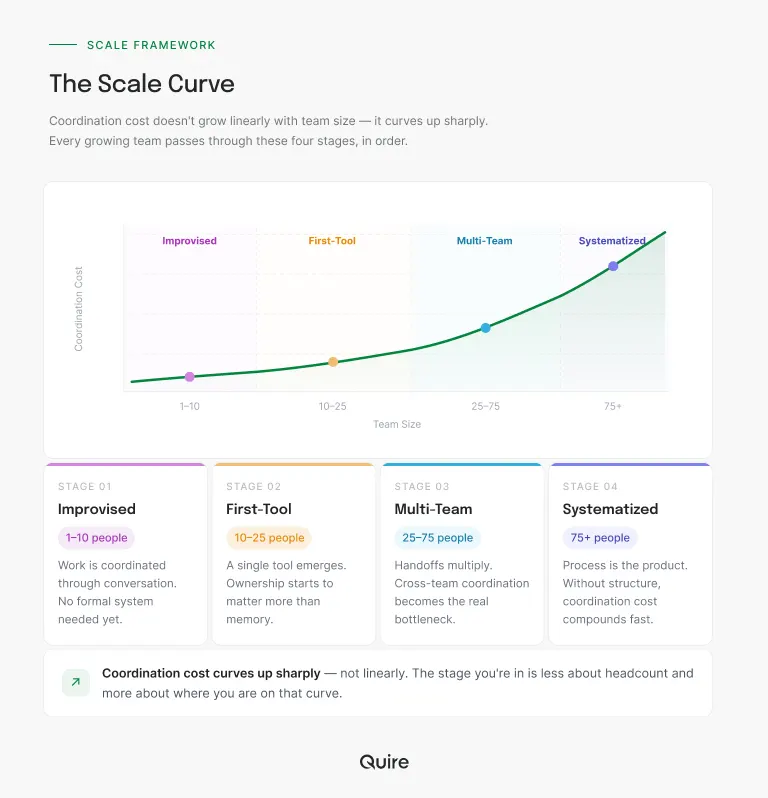
Every growing team passes through these four stages in order, at roughly the size ranges below. I call it the Scale Curve because coordination cost curves up sharply rather than growing linearly, so your stage is less about headcount than about where you sit on that curve.
Each stage is defined by the kind of coordination the team needs to stay coherent, not by how sophisticated the process looks.
Stage 1: Improvised (1–10 people)
Everything lives in chat and shared docs. Nobody has a "project management tool" in any formal sense, and that's fine. At this size, the coordination cost of a tool is higher than the cost of the coordination the tool would eliminate.
What this stage needs: a shared doc for the big picture, a chat tool for the day-to-day, and a lightweight to-do list that anyone can glance at without logging into something. What it doesn't need: roadmaps, Gantt charts, or anyone with "project manager" in their title.
The failure mode here is over-tooling. You buy a real PM tool because it feels professional, spend three weeks migrating everyone, then watch half the team stay in Slack because the tool is heavier than the problem.
Stage 2: First-Tool (10–25 people)
One tool, newly adopted, not yet a habit. The team has crossed the size where "everybody just knows" stops working, and they've picked a tool to compensate. The tool is often under-used at first, half the work still happens in Slack and docs, because nobody has enforced the norm that work lives in the tool.
What this stage needs: one shared PM tool with a clear norm that all tasks live there, a simple structure (projects → tasks → subtasks), and a rhythm, daily async check-in, weekly 30-minute sync, biweekly written update for anyone who isn't in the project. What it doesn't need: custom workflows, automations, integrations, or a heavyweight methodology like Scrum unless the team already has experience running it.
The failure mode here is drift. Tasks live in the tool while the real decisions happen in Slack DMs, and the tool becomes a zombie list nobody trusts.
At this stage the whole job is making "if it's not in the tool, it isn't real" stick.
A tool with chat built in, like Quire, makes that norm easier to enforce, because the quick questions that used to justify the Slack detour now have a home next to the task.
That daily async check-in is the most valuable ritual to get right at this stage: a daily standup template a real team will actually keep, live or async, and under fifteen minutes.
Stage 3: Multi-Team (25–75 people)
The team is now big enough that it's really several teams. Cross-functional work is common, and coordination across teams is the main source of pain. Weekly one-on-ones can no longer carry the load, and status has started to lie because nobody has time to keep it honest.
What this stage needs: nested hierarchy (so a marketing launch can nest under a product launch under a quarterly goal), shared state across teams (so design and engineering see the same task, not two copies that drift), explicit handoff tracking, and a real answer to cross-functional coordination. This is usually where teams start looking at nested task hierarchy as a load-bearing feature rather than a nice-to-have.
The failure mode at this stage is the PM tax. A dedicated project manager gets hired to maintain the tool, and then the tool requires maintenance, and then the PM spends half their week updating it, and now status is a full-time job.
The fix is a tool where task state is the status rather than a derivative of it. Once it is, the reporting that sits on top is something you can automate rather than hire for, which is what AI project management workflows do.
Stage 4: Systematized (75+ people)
The team has grown into a formal structure. Multiple functions. Defined processes. Probably at least one person thinking about "operating rhythms." At this size, project management stops being something you do and starts being a function the organization has.
What this stage needs: reporting that rolls up to leadership without a human reconciling it, integration with adjacent systems (HRIS, finance, product analytics), formal methodology for the teams that want it (some do, some don't), and the ability to support a portfolio view across multiple concurrent projects. Tooling starts to matter less than the operating model the tooling supports.
Three capabilities separate a tool that survives Stage 4 from one that gets outgrown. First, a portfolio layer that reads the same task state your teams already maintain, so leadership's roll-up is a view rather than a document somebody reassembles by hand.
Quire handles this through a built-in analytics layer and cross-project folders, meaning the numbers a founder sees are the numbers the team is working in, not a stale copy.
Second, permission scoping, because at 75+ people you have contractors, clients, and adjacent departments who need part of the picture without full access.
Quire covers this with per-project Permission Control, an External Team mechanism that scopes an outside collaborator to specific tasks, single sign-on over SAML 2.0, which covers Okta, Google Workspace, Azure AD and any other provider speaking that standard, and Master Organization for organizations that run several linked orgs off one member pool.
Third, integration with the operational stack (calendar, chat, source control, reporting) so project state stops being an island the rest of the company can't see into.
Quire's side of that is a REST API that pushes webhooks instead of making you poll, so the roll-up finance or BI wants gets built rather than requested.
The other Stage 4 shift is organizational. Project management becomes a discipline someone owns rather than a habit everyone shares, so the question moves from "which tool" to "who defines the conventions and audits them." The healthiest large teams write the operating rhythm down and treat it as a living document rather than folklore.
The failure mode at this stage is calcification. The systems that got you here become the systems that slow you down, because changing them is expensive and nobody has the authority to.
A Summary Table, Because Tables Make This Stick
| Stage | Size | Coordination | What to buy | What to avoid |
|---|---|---|---|---|
| Improvised | 1–10 | Keep everyone in the loop, informally | Shared doc + chat + lightweight list | A real PM tool |
| First-Tool | 10–25 | Establish "work lives here" norm | One PM tool + weekly rhythm | Custom workflows, heavy process |
| Multi-Team | 25–75 | Cross-team coordination + shared state | Nested hierarchy + handoff tracking | Tool where status is a manual report |
| Systematized | 75+ | Portfolio view + roll-up reporting | Integrated tooling + formal methodology | Systems that can't be changed without six months of notice |
Whatever stage you're in, the plan itself needs a shape that survives the week: the project plan template, seven sections built to stay in sync with the work.
How Do You Tell Which Stage You're In?
Team size is a rough proxy; the real tell is the pattern of pain. Four questions will usually locate you:
- When a new person joins, how long before they know what everyone on the team is working on? Under a day = Stage 1. A week = Stage 2. A month, and only because someone walked them through it = Stage 3. It's a recurring onboarding project = Stage 4.
- Where does the most important context live? Slack = Stage 1. Split between Slack and the PM tool = Stage 2. Mostly in the PM tool but scattered across teams = Stage 3. Structured in the PM tool with defined conventions = Stage 4.
- What happens when two teams disagree on a dependency? Someone notices in chat and resolves it in an hour = Stages 1–2. A meeting gets scheduled = Stage 3. A process exists for escalation = Stage 4.
- How long does it take to answer "what's shipping next month?" Minutes, from memory = Stages 1–2. An hour, by pulling the right view = Stage 3. It comes out of a roll-up that already exists = Stage 4.
If your answers straddle stages, you're probably in transition. That's normal. Transitions are where most of the pain is, and where choosing the right PM tool has the biggest payoff.
There's a fifth tell, and it's the one that costs you people rather than time: work quietly stacking on whoever is most reliable. Team workload management covers how to measure real capacity and rebalance before your best person hands in a notice.
How Do You Transition Between Stages Without Chaos?
Moving between stages is where teams blow themselves up. Three principles keep it boring:
Don't skip stages. A twelve-person team doesn't need Stage 3 tooling. Putting nested hierarchy, cross-team dashboards, and handoff tracking on a team that small will slow them down more than it helps. The tool outgrows the team, which is just as bad as the team outgrowing the tool. Placing yourself on the lightweight-to-heavyweight spectrum comes down to scoring five dimensions against the work you're actually doing, rather than sorting yourself by headcount.
Pick a forcing function. Migrations happen when something forces them. Usually it's a failed launch, a rehire, or a new function being added (marketing, ops, CS). If you're trying to transition without a forcing function, you'll stall, because the existing setup will still feel "mostly okay" right up until it isn't.
Migrate people, not just tasks. Moving the data takes an afternoon. Rebuilding the norm that work lives in the new place takes a fortnight. Plan for two weeks of dual-tool awkwardness while everybody relearns, and communicate the "if it's not in the tool, it isn't real" rule out loud, every day, until it's internalized. Silent migrations always fail.
Most forcing functions are just risks nobody wrote down: a risk register gives a scaling team the list of what could blow up next, scored, owned, and reviewed before it gets to force anything.
What Tools Do You Need at Each Stage?
Tools don't define your stage; your stage defines your tools. Since the question comes up constantly, here's the short version:
Stage 1 (Improvised): A shared doc, a chat tool, and maybe a basic checklist. If anyone asks about a PM tool, wait another six months.
Stage 2 (First-Tool): A PM tool with a clear home for every task. Prioritize ease of adoption over feature depth. If your team hates using the tool, no feature will save you.
Stage 3 (Multi-Team): A PM tool with nested hierarchy, shared cross-team state, handoff tracking, and stakeholder-friendly read-only views. This is where agency teams and scale-up startups hit the same wall for the same reasons.
For startups, that wall usually shows up first as a flat board like Trello that's stopped scaling.
Asana and Monday both handle Stage 2 comfortably and emphasize standardized workflow, which suits organizations that want every team working the same way.
Their tradeoff shows up when you genuinely need three or four levels of nested work and cross-team views without per-team data drift, because depth is where they flatten first. Depth is what Quire was designed for.
Stage 4 (Systematized): Tooling that integrates with the rest of your operational stack and supports portfolio-level reporting. Often this is the same tool as Stage 3, extended with integrations and cross-project folders rather than replaced. Sometimes it's a migration. It depends on whether Stage 3's tool can roll up across projects without someone rebuilding the numbers by hand.
When a stage change does call for a new tool, switching project management tools without losing your history lays out the move, from a single pilot project to the date the old tool stops taking edits.
Two disciplines sit under these stages. Stage 4 is where two projects want the same engineer in the same week: what project portfolio management is. Stage 3 is where "how long did that take" stops being answerable from memory: project management time tracking.
If you want to see how this looks concretely at each stage, Quire pricing includes a free tier that works fine for Stages 1–2 and paid tiers that open up the Stage 3 and Stage 4 features as you need them, without a rebuild at each step.
Key Takeaways
Project management for growing teams runs in four stages, each stacking on the one before it:
- Improvised. Runs on shared docs and chat, and that's enough.
- First-Tool. A team picks a single PM tool and builds the norm that work lives there.
- Multi-Team. Nested hierarchy, shared state, and handoff tracking become load-bearing.
- Systematized. Project management becomes a function, not a task.
The skill that matters most is recognizing which stage you're actually in, and being honest when you've crossed into the next.
Most teams that feel stuck aren't stuck because they're in the wrong stage. They're stuck because they're running Stage 2 tools on a Stage 3 team, or Stage 3 processes on a Stage 2 team, and wondering why nothing fits.
Frequently Asked Questions
What does project management for growing teams actually mean?
PM built around the failure points that appear once a team outgrows the size its setup was designed for. A five-person team and a forty-person team need different systems, and the skill is knowing which one you currently have.
When should a growing team switch from spreadsheets to a real PM tool?
Around ten people, though dependency density is the better trigger. More than three parallel projects, or more than five people who need the state of any one of them, and the spreadsheet costs more than it saves.
Why do PM tools that work at 10 people break at 25?
At ten, communication carries the load because everybody knows what everybody is doing. At twenty-five nobody does, so structure has to carry it instead, and small-team tools buckle once nested hierarchy and formal handoffs turn load-bearing.
What's the right PM tool for a 20-person startup?
One with nested task hierarchy so projects don't flatten into unreadable lists, and shared state across teams so you aren't reconciling three tools into a weekly deck. Quire was built around that depth. Automations and dashboards can wait until 40 or 50.
How do I know if we're outgrowing our current PM tool?
When people route around the tool rather than through it. Meetings held to make the board match reality, decisions living in Slack threads, a project manager who maintains the system more than anyone produces inside it.
The full list is in our write-up on the signs you've outgrown your project management tool.
Does fixing project management make a growing team more productive at work?
The gain is coordination time rather than individual speed. A team at the wrong stage burns hours reconstructing status that the tool should already show. Matching the setup to the stage hands those hours back.
Not sure which stage you're in?
Quire's free tier covers most teams through Stage 2, and the paid plans open up the Stage 3 and Stage 4 capabilities: nested hierarchy, cross-team views, handoff tracking, portfolio roll-up, permission scoping, and single sign-on. It is the same workspace at every stage, so moving between them is a settings change rather than a migration.
Try Quire free for 30 days, no credit card, full access. If it fits, you'll know within a week. If it doesn't, at least you'll have a clearer picture of what your team actually needs.