project management · May 25, 2026
Signs You've Outgrown Your Project Management Tool

Last updated: October 20, 2026
You've outgrown your PM tool when the team works around it, status meetings exist to reconcile it, and the PM spends more time updating than anyone spends working. Before switching, run a two-week diagnostic to separate tool problems from process problems.
- What are the 8 signs you've outgrown your PM tool?
- How do you tell a tool problem from a process problem?
- What does waiting too long actually cost?
- What are the real costs of switching too early?
- How do you run the 2-week diagnostic?
- Where do teams most often land after the diagnostic?
- Key Takeaways
- Frequently Asked Questions
The moment you realize your PM tool has stopped working for you is rarely a single dramatic failure. It's more like waking up and noticing the shoes you've been wearing for two years are suddenly too tight, and honestly they've probably been too tight for a while. You just didn't register it until today.
Most teams are here, and most of them don't switch, because switching feels disproportionate to the discomfort. The tool still works. The team is still shipping. Nothing's on fire. But everyone is quietly paying a tax that grows about 10% per quarter, and nobody adds it up until the tax exceeds the cost of switching.
This post is the sum-it-up. Eight signals that tell you the tool has become the problem, a way to sort the tool problem from the process problem (they're often confused), and the honest cost of waiting too long versus switching too early.
What are the 8 signs you've outgrown your PM tool?
In rough order of severity. If you see three or more of these regularly, the tool has probably outgrown you.
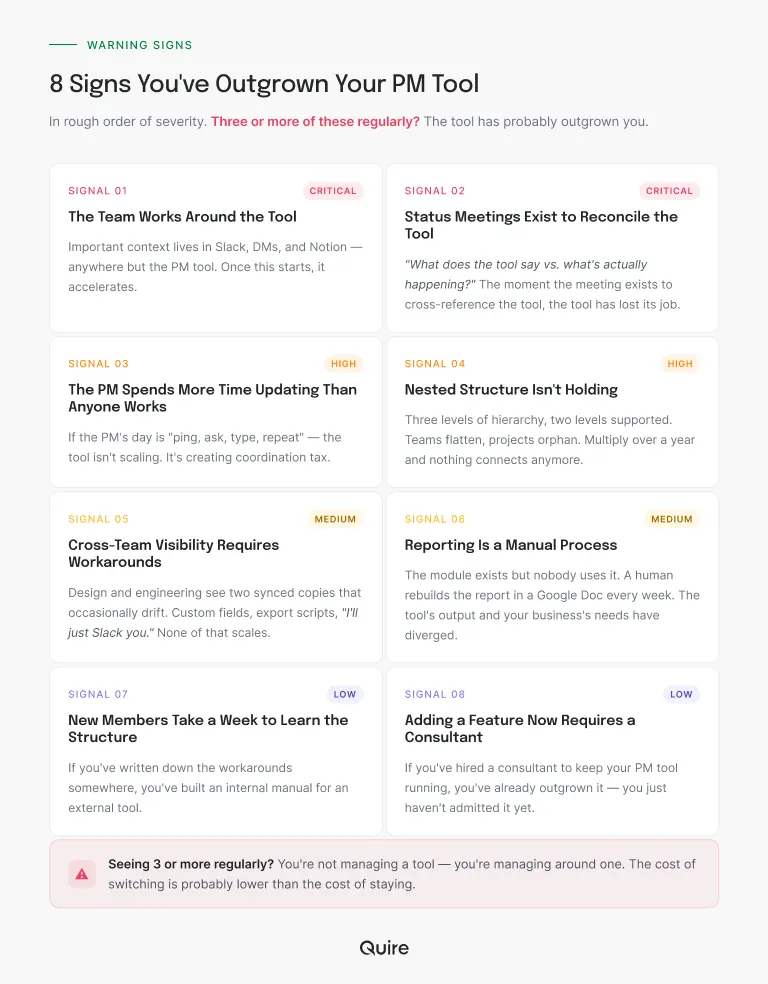
1. The Team Works Around the Tool
This is the strongest signal. When important context starts living in Slack, in DMs, in Notion pages, in shared docs, anywhere but the PM tool, the team has decided the tool isn't worth the effort. Once this starts, it accelerates. Every new decision gets made outside the tool, every new piece of context lives elsewhere, and the tool becomes a task list for tasks that have already been discussed somewhere else.
2. Status Meetings Exist to Reconcile the Tool
If anyone has said "what does the tool say vs. what's actually happening?" in the last month, you have a reconciliation problem. A healthy tool is status. An unhealthy tool is one version of reality that needs to be checked against the other. The moment the meeting exists to cross-reference the tool, the tool has lost its job.
3. The PM Spends More Time Updating Than Anyone Spends Working
A warning sign specific to growing teams. In small teams, individual contributors update their own tasks. In larger teams that have hired a PM, updates often fall to the PM as a coordination tax. If your PM's day has become "ping people, ask for updates, type them into the tool, ping them again," the tool isn't scaling. It's creating work.
4. Nested Structure Isn't Holding
When a project has three levels of hierarchy and the tool only supports two, people flatten. A marketing launch that should live under a product launch gets pulled out into its own project, and now the two projects don't talk to each other. Multiply this across a year, and the tool has about forty orphan projects that used to be coherent and aren't anymore.
5. Cross-Team Visibility Requires Workarounds
If design and engineering can't see the same task, or if they see it but it's actually two synced copies that occasionally drift, you have a shared-state problem. Workarounds typically show up as custom fields, weekly export scripts, or the dreaded "I'll just Slack you when it's done." None of those scale. This is usually the first sign a team needs software actually built for cross-functional work instead of a single-team tool stretched thin.
6. Reporting Is a Manual Process
The reporting module exists, but nobody uses it, because the shape of what leadership wants doesn't match what the module produces. So a human rebuilds the report every week in a Google Doc, pulling numbers from the tool and reformatting them. That's a tell: the tool's output shape and your business's need shape have diverged.
7. New Team Members Take a Week to Understand the Structure
In a tool that fits the team, a new hire is productive in it within a day.
In a tool that has been bent around a team it wasn't designed for, onboarding takes a week of someone walking them through the "we use this field for this, ignore this column, and this project is named weirdly because we couldn't configure the real structure."
If you've written down the workarounds somewhere, you've built an internal manual for an external tool.
8. Adding a Feature Now Requires a Consultant
At some point, tools that didn't fit start requiring help to extend. Admin consultants, certified partners, Zapier wizards. The fact that this industry exists is proof that plenty of teams have outgrown their tools and are paying someone to keep the tool alive past its useful life. If you've hired a consultant to keep your PM tool running, you've already outgrown it. You just haven't admitted it yet.
Score yourself: how many signals apply?
Go through the eight signals and check each one your team hits regularly, not once. Then tally.
How to read your score:
- 0 to 2 checked: The tool still fits. Anything bothering you is probably a process tweak, not a migration.
- 3 to 4 checked: You're on the edge. Run the two-week diagnostic below before deciding.
- 5 or more checked: The tool is the bottleneck. Start evaluating alternatives, but still run the diagnostic so you switch for the right reasons.
How do you tell a tool problem from a process problem?
The trap with switching tools is that roughly half of the "this tool doesn't work" frustration is process frustration that a new tool won't fix. Before you switch, run a two-week diagnostic.
Step 1: Log every pain moment. For two weeks, have the team write down every time the tool feels wrong. One sentence each. No editing.
Step 2: Categorize each one. Go through the list and mark each pain point as either (a) "the tool literally cannot do this" or (b) "the team hasn't configured or committed to this yet."
Step 3: Do the math. If more than 60% of the pain is category (a), the tool is the problem. If more than 60% is category (b), the process is the problem and switching tools will just move the problem to a new interface. If it's roughly 50/50, fix the process first, then re-evaluate.
Most teams skip this step and skip straight to tool evaluation, which is why tool migrations often fail. You arrive at the new tool with the same process problems and spend six months wondering why it doesn't feel better.
What does waiting too long actually cost?
Late switching is usually more expensive than early switching, because the cost is invisible. You're paying in:
- Meeting hours that don't come back. Every status meeting that exists because the tool can't be trusted is time the team would get back.
- Morale. People quietly stop trusting the source of truth. The longer this persists, the harder it is to rebuild when you do switch.
- Context loss. The workarounds accumulate. Undoing them during migration takes longer than it would have to switch earlier.
- Recruiting drag. Senior hires notice. If the tool is broken, good PMs and ops leads will ask about it in interviews, and the answer matters.
A reasonable back-of-envelope: a team of 30 paying a one-hour-per-person-per-week reconciliation tax is losing 30 hours of focused work a week. At an average fully-loaded cost of $75/hour, that's $117,000 a year, before factoring in the slower projects and misaligned decisions.
That number is a single team-size example, not a fixed price, so scale it to your own headcount and rate: the same one-hour tax runs roughly $39,000 a year for a team of 10, $117,000 for 30, and $234,000 for 60. Adjust the hourly figure to your market and the math still points the same way. In almost every case the migration cost is lower.
What are the real costs of switching too early?
Early switching also has real costs, which is why this should be a diagnostic, not a panic.
- Migration time. Two to four weeks of dual-tool awkwardness for a team of 20 to 50. Throughput drops during this period.
- Habit loss. The habits you built in the old tool don't transfer. The new tool has its own quirks, and you'll rebuild them.
- The grass-is-greener trap. Every tool looks great in the demo. Some of them also look great for the first month. The real test is month six, which no demo covers.
If you're switching because of a single bad quarter or a leadership demand, you're probably too early. If you're switching after six months of documented pain and a clear diagnostic, you're probably right on time.
How do you run the 2-week diagnostic?
If you take one thing from this post, take this: before you switch, run a two-week diagnostic. It looks like this:
- Day 1: Share the eight signals above with the team. Ask which apply.
- Days 1 to 14: Team members log every pain moment, anonymously if that helps honesty.
- Day 14: Categorize as "tool limit" vs. "process gap." Count percentages.
- Day 15: Decide. Either fix process (do a one-month reset) or start tool evaluation.
The key rule for the evaluation: don't do a six-month trial. Do a two-week sprint on a real project, which we walk through step by step in how to evaluate a PM tool.
Where do teams most often land after the diagnostic?
Patterns repeat. Worth naming them so you can compare your situation honestly. Here is the lay of the land at a glance:
| If you are currently on | Diagnostic typically surfaces | Likely fit |
|---|---|---|
| Trello or a spreadsheet | Nesting fails, cross-team visibility breaks, PM update overhead | A nested PM tool for the Stage 2-to-3 transition |
| Asana, Monday, or ClickUp | Feature bloat, slow adoption, reporting overhead | A lighter middle-tier tool that fits without the weight |
| Notion or wiki-shaped tools | Tasks treated as pages, no real assignment or status engine | A PM tool with structured task state and dependencies |
| Linear or other engineering-shaped tools | Non-engineering teams (marketing, ops) will not adopt | Hybrid stack: keep for engineering, add a lighter companion for non-eng |
| Jira | Non-engineering teams will not use it, eng will not give it up | Hybrid stack with a non-engineering companion tool |
The three patterns with the most signal in the wild:
If your old tool is Trello or a spreadsheet and the diagnostic surfaces nesting problems, cross-team visibility, and PM update overhead, you are hitting the Stage 2-to-Stage 3 transition described in the growing teams playbook.
If Trello specifically is the tool you're outgrowing, when flat boards stop scaling walks the Trello-to-nested migration step by step. This is exactly what Quire was built for: real nesting, shared state, and no mandated process on top.
It keeps working past that transition too, since the same structure holds a nine-person team and a multi-department organization without a second migration. Most teams in this spot try Quire's free tier as a parallel sprint and decide within two weeks.
Related to that same transition: if what's breaking is your view across many projects at once, rather than the structure inside any single one, that's a portfolio problem more than a tool problem. Project portfolio management covers how to see the whole set without a wall of status meetings.
If your old tool is Asana, Monday, or ClickUp and the diagnostic surfaces feature bloat, slow adoption, or reporting overhead, you are often dealing with a tool that is heavy where you needed light.
Same evaluation method applies; the question is whether the middle of the spectrum fits better than the heavy end (the lightweight vs heavyweight PM post has a five-dimension self-assessment that names this exact decision).
And moving lighter no longer means giving up the exec view: Quire's Dashboard View builds that leadership report from widget panels and charts, so the weekly Google-Doc rebuild from sign 6 is usually the first casualty of the switch.
If your old tool is Jira and the diagnostic surfaces "non-engineering teams won't use it," that is a real signal but a tricky migration. Engineering tends to defend Jira. The cleanest answer is usually a separate tool for non-engineering work that integrates back, rather than a full migration.
Made the call? Switching project management tools without losing your history covers the move itself: what to bring over, what to archive read-only, and how to roll it out one team at a time.

Key Takeaways
Most teams switch PM tools either too early or too late. Eight signals are the real indicators: team works around the tool, status meetings reconcile, PM overhead exceeds IC work, structure won't nest, cross-team visibility broken, manual reporting, slow onboarding, and consultant dependency.
Before switching, run a two-week diagnostic to separate tool problems from process problems. Late switching is usually more expensive than it looks, because the cost is distributed across every week that passes. Early switching has real costs too, mostly around migration and habit loss.
The right switching moment is after you've done the diagnostic and can point to which specific tool limits are the bottleneck.
Frequently Asked Questions
What are the clearest signs that a team has outgrown its project management tool?
The clearest signals are behavioral, not technical. The team starts working around the tool instead of inside it. Important context lives in Slack rather than in tasks, status meetings exist to reconcile what's in the tool with what's actually happening, and PMs spend more time updating the tool than anyone spends working in it.
How do you tell the difference between a tool problem and a process problem?
Run a two-week diagnostic. Document every moment the tool feels wrong and categorize each one as "the tool literally can't do this" or "the team hasn't set this up yet." If more than 60% of the frustration is process, fix the process first. If more than 60% is the tool, start evaluating alternatives.
Ask whether the workaround would survive a tool change. A spreadsheet kept because the tool cannot nest work is a tool problem, and Quire's task tree removes it. A spreadsheet kept because nobody owns the work is not.
Is it worse to switch project management tools too early or too late?
Both are bad in different ways. Switching too early costs migration time and lost team habits. Switching too late costs compounding coordination overhead, weekly hours that never come back, and morale drain from people who have stopped trusting the system. Late is usually worse because the cost is invisible until you stop paying it.
What's the typical cost of migrating from one PM tool to another?
For a team of 20 to 50 people, expect two to four weeks of dual-tool awkwardness, one to two weeks of focused setup time, and a meaningful drop in throughput. Data migration is the easy part. The hard part is the behavioral rebuild.
How often should a growing team re-evaluate their PM tool?
Once a year, and whenever the team crosses a meaningful size threshold, roughly 25 people and again at 75. The evaluation doesn't have to lead to a switch. Often it leads to "we have the right tool, we're just using 40% of it." That answer is worth the time it takes to produce.
Ran the diagnostic and decided you're ready to look?
Quire's free tier covers up to 10 members, 4 projects, and 1,000 tasks per project with full feature access, enough to run a real two-week evaluation sprint without setting up procurement. Nested hierarchy, shared cross-team state, and read-only stakeholder views work out of the box.
Start free at quire.io/signup. No credit card. Migrate one in-flight project, see how it holds up, decide on Day 14.