project management · Jul 23, 2026
What Is Project Portfolio Management? (And When You Actually Need It)

Last updated: October 6, 2026
Project portfolio management (PPM) means running all your projects as one set instead of one at a time: choosing which to fund, splitting shared people across them, and watching the whole group at once. You need it when projects start fighting over the same people, usually past 5 to 10 at once, and not a moment sooner. Three jobs: pick, staff, oversee. And the portfolio view should be something you read, not something you rebuild from five meetings.
- What is project portfolio management?
- When do you actually need project portfolio management?
- What's the difference between a project and a portfolio?
- What are the three jobs of portfolio management?
- How do you choose which projects make the cut?
- How do you see across projects without five status meetings?
- What does a portfolio review actually look like?
- What are the most common portfolio management mistakes?
- Key takeaways
- Frequently asked questions
Every growing team hits this moment without noticing it. Someone asks the ops lead for "a quick status across everything," and forty minutes later there are six browser tabs open, two half-read Slack threads, and a spreadsheet that was accurate this morning and isn't now.
That scramble is the tell that you've crossed into project portfolio management, whether or not anyone has called it that. Somewhere between the third project and the seventh, the job changed.
The hard question stopped being "is this project on track?" and became "which of these deserves my two best people this week, and do all seven need to exist at all?" No single project's plan can answer that. It's a question about the whole set.
This post is the practical version: what PPM actually is, the honest signal that you need it (it arrives later than most frameworks claim), the three jobs it comes down to, how to decide what gets funded, and how to watch every project at once without turning your week into a relay of status meetings.
What is project portfolio management?
Project portfolio management (PPM): the practice of running all your projects as a single set instead of one at a time. It answers three questions no single project can: which projects should exist at all, how you split shared people and budget across them, and how the whole group is doing right now.
The oldest shorthand still fits best. Project management is about doing projects right. Portfolio management is about doing the right projects. One is execution, heads-down inside a single effort. The other is selection and oversight, sitting one floor up and looking across all of them at once.
The two even fail in different ways. A project fails loudly, by slipping a date everyone was watching. A portfolio fails quietly: every project looks fine on its own, while the team keeps saying yes to more work than it can staff, and nobody is minding the total.
When do you actually need project portfolio management?
Later than you would guess, and pushing it earlier is a real mistake of its own. You need portfolio management when your projects start competing: the same person wanted in two places, the same budget stretched over three requests, the same slice of leadership attention split five ways.
Running projects one at a time works fine right up until they collide like that. For most teams the collisions start somewhere past five to ten projects at once. Below that, the projects are mostly independent, plain per-project tracking is plenty, and a portfolio process would just be ceremony hunting for a problem to solve.
There's a reason the pain shows up as overload rather than as one bad project. According to a Harvard Business Review analysis of initiative overload, the trouble is rarely a single project run badly.
It's leaders who keep launching new work without ever stopping the old, until everything below the executive line is quietly starved for people. Their point lands hard: strategy is choosing what not to do, and execution is actually not doing it.
A portfolio is where a team makes that call on purpose instead of by accident.
Still, the cleanest signal isn't a project count, it's the shape of your hardest question. "Is this project on track?" is project work. "Which of these five should this person touch first?" is portfolio work.
The week that second question moves in and refuses to leave is the week you need this. If you have felt that shift coming for a while, the early symptoms have their own tell, catalogued in signs you've outgrown your PM tool.
Not sure which side of the line you're on? Lightweight vs heavyweight PM maps where your team belongs, and why piling on process too early tends to backfire.
What's the difference between a project and a portfolio?
A project is one effort with a goal and an end date. A portfolio is every project you're running at once, treated as a single thing you manage on purpose. The gap between them is wider than size, and it changes what you actually pay attention to.
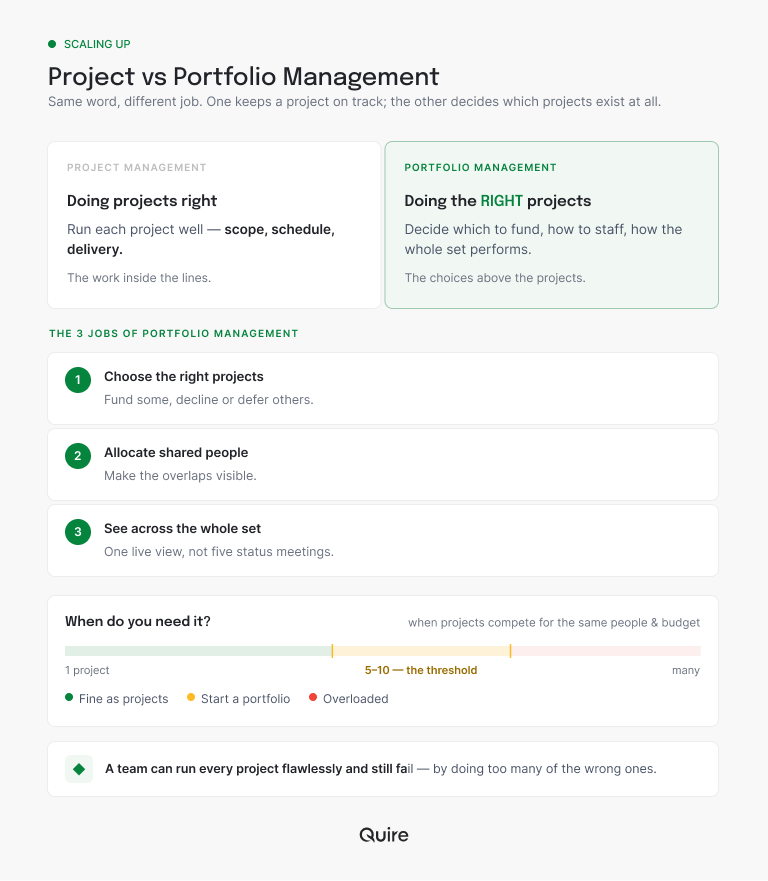
The split goes deeper than that headline. Here it is row by row:
| Aspect | Project management | Portfolio management |
|---|---|---|
| Core question | Is this project on track? | Are these the right projects, and can we staff them? |
| Focus | Tasks, milestones, deadlines | Health, capacity, and the mix across the set |
| Direction | Deep into one effort | Wide across many, on purpose |
| Key decision | How do we ship this on time? | What do we fund, defer, or stop? |
| Failure mode | The project slips a date | Every project is fine; the team is underwater anyway |
Notice what the portfolio view leaves out on purpose: the individual tasks. At this altitude the tasks aren't the point, and trying to track every one of them at once is how portfolio oversight curdles into a bigger, slower version of the same overwhelm you were trying to escape.
What are the three jobs of portfolio management?
Strip away the frameworks and portfolio management comes down to three jobs: pick the projects, staff them, and keep an eye on the whole set. Everything else is paperwork wrapped around those three.
Selection. Deciding what gets funded, what waits, and what gets a polite no. It's the most consequential of the three and the least practiced, because every yes feels like momentum and every no needs someone willing to be unpopular for an afternoon.
Allocation. Deciding who works on what, and dragging the overlaps into the open. Shared people are where portfolios crack first. Each project quietly assumes it has more of that one senior designer than it really does, and she absorbs the difference until a deadline makes the math visible for everyone.
Oversight. Keeping one live view of the whole set, so the project sliding toward trouble gets noticed this week instead of at the quarterly review, and the one that's been eating three people for a reason nobody remembers finally gets asked what it's for.
Pick, staff, oversee. Do those three and you're running a portfolio. Skip them and you've got a stack of projects and a lot of optimism.
Selection is judgment you can't hand to software. Allocation and oversight are mostly a visibility problem, and visibility is the part a shared view can actually take off your plate, which is why the tooling question below is really only about those two.
How do you choose which projects make the cut?
Score them, rank them, and fund down the list until you run out of people. The mechanics are almost dull. The honesty is the hard part.
Score every project, the ones already running and the ones still being pitched, against the same short list of factors: strategic value, expected return, effort, and risk. The rubric isn't there to be precise to two decimals. It's there to give "I've just got a good feeling about this one" a fair fight against actual reasons.
That risk factor is only as honest as each project's own list: a per-project risk register, scored and owned, turns "how risky is this one" from a shrug into a number you can rank on.
Then rank them and commit down the list until your real capacity is spoken for, and draw that line where people can see it. Everything below the line waits its turn in the open, rather than sitting officially "in progress" while quietly getting nobody assigned to it.
Calling it a waiting list keeps everyone honest about what's actually paused. Most overloaded teams aren't working on the wrong things. They're working on too many right things at a third of the staffing each one needs, which delivers the exact same lateness with far better intentions.
Capacity honesty at the portfolio level rests on capacity honesty per person: team workload management is how you get each person's committed hours to add up across every project before you fund the next one.
How do you see across projects without five status meetings?
You give the whole set one live view that reads itself, instead of assembling status by hand every week. Oversight you have to physically go and collect doesn't survive a busy month, so it has to be something you glance at, not something you convene.
The default setup guarantees the meetings. Each project's status lives inside that project, so the only way to see everything is to hold five check-ins, or chase five leads across chat, and then stitch the answers into a summary that's stale before you've finished writing it.
That assembly cost has a name and a growth curve of its own: the coordination tax, and why reporting quietly eats growing teams first.
The fix is a single view that reads across every project on its own. In Quire, you drop related projects into a Folder so the whole portfolio has one address instead of ten open tabs.
Then you point a Smart Folder at whichever projects you care about and pull their tasks into one live list: everything overdue across the set, every launch task due this month, every card tagged to a single client, all of it updating as the underlying projects change.
Running this across a whole organization rather than one team? Quire at organization scale covers the roll-up, permission, single sign-on, and multi-org billing side of the same setup.
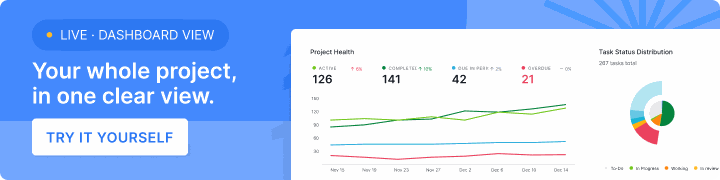
And with Dashboard View, the oversight layer becomes a literal dashboard.
Build one at the Folder or Organization level and it takes cross-project widgets: a Portfolio Health chart for the read across every project at once, Portfolio Activity for what actually moved this week, and a Member Workload panel showing who is carrying how much across the whole set.
Keep it private for your own Monday triage, or share it so leadership reads the same screen you do instead of asking you to rebuild it in slides.
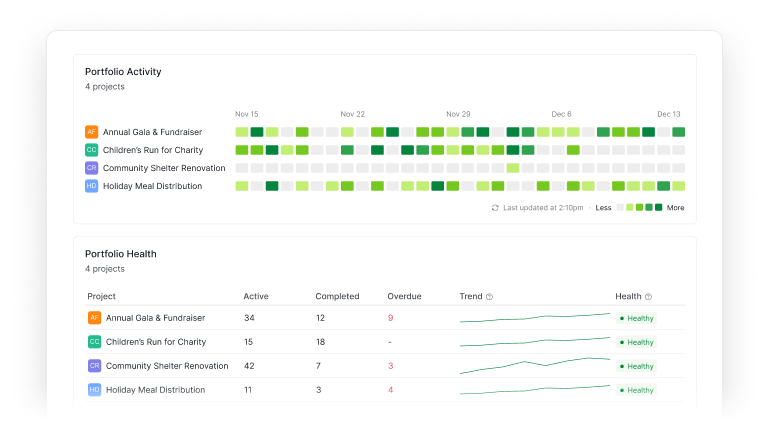
For the people problem, My Tasks gives each person one view of their own load across every project they're on, so a double-booking is visible to them, and to you, weeks before it hardens into a missed date. And the revamped Overview tab is now scope-aware: open it at the organization or folder level and it already shows cross-project widgets like Portfolio Activity and Member Workload, with no setup at all.
The portfolio stops being a picture someone keeps repainting every Friday and turns into a place you look.
If your question is how to run the projects you already have, not which ones to keep, how to manage multiple projects is the operator's side of this post: one workspace, one cross-project view, and fewer switches.
None of this needs a heavyweight rollout, a separate portfolio product, or a process everyone has to relearn.
If your projects already sit in one tool, pointing a Smart Folder at them takes a few minutes, and a portfolio Dashboard is the same widget library you already know arranged your way, so it costs almost nothing to try the whole idea on the projects you're already juggling and see whether the cross-project view earns its place before you commit to more.
Dashboard View is available on the Professional plan and higher; the scope-aware Overview tab is on every plan, including Free. Details are on the pricing page.
What does a portfolio review actually look like?
Picture a 25-person product studio running nine projects, doing its monthly portfolio review in half an hour.
They pull up their portfolio Dashboard, which in Quire is built once at the Folder level: a Portfolio Health chart, Portfolio Activity, and a Member Workload panel, with a Smart Folder one tab over for when someone needs the task-level detail.
They stay high on purpose: green, amber, who's committed where. Projects one through five are green, and they get about thirty seconds as a group.
Project six goes amber, because the Member Workload panel shows its two engineers are also the two engineers carrying project eight, and both projects hit their busiest week together.
The call takes five minutes: project eight's launch slides a week. A collision that would have detonated a deadline next month gets defused while it's still just a note on a screen.
Then the awkward item. Project nine, an internal docs refresh, is green, on time, no complaints. It has also had a senior designer at half-time for two months, and when someone asks out loud what the company gets from it, the room goes quiet.
It made sense back in March. Now it's the office plant nobody remembers buying, watered on schedule and growing toward nothing. So they pause it. The designer moves to the client project that's been short-handed for weeks, and the portfolio gets healthier by stopping something that was, on paper, going perfectly well.
No task got reviewed. Nobody read a status out loud. Health, capacity, mix, thirty minutes.
What are the most common portfolio management mistakes?
The failures rhyme. Here are the five that show up most, roughly in the order teams hit them:
- Starting too early. A portfolio process laid over three independent projects is ceremony, not management. Wait for the real thing, which is actual competition over the same people.
- Only ever adding. A real portfolio subtracts. If projects only ever go onto the list and nothing comes off, the list just grows into a monument to everything you've said yes to, and the staffing math quietly falls apart underneath it.
- Trusting each project's math on shared people. Every project books the shared designer as if she's theirs alone. But one designer split three ways is still one designer, and the calendar always finds out. Surface the overlaps yourself, before a missed date does it for you.
- Reviewing tasks instead of the mix. If your portfolio review is working through individual tasks, you've wandered back into project management and turned the volume up.
- Status by interview. A portfolio view rebuilt from five meetings is out of date before the fifth one wraps.
The second one earns an extra line. Pausing a healthy project that's no longer worth the people on it is the single most valuable move in portfolio management, and reliably the one that feels worst. Do it anyway.
More projects usually arrive strapped to more people, and the two problems grow up together: project management for growing teams is the scale-aware playbook for that whole transition.

Key takeaways
Project portfolio management is doing the right projects, where project management is doing projects right. It runs on three jobs: choose what gets funded, staff the shared people on purpose, and keep the whole set under one live view.
Two habits make it real. Fund to honest capacity, with a waiting line people can actually see. And keep a stop list you're willing to use, because the hardest, most valuable call is pausing a project that's going fine but earning too little for the people it's holding.
You cross into needing all of this later than the frameworks suggest, usually once you're past five to ten projects fighting over the same people. Adopt it before that and you've added weight with nothing to lift.
Running more projects than you can keep in your head? Start free at quire.io/signup, drop them into one Folder, add a Dashboard on top, and read your portfolio instead of rebuilding it every week.
Frequently asked questions
What is project portfolio management?
Running all your projects as one set instead of one at a time: choosing which to fund, splitting shared people across them, and watching the whole group perform. It answers the questions no single project plan can.
What's the difference between project management and project portfolio management?
Project management is doing a project right. Portfolio management is doing the right projects. One owns a single delivery, the other owns the mix, and a portfolio can fail even while every project in it looks fine.
When do you need project portfolio management?
When projects start competing for the same people and budget, usually past five to ten at once. The tell is when "which of these should this person do first" has replaced "is this on track" as your hardest question.
What does a portfolio manager do?
Picks which projects get funded, allocates the shared people, watches the health of the set, and pauses projects that stop earning their capacity. The hardest part is stopping the ones that are fine but not worth it.
How do you prioritize across multiple projects?
Score everything on the same factors, rank it, and fund down the list until real capacity runs out. What's below the line waits in plain sight. Capacity honesty beats scoring precision every time.
Can you use Quire for project portfolio management?
Yes. Folders group the projects, Smart Folders read tasks across them, and Dashboard View turns the set into a live portfolio dashboard with widgets like Portfolio Health, Portfolio Activity, and Member Workload at the Folder or Organization level. Dashboards need Professional or higher; the scope-aware Overview baseline is on every plan.
How do you manage multiple projects without extra meetings?
One live view across the set. In Quire, a Folder groups the projects, a Smart Folder shows the tasks across all of them, and My Tasks gives each person their own load, so status is read, not performed.