project management · Jun 22, 2026
Startup Project Management: When Flat Boards Stop Scaling

Last updated: September 3, 2026
Flat boards like Trello work great for small, simple workflows. They start to break once a startup passes 10 to 15 people and the same work spans several projects, owners, and reporting layers. The fix is a tool with real hierarchy and multiple views, not a heavyweight enterprise system you'll fight for a year.
- Why does Trello work so well at the start?
- When do flat boards actually stop scaling?
- What are the signs you've outgrown a flat board?
- What should you look for in a replacement?
- What about Asana, Notion, Linear, or Jira?
- How do you migrate off Trello in an afternoon?
- Key takeaways
- Frequently Asked Questions
Trello is the friendliest project management tool there is. You set it up in twenty minutes on a Sunday night, your first three hires get it instantly, and nobody has to sit through a training. For an early-stage startup, that's exactly right. The job is to ship, not to manage the shipping.
Then the team hits ten people, then fifteen, and something quietly shifts. The same task starts living on three different boards. People stop checking the board and start asking in Slack. The weekly status meeting runs long because the tool doesn't surface enough.
You spend a Tuesday rearranging columns, and someone asks whether there's a "real" PM tool the team should be on.
The drag is measurable: Harvard Business Review clocked knowledge workers toggling between apps about 1,200 times a day, losing close to four hours a week just reorienting, and a board that's stopped surfacing the work quietly feeds that pile.
You're not alone, and your team didn't do anything wrong. Trello breaks at predictable points. That's a property of the tool, not a failure of yours.
This is for the founder or ops lead at a startup somewhere between 10 and 50 people who's starting to feel the seams. We'll cover when flat boards stop scaling, the five signs you've outgrown one, what actually matters in a replacement, and why the most common mistake, overshooting into a heavyweight tool, often hurts more than staying put.
Why does Trello work so well at the start?
Start by being fair about what Trello is genuinely good at, because the "you've outgrown it" conversation tends to curdle into a pile-on, and that helps no one.
Trello's whole design philosophy is flat, visible, and fast. A board, some columns, some cards. Anyone can use it within the hour. It's perfect when the unit of work is a card and the state of the work is a column: a bug tracker with backlog, in progress, in review, done. An editorial calendar. A deal pipeline.
For a five-person startup running three or four flat workflows, Trello is hard to beat. No setup cost. No training cost. No process overhead. Everyone sees the same board, and the board tells the truth.
The problem isn't that Trello is bad. It's that startups grow into workflows Trello was never designed to hold, and the tool has nowhere to go.
When do flat boards actually stop scaling?
Here's the short version, the one to screenshot for your next planning meeting.
Flat boards scale beautifully right up until your work stops being flat. A single board with columns is perfect when each task is independent and its status is just a column. They start to break the moment your work picks up structure: tasks that belong to more than one project, dependencies between them, competing priorities, several teams touching the same launch, and someone upstairs who wants a roll-up.
For most startups, that shift lands between the tenth and fifteenth hire. There's real math behind that range. Coordination cost grows with the connections between people, not the headcount, and connections multiply fast.
Fred Brooks put a formula on it in The Mythical Man-Month: a team of n people has n(n-1)/2 communication paths. Five people juggle ten. Fifteen juggle a hundred and five. A flat board that quietly held ten channels has no hope of holding a hundred.
Not because anyone did anything wrong, but because the work itself grew a hierarchy the board can't represent. A card is either on a board or it isn't. There's no in-between, and real startup work lives in the in-between.
The trap is assuming the answer is a bigger, heavier tool. Most teams at this stage don't need enterprise process. They need structure: nesting, shared state, and a few views onto the same work. Structure without the bloat is the whole game, and it's the same wall the scale-aware playbook for growing teams describes as the multi-team transition.
What are the signs you've outgrown a flat board?
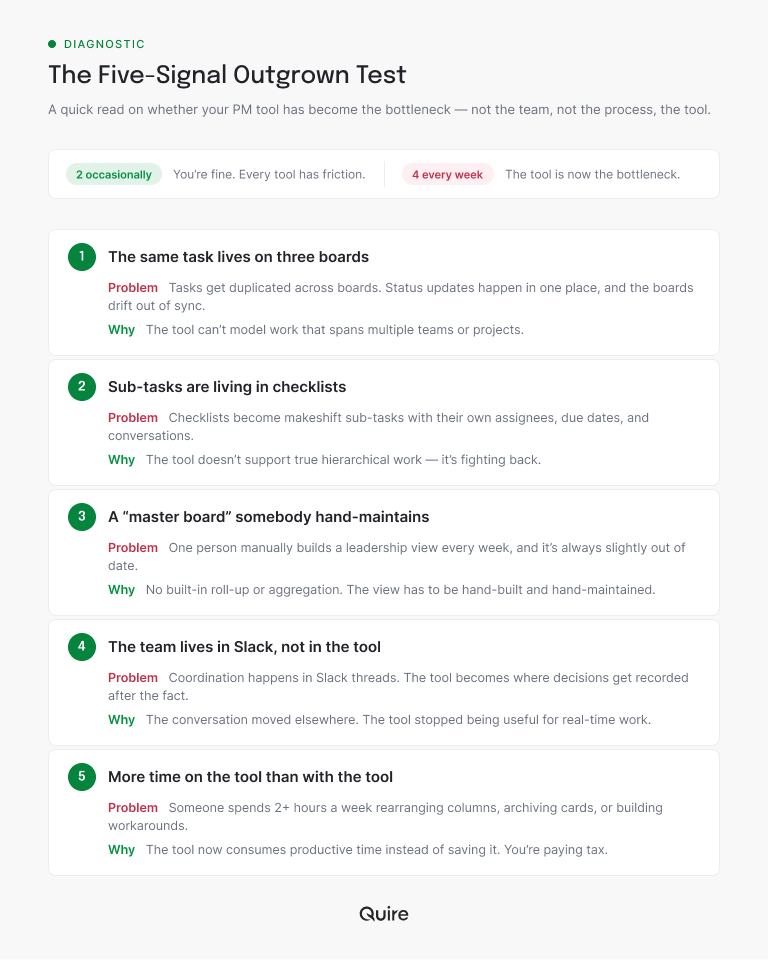
Here's a quick diagnostic I've started calling the Five-Signal Outgrown Test. If two of these happen once in a while, you're fine. If four of them happen every week, the tool is the bottleneck now, not the team, not the process.
1. The same task lives on three boards
You've got a Product board, a Marketing board, and a Q3 Launch board. The launch needs both teams, so its tasks get copied onto all three, and a status change now has to happen in three places. Usually it happens in one, and the boards drift. The drift has nothing to do with how careful anyone is being. The same work sits between two teams, and a flat board can't hold an in-between.
2. Subtasks are living in checklists
Trello's checklists are lovely for shopping-list items and miserable when each item is really its own task, with an assignee, a due date, and a conversation. You'll see comment threads pile up on a card that should be five subtasks, assignments typed into checklist text, and due dates stuffed into the card title because the checklist can't hold them. That's the tool fighting back. It wants flat work, and your team has hierarchical work now.
3. Someone hand-maintains a "master board"
A founder or ops lead keeps a board called Everything, or Leadership View, and drags cards around it once a week so leadership can see what's going on. It's stale by the time anyone looks. The board exists because the real boards don't roll up, so a human rebuilds the roll-up by hand every week, and quietly starts to dread Mondays.
4. The team lives in Slack, not in the tool
This is the canary in the coal mine. When people stop opening the tool and coordinate in Slack threads instead, the board has lost its job, because the conversation already lives in Slack. Once Slack is the system of record, decisions vanish into scrollback, new hires can't reconstruct why anything was decided, and the board becomes wallpaper nobody trusts.
5. More time on the tool than with the tool
When someone loses two hours a week rearranging columns, archiving cards, and hand-rolling automations, the tool is eating productive time instead of saving it. Below that line, it helps. Above it, you're paying rent. You'll hear it in how the team talks, and "I need to clean up Trello" is not a sentence anyone should say every week.
Want the tool-agnostic version of this test? Signs you've outgrown your PM tool runs the same diagnostic across any tool, not just flat boards, and adds a way to tell a tool problem from a process problem before you switch.
What should you look for in a replacement?
The temptation when Trello breaks is to grab the heaviest tool someone on the team has used before. Usually that's Jira because an engineer suggested it, or full Asana because someone saw it at their last company. Both are excellent at scale. Both are wildly over-built for a 15-person startup, and you'll spend more time fighting them than you ever spent fighting Trello.
The right replacement gives you the structure a flat board lacks without forcing process you're not ready for. Three properties matter more than the feature list.
Real hierarchy
The new tool needs to nest tasks more than two levels deep. A launch has milestones. Milestones have workstreams. Workstreams have tasks. If the tool stops at task-and-subtask, you'll hit the same wall in six months and get to be the person who picks the next tool, which is nobody's favorite job.
Startup work isn't flat. A landing-page redesign isn't a card, it's a workstream with research, copy, design, build, review, and launch under it. The tool has to hold that shape without you bending it into checklist items that grow legs. Quire's nested task tree is the cleanest version I've used, but the point isn't the brand. Deep nesting is the floor for a growing team, not the ceiling.
Multiple views on the same data
Different people should get different views of the same tasks without anyone owning a separate board. The product manager wants a list. The launch lead wants a timeline. The team wants a board. Leadership wants a roll-up. All four should come from one set of tasks, not four boards somebody syncs by hand at lunch.
This is the property that makes the master-board problem vanish. If leadership can pull the roll-up themselves, the ops lead's Monday goes back to being actual work instead of a copy job.
There's one thing a flat board simply can't do, and coming from Trello it's the big one: hold your hierarchy when you switch to cards.
Quire's nested Kanban board has a toggle called Task Bundle that keeps subtasks grouped under their parent card, so the tree you built in the list doesn't scatter into loose cards the moment you go visual.
That's the direct fix for the subtasks-in-checklists problem from the five-signal test, because the board finally speaks the same language as the list.
Going deeper on the board: Kanban swimlanes slice the same cards into rows by assignee, section, or priority, and the status column guide covers shaping the columns themselves.
Lightweight now, scalable later
This is the one most teams get wrong. The replacement should feel as light as Trello on day one and still hold up when you're fifty. The trap is a tool that demands process you don't need yet: mandatory sprints, required custom fields, enforced workflows.
A twelve-person startup needs Trello-plus-hierarchy, not a methodology. A good tool gives you the option to add process later, not the obligation to use it now. Empty fields you fill in over time are fine. Mandatory ceremonies get the tool quietly abandoned inside a month.
For a fast read on where most PM tools sit on this spectrum, the lightweight vs heavyweight PM post has a five-dimension scoring model for picking your spot.
What about Asana, Notion, Linear, or Jira?
These are the names that come up most in the "what should we use instead?" conversation. Here's the honest version of each, measured against a startup stepping off Trello, not a 500-person org. For the wider field beyond these four, here are side-by-side comparisons of the best project management software.
| Tool | Strongest at | The catch when you're leaving Trello | Fit for a 10-to-50 team |
|---|---|---|---|
| Asana | Cross-functional work at scale, especially marketing teams | Per-seat cost climbs fast, and the UI nudges you toward process you may not need yet | Capable, but usually heavier than a 15-person team needs |
| Notion | Docs, wikis, and knowledge living next to tasks | The database is doc-first, so cross-project task rollups get slow and brittle as you grow | Great for content, shaky as your main PM tool past 15 people |
| Linear | Fast, polished issue tracking for engineers | Built for engineering, not for marketing, design, or customer success | Strong for eng-only teams, a mismatch once other functions join |
| Jira | Deep, configurable workflows for big engineering orgs | Heavy setup and process overhead, and non-engineering teams tend to resist it | Overkill for a startup just stepping off Trello |
For a team leaving Trello, the right answer usually isn't the loudest name. It's the tool that gives you Trello-plus-hierarchy without dragging in process you're not ready for. That's the slot Quire was built for, which is part of why this post exists.
Still, weigh two or three candidates against the three properties above first. The cheapest way is a two-week sprint on one real project, which the how to evaluate a PM tool post walks through step by step.
How do you migrate off Trello in an afternoon?
If you've decided to move, the migration is usually less painful than people fear. For a startup with fewer than 50 active cards, plan on one focused afternoon. For hundreds of cards across many boards, give it a week and work in batches. Here's the order that keeps it calm.
1. Decide the hierarchy before you move anything
Sketch the structure first, on paper, in a doc, or starting from a ready-made project template. Top-level projects, second-level workstreams, third-level tasks. Get the shape right before you fill it, because the structure you choose now is the one you'll live in for a year.
2. Migrate one project at a time
Don't import all your boards at once. Move one project first and let it teach you what the structure feels like, then adjust. A 200-card import on a structure you haven't tested is how migrations go sideways.
3. Set a cutover date and archive Trello
Two to four weeks of running both tools is fine for confidence. Past that, dual-running becomes its own tax, and you end up with two half-true sources of record. Pick a cutover date, archive the Trello boards, and commit to the new tool.
4. Give the team a fifteen-minute walkthrough
One short walkthrough and a one-page cheat sheet is plenty. Don't try to teach every feature. Teach the structure and let the team find the rest. People learn a tool by using it on real work, not by watching a demo of it.

Key takeaways
- Flat boards like Trello are great for small, flat workflows and genuinely hard to beat early on.
- They stop scaling once work spans multiple projects, owners, dependencies, and reporting layers, usually around 10 to 15 people.
- The Five-Signal Outgrown Test: duplicated cards, checklist-as-subtask, a hand-maintained master board, coordination moving to Slack, and time spent on the tool instead of in it.
- The right replacement has three things: real hierarchy, multiple views on the same data, and Trello-level setup cost.
- Don't overshoot. A startup leaving Trello rarely needs Jira or full Asana. It needs structure without the bloat.
Frequently Asked Questions
When does Trello stop being enough for a startup?
Usually between the tenth and fifteenth hire. You'll see the same task on three boards, subtasks crammed into checklists, and a weekly status meeting that exists because the board doesn't show enough. It's the tool's flat design, not your team.
What should you look for when you graduate from Trello?
Three things. Real hierarchy so tasks nest as deep as the work does, multiple views on the same data so each role reads it their way, and Trello-level setup cost so the tool doesn't punish a small team. Depth without a rebuild, mainly. Quire keeps the board you already know and puts a real task tree behind it, so existing cards keep working while sub-work finally has somewhere to live.
Is a heavier tool always the right move?
No. Some teams outgrow Trello's structure but not its weight class. Jumping to Jira or full Asana adds overhead a 15-person team doesn't need. More structure at the same weight usually beats more weight.
How long does migrating from Trello take?
For fewer than 50 active cards, one focused afternoon. For hundreds across many boards, about a week in batches. The slow part isn't moving cards, it's deciding the hierarchy they'll land in.
Trello was the right tool. You used it well enough that your team grew past it, which is a good problem to have. The mistake most teams make is staying too long, then overcorrecting into a tool that demands enterprise process from a startup that doesn't need it.
The middle path, hierarchy and multiple views at Trello-level setup cost, is the one that actually fits a 10-to-50-person team. If you want to feel that path end to end, Quire's free tier gives you full feature access for 30 days, no credit card. That's long enough to migrate a couple of projects, run them in parallel for two weeks, and see whether the structure matches how your team actually thinks.
So, ready to retire the Tuesday Trello cleanup? The next stage of your startup probably doesn't want a heavier tool. It wants a smarter one. Pick the structure first and the brand second, and your team will feel the difference inside a week.