features · Apr 16, 2025
Say Hello to Quire Templates: Project Kickstart Made Easy
Last updated: August 27, 2026
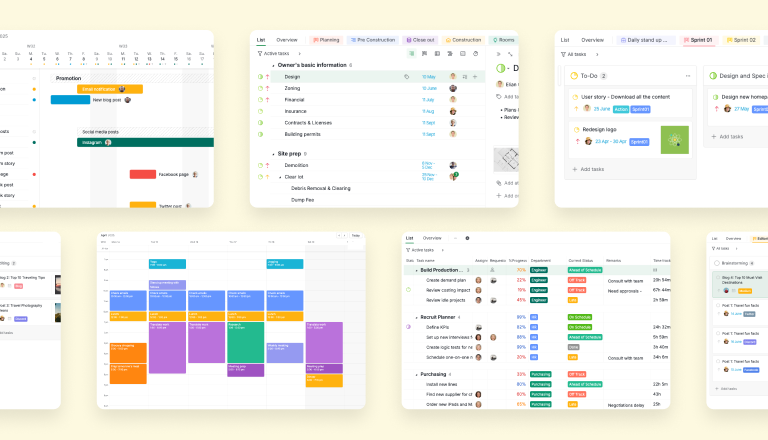
Quire Templates are ready-made project blueprints with tasks, subtasks, stages, and a workflow already set up. Pick one that fits the work (Agile and Scrum, Customer Relationship Pipeline, marketing campaign, customer engagement), duplicate it into your organization, and start on the work instead of the setup.
- What Are Quire Templates?
- How Do You Use Quire Templates in Real Workflows?
- Which Quire templates do different teams reach for first?
- Why Use Templates Instead of Starting From Scratch?
- How Do You Duplicate a Quire Template?
- What separates a good template from a bloated one?
- When Quire Templates aren't the right fit
- Common mistakes when using project templates
- What's the Next Step With Quire Templates?
- Frequently Asked Questions
Most new projects burn the first day on setup, not on the actual work: build the task list, decide on stages, configure the views, copy in the structure that worked on the last similar project. Quire Templates removes that day. Pick a template that fits the work, duplicate it into your organization, and start running.
The research is on the side of templates.
PMI's PMBOK Guide treats standardized templates as one of the core organizational process assets for any maturing project team, and decades of Toyota Production System research keep finding the same thing in a different domain: capturing the best-known way of doing something and making it the default frees energy for the work that actually requires judgment.
Templates aren't laziness, they're cognitive overhead reduction. Kahneman's Thinking, Fast and Slow makes the same point in psychology terms: every decision your team doesn't have to make on a Monday morning is one they can spend on the work that matters.
What Are Quire Templates?
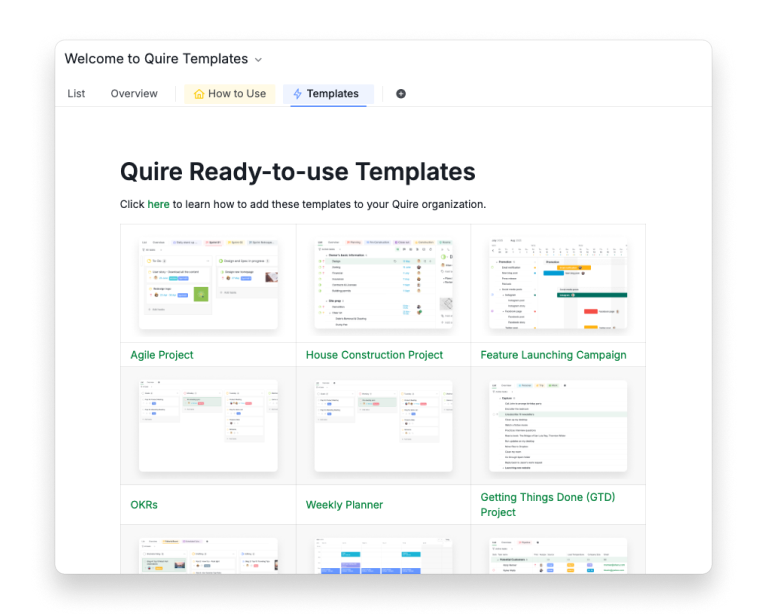
Think of them as ready-made blueprints for your projects. Instead of building everything from the ground up, you just pick a template that fits your needs, and boom-you've got a full project setup with tasks, subtasks, stages, and a workflow ready to go.
Whether you're running a sprint with your dev team, launching a new marketing campaign, or planning a customer engagement strategy, there's probably already a template waiting for you.
Our team recorded a full walkthrough of the Marketing, Event Planning, and Agile templates, about an hour end to end.
In this session16:16 Marketing Campaign template walkthrough25:15 Event Planning template walkthrough32:28 Agile and Scrum template walkthrough43:51 Hidden gems: Smart Folders, Documents, Charts, Recurring Tasks, Peekaboo, Time Tracking
How Do You Use Quire Templates in Real Workflows?
A Scrum team is the clearest case. Quire's Agile & Scrum template ships with a backlog, sprint planning lists, and a board view already configured. Duplicate it and start the first sprint instead of spending an afternoon rebuilding the same structure your last project had. Once the template is in place, you can drag and drop the sprint tasks onto the calendar to lock in due dates before kickoff.
For sales, the Customer Relationship Pipeline template tracks customers from first contact through closed deal using sublists and a Kanban board. The next rep onboarding inherits the pipeline structure instead of redesigning it.
Here are the most common Quire Templates at a glance:
| Template | Best for | What's pre-configured |
|---|---|---|
| Agile & Scrum | Dev teams running sprints | Backlog, sprint planning lists, board view |
| Customer Relationship Pipeline | Sales tracking deals from first contact to close | Pipeline sublists, Kanban board view |
| Marketing Campaign | Multi-channel launches and coordinated rollouts | Campaign task hierarchy organized by stage |
| Customer Engagement | Tracking customer touchpoints over the lifecycle | Engagement workflow steps |
Every template is fully editable after you duplicate it, so the table above is a starting point, not a fixed menu.
Browse the full Quire Templates library, or jump straight to a category: Productivity Methods, Project Management, Business Operations, or Marketing & Creative.
Which Quire templates do different teams reach for first?
A short tour of what we see teams pick up first when they're new to Quire, by role.
Marketing leads: start with the Marketing Campaign template. It comes with task hierarchies for the standard campaign phases (research, asset production, channel rollout, performance review), so a quarterly campaign launch becomes a one-hour kickoff instead of a half-day setup. Most marketing teams clone it once per quarter and rename rather than building from scratch.
Sales managers: the Customer Relationship Pipeline template ships with the standard funnel sublists already wired up. New reps inherit the same pipeline shape, which makes coaching easier (everyone is working in the same five lists) and onboarding a new rep is a duplicate-and-assign action rather than a system-design exercise.
Engineering leads: the Agile and Scrum template is the obvious starting point, but the more interesting move is to fork it once for your team's specific ceremonies (your backlog-grooming cadence, your sprint length, your story-point scale, or how you run a daily standup) and save that as your internal template. Future sprints start from your version, not Quire's generic one.
Customer success leads: the Customer Engagement template captures the touchpoints across the customer lifecycle. Teams that adopt it usually find the gap between "what we say we do for customers" and "what's actually happening" closes by a couple of weeks, just because the touchpoints become visible instead of tribal knowledge.
Operations leads: less obvious but worth trying. Operations work tends to be repetitive (vendor onboarding, internal audits, quarterly compliance), which means templates pay off faster here than almost anywhere else. The setup cost on a recurring operations process is paid once and then refunded every quarter. Most operations teams underuse templates because they don't think of their work as project-shaped, but a quarterly compliance audit with 15 stable tasks is exactly the shape templates were built for.
What ties all five roles together is that templates pay off when the work has a shape. If your operations team has a repeatable 15-step audit, your marketing team has a quarterly campaign rhythm, and your sales team has a stable pipeline, templates aren't optional anymore. They're the floor. If your work is genuinely novel every time, templates are the wrong tool and a blank project is the right one.
Why Use Templates Instead of Starting From Scratch?
The bigger value beyond saved setup time is consistency. When every project starts from the same structure, people find things faster, handoffs are predictable, and the template captures the workflow so nobody reinvents it on each kickoff. That payoff compounds for growing teams: every person you add inherits the structure instead of inventing their own.
Every template is fully customizable after you duplicate it. Rename tasks, add subtasks, change stages. The template is a starting point, not a constraint.
Want the catalog rather than the feature tour? Every one is listed out in 20+ project management templates your team will actually use, with what each contains and when to reach for it.
Related: The Project Plan Template That Doesn't Fall Apart in Week Two — for the planning structure (scope, milestones, owners, dependencies) that should exist before you duplicate any project template.
How Do You Duplicate a Quire Template?
Head over to our Quire Templates page and take a look around. We've got a bunch of templates to explore, and we're always adding more.
Choose a project that you would like to use.
Click the dropdown menu icon next to the project name at the top and select
Duplicate.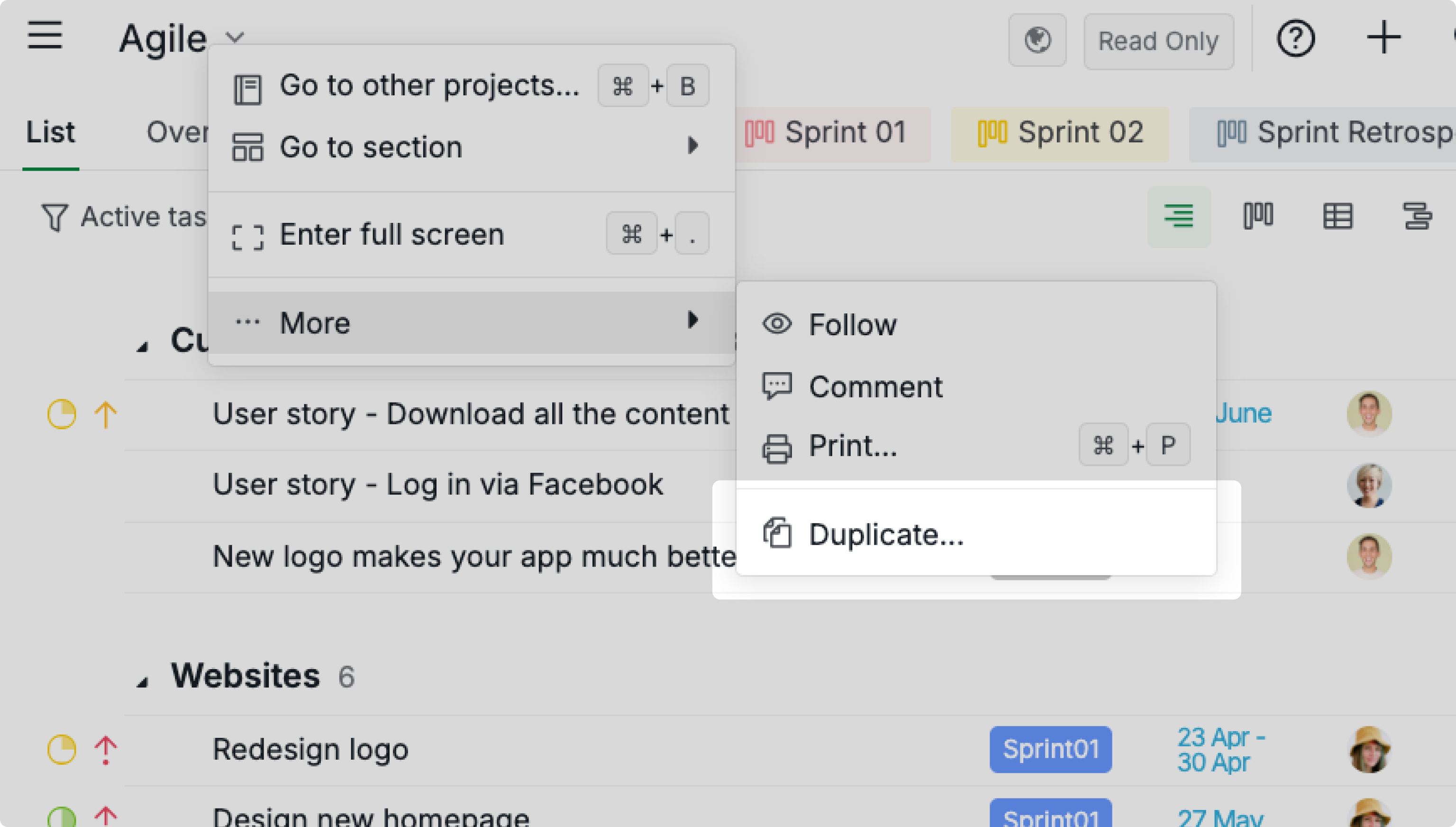
Give your new project a name and select which organization you'd like to add the project template to, then click
Create.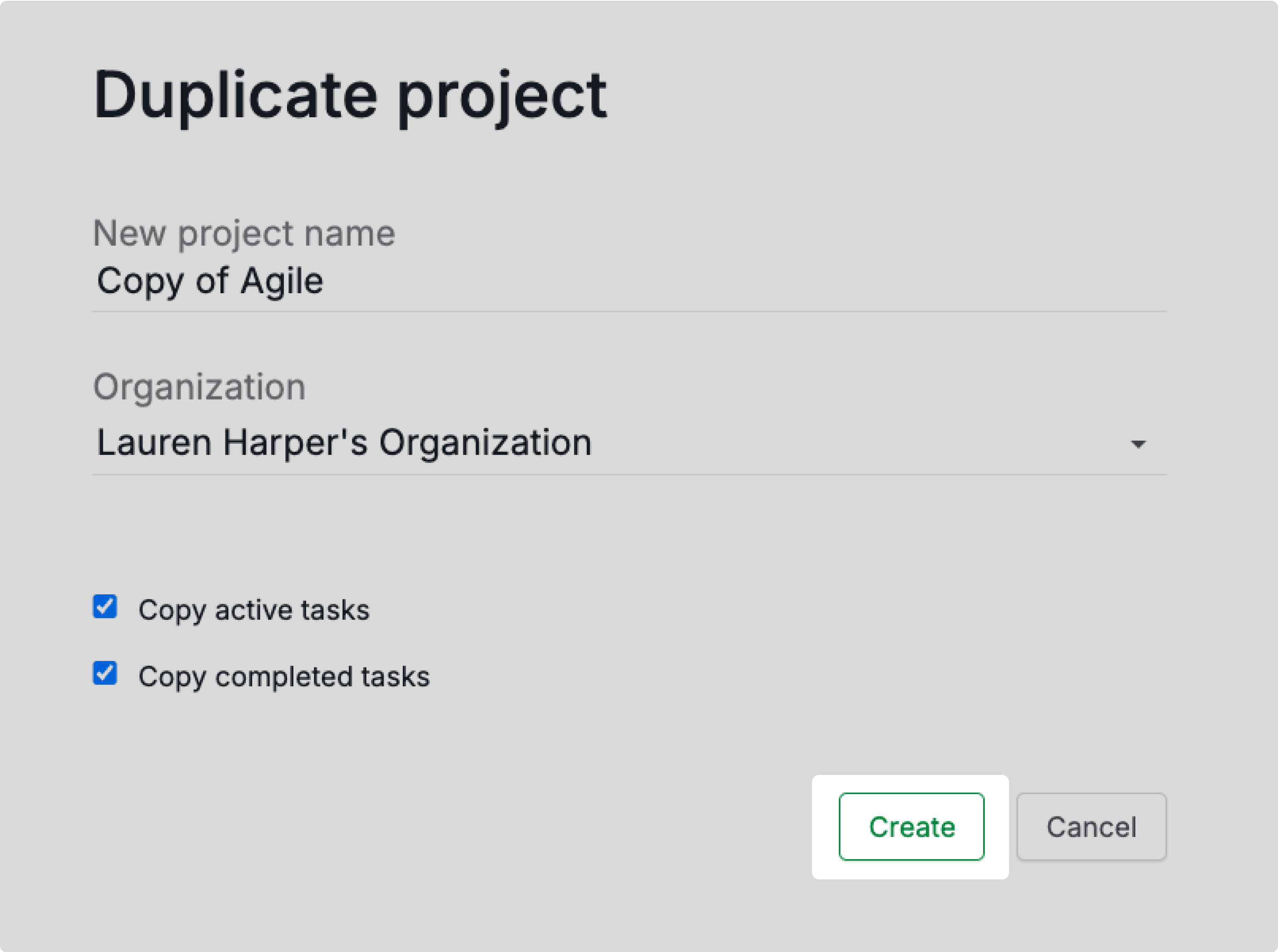
What separates a good template from a bloated one?
After watching teams build their own templates inside Quire, a few patterns separate the ones people actually re-use from the ones that quietly die.
Good templates have one obvious owner. Someone on the team is responsible for keeping the master version current. Without that, the template drifts as the process evolves and people stop trusting it. A single owner with a quarterly review on their calendar is enough.
Good templates are small. A 200-task template intimidates more than it helps. The teams whose templates get the most reuse usually have 20 to 40 tasks per template, organized in three to five sublists. Anything more starts to feel like homework on day one.
Good templates leave room for project-specific work. A campaign template that prescribes every task crowds out the work that actually distinguishes one campaign from another. The template should cover the recurring 80%; the project itself adds the 20% that's specific to this run.
Good templates document the assumptions, briefly. A two-sentence note at the top of the template (what it's for, when it doesn't fit, where to ask questions) saves an hour of confused-team-meeting energy every time someone new uses it. Add it to the project description or the first task.
The templates that live longest in any Quire workspace tend to share all four of those properties. The ones that die usually fail on one of them: no owner, too big, too rigid, or no context.
When Quire Templates aren't the right fit
Templates pay off when there's a repeatable shape to the work. They do not pay off in every case:
- Truly novel one-off projects. If the work has no precedent and you are inventing the structure from first principles, picking a template and bending it usually takes longer than building from a blank project.
- Tiny solo workflows. A personal to-do list with five tasks does not have enough setup overhead to amortize. Just create the tasks.
- Heavily regulated processes. Compliance, clinical, or legal workflows often need specific fields, audit trails, or approval steps a generic template cannot anticipate. Build a custom blueprint and save that as your team's internal template instead.
Common mistakes when using project templates
A template only saves time if you use it as a starting point. Things that quietly waste the win:
- Over-customizing before testing. Tweaking the template heavily before you have run a project through it once means you are optimizing on assumptions, not friction you actually hit.
- Forcing the wrong template onto the work. A sprint template applied to a long ongoing program, or a CRM pipeline applied to internal projects, creates more rework than it saves. Pick by use case, not by which template you used last time.
- Duplicating the same template five times. If three projects keep diverging from the original, the answer is usually to update the master template once, not to maintain three forks of it.
- Treating the template as a constraint. Renaming tasks, dropping irrelevant lists, and adding subtasks specific to this project is the whole point. The template is the floor, not the ceiling.
What's the Next Step With Quire Templates?
Pick the template closest to the project you are about to start. Duplicate it into your organization, rename the tasks to fit, and skip the empty-task-list step entirely. The template hub is the starting point.
Have a template worth sharing back to the Quire community? Email feedback@quire.io.
Frequently Asked Questions
What are Quire Templates?
Quire Templates are ready-made project blueprints with tasks, subtasks, and workflows already set up. Duplicate one and start working instead of building from scratch.
Why use a template instead of starting fresh?
Templates save time and keep every project structured the same way, so teams can find things faster and skip the setup debate on every kickoff.
What types of templates are available?
Common ones include Agile and Scrum, a Customer Relationship Pipeline, marketing campaigns, and customer engagement, with more added over time.
How do I use a Quire Template?
Visit the Quire Templates page, click the dropdown next to a template's project name, choose Duplicate, pick your organization, and rename. That's it.
Are templates free?
Yes. Browsing and duplicating both work on the free plan. A duplicated template becomes one of your projects, so the only limit to watch is your plan's project count.
Ready to skip the setup day on your next project?
Browse the Quire Templates library, duplicate the one closest to the work, rename the tasks, and start on day one instead of building from a blank project.