features · Apr 12, 2024
3 Best Practices to Use Table View - A Detailed Guide from Quire Team
Last updated: September 3, 2026
Three real Quire Team practices for Table View: as a CRM (Customer Success team), for social media scheduling and performance (Marketing), and for resource allocation plus workload management (PM team). Available on Professional and higher plans. Same data as Tree view; different angle.
- How do you get started with Quire Table View?
- When do you outgrow Quire Table View?
- Practice 1: How do we use Quire Table View as a CRM tool?
- Practice 2: How do we track social media content and schedules?
- Practice 3: How do we allocate resources and manage workload?
- Should you try Table View on your next project?
- What do the three practices look like at a glance?
- Frequently Asked Questions
The case for tabular views in knowledge work has been made for decades. According to Edward Tufte's research on dense information design, showing many data points together (instead of one at a time) lets the eye spot patterns it can't spot otherwise, and that's why spreadsheets stayed relevant for 40 years after the personal computer arrived. Quire's Table View applies the same principle to project tasks.
For project managers, finding versatile and adaptable tools matters. Quire steps up to the plate as a platform designed to organize tasks, support collaboration, and surface workload data. One of its less-obvious features is the Table View, which lets teams see and analyze many tasks at once with their data side by side. In this guide, we'll show three concrete ways the Quire team uses Table View internally.
How do you get started with Quire Table View?
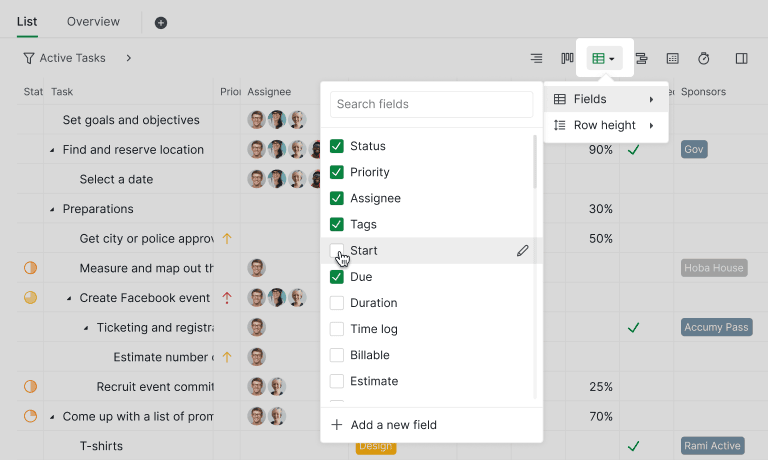
Before we dig into specific practices, let's get acquainted with Quire Table View. If you're already familiar with Quire, you'll know the design keeps the depth reachable and out of the way at the same time. Table View is no exception. It's a visual representation of your project data in a spreadsheet-like format, offering a different perspective that can be useful for various purposes.
To access Table View in Quire, simply navigate to your project, clicking on the table view icon. You can choose which fields to show as columns in the table view in this step as well.
For how to find Table View in Quire and a step-by-step guide, please visit our guide.
If you are new to the setup behind these practices, our team recorded a 47-minute session introducing Custom Fields, formulas, and Table View.
When do you outgrow Quire Table View?
Quire Table View works well as a CRM or reporting surface whenever the records and the work they generate belong in the same place. You outgrow it when you need a separate tool's specialized features: deep marketing automation, advanced resource matching, or multi-source BI joins. Until then, one Table View saves you from running a second tool alongside Quire, and from reconciling the two every month.
Practice 1: How do we use Quire Table View as a CRM tool?
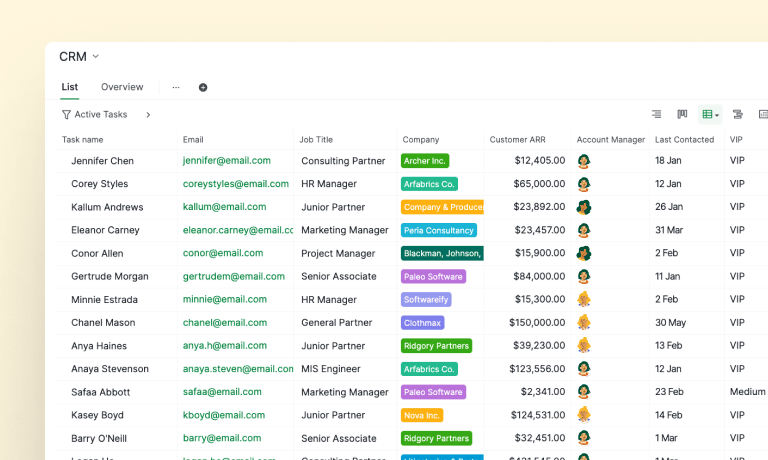
The information presented in this screenshot has been modified for illustrative purposes only.
Customer Relationship Management (CRM) is crucial for businesses of all sizes, and Quire Table View can serve as a versatile CRM tool. Here's how our Customer Success Team optimizes Quire:
- Customize Columns: We tailor the Table View by adding custom columns such as customer name, contact information, deal stage, and follow-up dates. This customization allows us to track and manage customer interactions efficiently.
- Filter and Sort: Use Quire's filtering and sorting options to segment the customer data based on criteria such as lead status, priority level, or last communication date. This functionality makes it easy to prioritize tasks and follow up with clients effectively.
- Collaborate Smoothly: Invite team members to collaborate within Quire, assign the leads to each team member, enabling them to update customer information, add notes, and track progress in real time. This collaborative environment fosters teamwork and ensures everyone stays on the same page.
By using Quire Table View as a CRM tool, we centralize our customer data, keep communication clearer, and improve customer satisfaction (a win-win for the team). To skip manual data entry entirely, connect your signup form or inbox through Zapier or n8n so new leads land as Table View rows the moment they come in.
Practice 2: How do we track social media content and schedules?
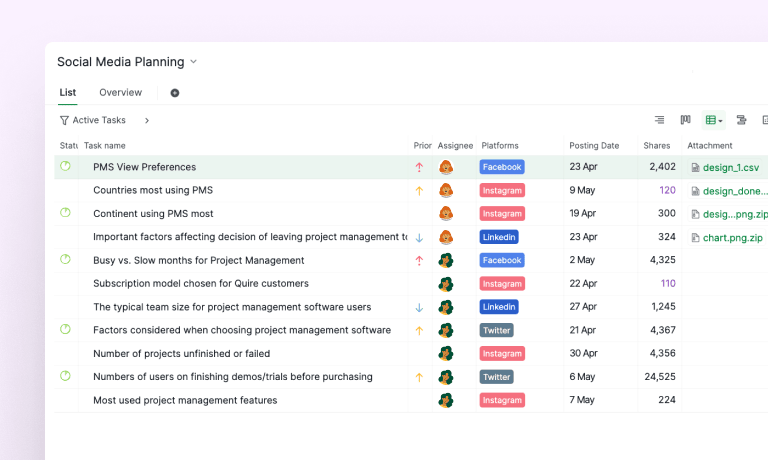
The information presented in this screenshot has been modified for illustrative purposes only.
Effective project management hinges on tracking progress and milestones, and Quire Table View provides a clear, organized way to do so. Our Social Media Team here has some practices to optimize social media schedule tracking using Table View:
- Incorporate Key Dates: We start by incorporating important dates such as the due date for each post, the posting dates, and milestone deadlines into the Table View. This provides a chronological overview of our social media schedule.
- Assign Tasks and Set Priorities: Once the post content has been created and added as tasks in Quire Table View, our Social Media Manager will begin assigning each task to the respective designer responsible for its design. With the due dates previously added, the design team will have clear priorities, enabling them to manage their workload effectively and meet deadlines punctually.
- Track Performance for Each Task: After posting content on our social media platforms, our Social Media Coordinator sets up columns in Quire Table View for metrics like Views, Shares, Comments, etc. With some conditional formatting, this visual tracking helps us quickly identify posts with high engagement rates and pinpoint content that needs improvement for better engagement.
By using Quire Table View for timeline visualization, we enhance our social media planning capabilities, improve coordination among team members, and optimize performance for successful execution.
We also use Quire Calendar View to plan our social media content in advance and ensure there's no overlap between posts.
Practice 3: How do we allocate resources and manage workload?
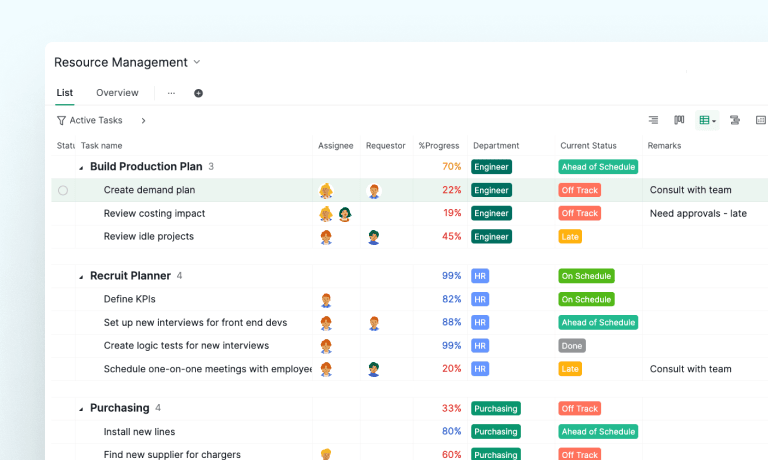
The information presented in this screenshot has been modified for illustrative purposes only.
Resource allocation and workload management are essential aspects of project planning, and Quire Table View offers valuable tools to streamline these processes. Here's how we make the most of Table View for resource management:
- Resource Assignment: Assign team members to tasks directly within Table View, allowing the manager level to allocate resources efficiently and balance workloads across team. Color-coding or icons can be used to denote resource assignments for quick visual reference.
- Workload Visualization: By color-coding the percentage progress of each task, we can easily gauge the current status of each task within Quire Table View. This visual cue allows us to identify tasks that are on schedule and those that may be off track. Also, we can quickly ascertain the responsible team member and track task history for efficient project management.
- Capacity Planning: Incorporate estimated task durations and resource capacities into Table View to facilitate capacity planning. This information helps us allocate resources effectively, set realistic timelines, and avoid resource bottlenecks that can impact project delivery.
With Quire Table View as our resource management tool, we can streamline resource allocation, optimize workloads, and ensure that the team operates at peak efficiency throughout the project lifecycle.
Should you try Table View on your next project?
Open a Quire project on Professional plan or above, click the Table icon, add the three or four columns that matter most for your team, and pick the practice closest to your use case (CRM, content schedule, or resource allocation).
Most teams settle on a column set within an hour and use it for months without changing it. The columns that matter are usually fewer than you think on day one. Pricing details on the Quire pricing page.
What do the three practices look like at a glance?
The Quire team's three Table View practices, in one view.
| Practice | In short |
|---|---|
| Table View as a CRM tool | Custom columns for customer name, contact info, deal stage, and follow-up dates turn Table View into a working CRM. |
| Social media content and schedules | Key dates, task assignments, and per-post performance metrics keep the whole social calendar in one grid. |
| Resource allocation and workload | Direct assignments, color-coded progress, and capacity planning make workload visible at a glance. |
For where Table View sits next to the board, the timeline and the calendar, read which project view fits the work.
Frequently Asked Questions
How do you use Quire Table View as a CRM tool?
Add custom columns for customer name, deal stage, and follow-up date, then filter and sort to segment leads and assign rows to teammates. It works as a CRM for teams that want the pipeline sitting next to the delivery work, without the marketing automation stack Salesforce or HubSpot are built around.
How do you track social media content with Quire Table View?
Add columns for content type, dates, status, and post-publication metrics, then assign rows to the responsible designer or copywriter. It becomes a content calendar and performance dashboard in one view.
How does Quire Table View support resource allocation and workload management?
Add columns for estimated duration, actual time spent, and percent complete, color-code progress, and group by assignee to see workload balance and catch overload early.
What plan tier do I need for Quire's Table View?
Table View requires a Professional plan or higher. Free and Basic tiers use Tree, Board, and Calendar views without the Table layout.
When should you use Table View versus Tree view in Quire?
Use Table View to compare many tasks side by side with their data. Use Tree view for daily task-by-task work. Same data, different angle: Tree for working, Table for reporting.