features · Aug 23, 2023
Unveiling Quire's Table View: Formulas, Custom Fields Galore, and Beyond
Last updated: September 3, 2026
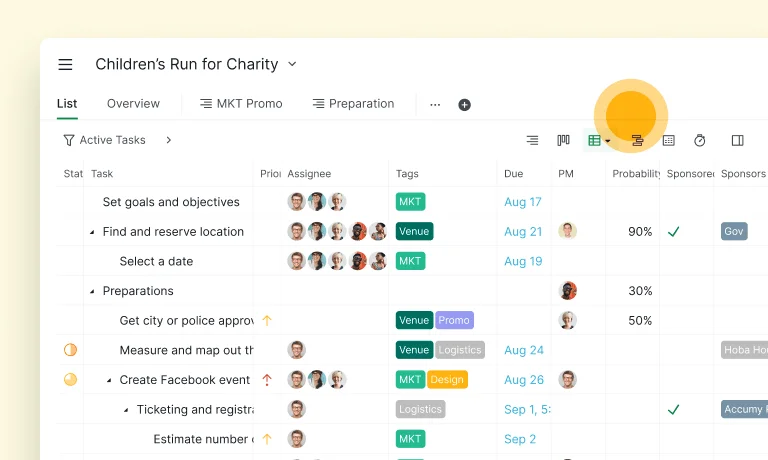
Quire Table View is a spreadsheet-style layout for any project. Rows are tasks, columns are properties or Custom Fields, and you can sort, filter, rearrange columns, and edit cells inline. Pair it with Quire's formula engine and the table becomes a small live dashboard. Available on Professional and higher plans.
Most Quire users live in Tree view by default. It's the right view when you're working a project one task at a time. The view falls short when you need to see many tasks side by side with their data: budgets, time logs, statuses, custom field values. That's when teams reach for Table View. It takes the same project data and lays it out as a spreadsheet, without leaving Quire and without re-keying anything.
The pattern is familiar from other domains. According to Edward Tufte's work on small multiples and dense information design, showing related data together (rather than one item at a time) lets the eye spot patterns across rows that it can't spot across pages. Table View applies that principle to tasks: forty tasks visible at once, with the columns that matter to your team, sorted by the column that matters today.
Table View is exclusively made for Professional and higher subscription tiers. More information can be found on our Pricing page.
What does Quire Table View actually look like?
Picture this: a high-tech blend of your favorite spreadsheet's organization mojo and the straightforwardness that you love about Quire. Hold on a sec, though.
This is more than a feature facelift. Table View makes your projects look prettier (yes, with style), but its real job is giving you an entirely new way of tackling your tasks.
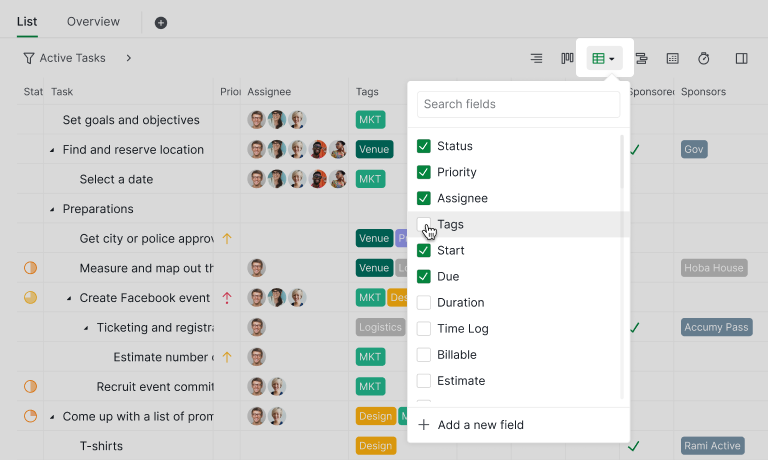
You can switch to your Table View for the project by clicking on the table view icon. You can choose which fields to show as columns in the table view in this step as well.
The real superstar here is the customizability that Table View brings to the table (pun intended) 😎 You can choose to utilize the tried-and-true Quire default fields, or better yet, you can don the hat of a project virtuoso and craft your own fields.
You heard that right - tailor the fields to your unique needs. If you're all about the project cost, add a "Budget" column. If your team thrives on time spent on tasks, insert a "Time log" field. The power lies in your hands.
Flexibility is the cornerstone of effective project management. Table View in Quire understands this need for agility. Rearranging columns is as simple as drag-and-drop.
Want to keep your most crucial information front and center? Rearrange the columns that matter the most to your team to the front so you can emphasize that information. With this level of adaptability, managing your project becomes less of a chore and more of a strategic dance.
In the classic list view, things could sometimes get a tad overwhelming. With Table View, it's like your projects all got VIP passes to the same gig, and they're hanging out together in one super-organized space.
For how to find Table View in Quire and a step-by-step guide, please visit our guide.
Our team also recorded a 47-minute session introducing Custom Fields, formulas, and Table View together.
How should you use Table View for your projects?
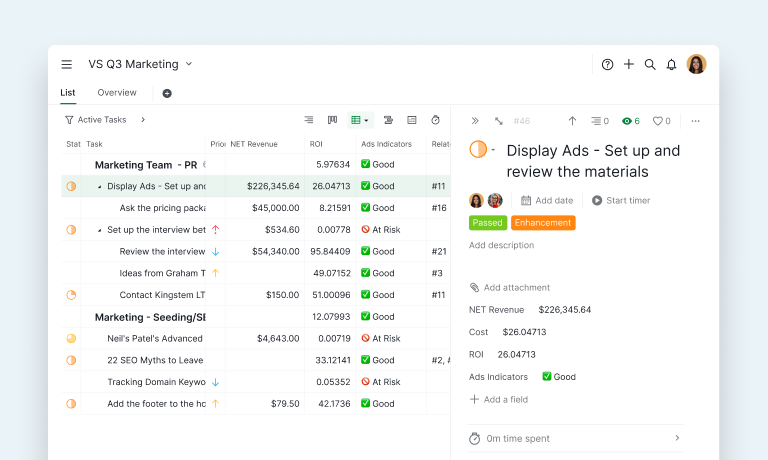
Did you remember we’ve also just released Custom Fields? The Table View lets you add custom fields that become columns in the table, giving you the flexibility to track exactly what matters to you.
Whether you're tracking budgets, client information, or even the color of your project's unicorn mascot (we won't judge), Table View lets you do it with flair. It's like having your project data laid out before you in a glorious smorgasbord of columns, just waiting for you to dig in.
For instance, you can create a custom field to indicate if your tasks are taking longer than the estimated hours. It's like a caution sign that warns you when you're venturing into time overdrive. For that kind of calculation across every subtask at once, see Quire's Array Formulas.
Also, we're all about keeping things visual, so why not make those tasks pop with different colors? Tasks with longer working hours can stand out like beacons, alerting you to potential hiccups.
For how to add custom fields in the Table View and a step-by-step guide, please visit our guide.
But that's not all, dear Quireans! Brace yourselves, because here comes the real turning point – you can also treat your Table View as your project database.
Imagine having all your project's vital information, from tasks and deadlines to budgets and stakeholders, organized in one neat, interactive table. No more frantic hunting through scattered files and folders. Table View is like your project's Grand Central Station – everything you need, right at your fingertips.
Table View later gained freeze columns, calculated columns, and conditional formatting. See Quire's Winter Updates for what shipped.
Ready to set up your first Table View?
Open any project in Quire (Professional plan or above), click the table view icon, and pick the three or four columns that matter most for your team. If your project has Custom Fields, add them as columns too.
Most teams find the right column set within an hour and don't change it much after that. The columns that turn out to matter are usually fewer than you think on day one.
For concrete examples of how real teams configure their columns, from a lightweight CRM to workload tracking, see 3 best practices for using Table View.
Table View is available on Professional and higher Quire plans. The pricing page covers what each tier includes.

A table is the right view for comparing many rows and the wrong one for showing momentum. For the full set of trades, read which project view fits the work.
Frequently Asked Questions
What is Table View in Quire?
A spreadsheet-style layout for any project, where each row is a task and each column is a property or Custom Field. Use it to see many tasks side by side instead of expanding them one at a time.
Which Quire plan includes Table View?
Professional and higher tiers. The free tier doesn't include it, and full pricing details are on the Quire pricing page.
How do you customize columns in Quire's Table View?
Switch to Table View and use the column picker to show or hide fields. Create a Custom Field first to add it as a column, and drag-and-drop to reorder columns.
Can you use formulas inside Table View?
Yes. A Custom Field with a formula value shows its computed result as a column, and it recalculates automatically as the underlying tasks change.
How does Table View differ from a spreadsheet?
A spreadsheet stores arbitrary data; Table View rows are real Quire tasks with the full task model, assignee, status, comments, subtasks. You can open any row into the full task panel without losing your place.