features · Jan 10, 2023
Introducing Time Tracking: Know How You Spend Your Working Hours
Last updated: July 28, 2026
Quire's Time Tracking is the built-in time tracker that records hours on tasks via Stopwatch, Pomodoro, or manual entry. Generates Time Reports (for billing) and Timesheets (for management). No second app required. Timesheet is Premium+; core tracking is on every plan.
Knowing how you spend every minute of your working hours is such a powerful thing. Whether you're a project manager or a freelancer, you should always know how to track your time and make every second count: to record the billable hours, improve team productivity, and push teams towards your goal.
The case for time tracking on knowledge work has been made repeatedly. Francesco Cirillo's Pomodoro Technique (which Quire's Pomodoro mode is built on) found that 25-minute focused intervals consistently outperform unbounded work sessions for sustained concentration.
Cal Newport's Deep Work argues from a different angle that protected focused intervals are the highest-use productivity intervention available. And PMI's Pulse of the Profession consistently surfaces that teams with reliable time-on-task data make better resource decisions than teams running on gut feel.
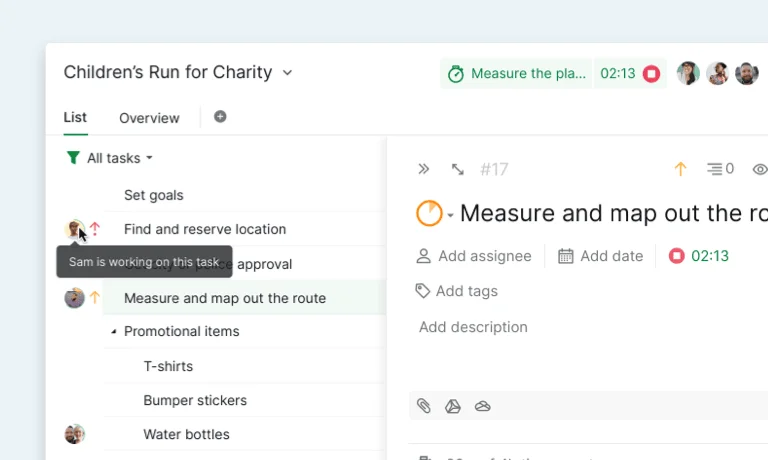
Today we proudly introduce the Time tracking feature to your team and you: a brand new way to measure teams' productivity with facts and stats.
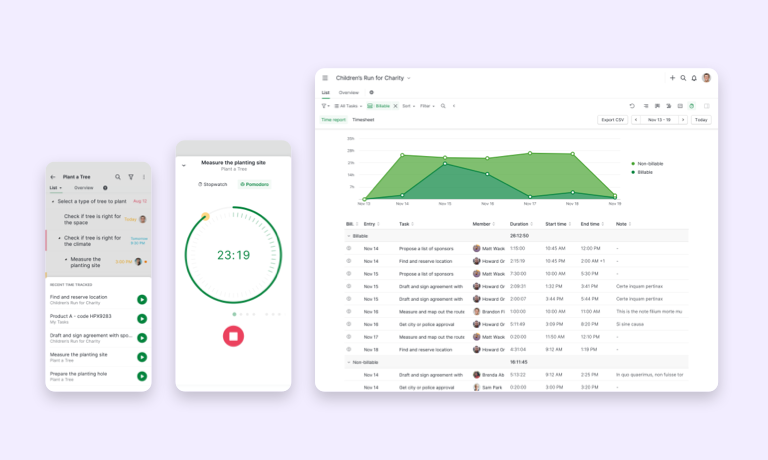
Quire lets you enjoy both Pomodoro and Stopwatch for exact time tracking on tasks.
What can you do with Quire Time Tracker?
Everything is implied in its name, here are some of the basic features that you can expect to see:
- Track the working hours that your team spends on each task in real-time, or manually add the time entries.
- Choose the Pomodoro or Stopwatch method to track each task.
- Set billable time and get billed for your time.
- Track the assignees individually.
- Generate detailed reports for managers and export them to CSV format.
In most cases regardless of the team’s size, a straightforward time tracker makes your work transparent and accessible. Quire time tracker offers reliable reporting, so that team managers can track the project’s progress and see how each task is spent during the working hours.
If you would rather watch than read, our team recorded a 34-minute session on time tracking in Quire.
How does Quire's Time Tracking compare to standalone time apps?
Most teams considering Quire's time tracking are comparing it to a dedicated time-tracking app. The tradeoffs are real and worth understanding.
| Tool | Built into PM workflow | Pomodoro support | Reporting | Plan tier required |
|---|---|---|---|---|
| Quire Time Tracking | Yes, on the task | Yes | Time Report + Timesheet | Free tracking; Timesheet on Premium+ |
| Toggl Track | No (separate app, integrations) | No native | Detailed | Free tier + paid |
| Harvest | No (integrations) | No native | Detailed + invoicing | Free for 1 user, paid for teams |
| Clockify | No (separate app, integrations) | Yes | Detailed | Generous free tier |
| RescueTime | No (passive tracking) | Limited | Aggregated by category | Free + paid |
The pattern: standalone trackers are typically more feature-rich on reporting and integrations. Quire's advantage is in eliminating the context switch between two apps. For teams where time data drives project decisions, in-tool tracking usually beats a separate app on the friction axis, even if a dedicated app is theoretically more capable.
Related reading: pair your time reports with Insight View for a wider view of team performance, or with Table View for custom calculations layered on top of your tracked hours.
Pomodoro vs. Stopwatch: which one do you need?
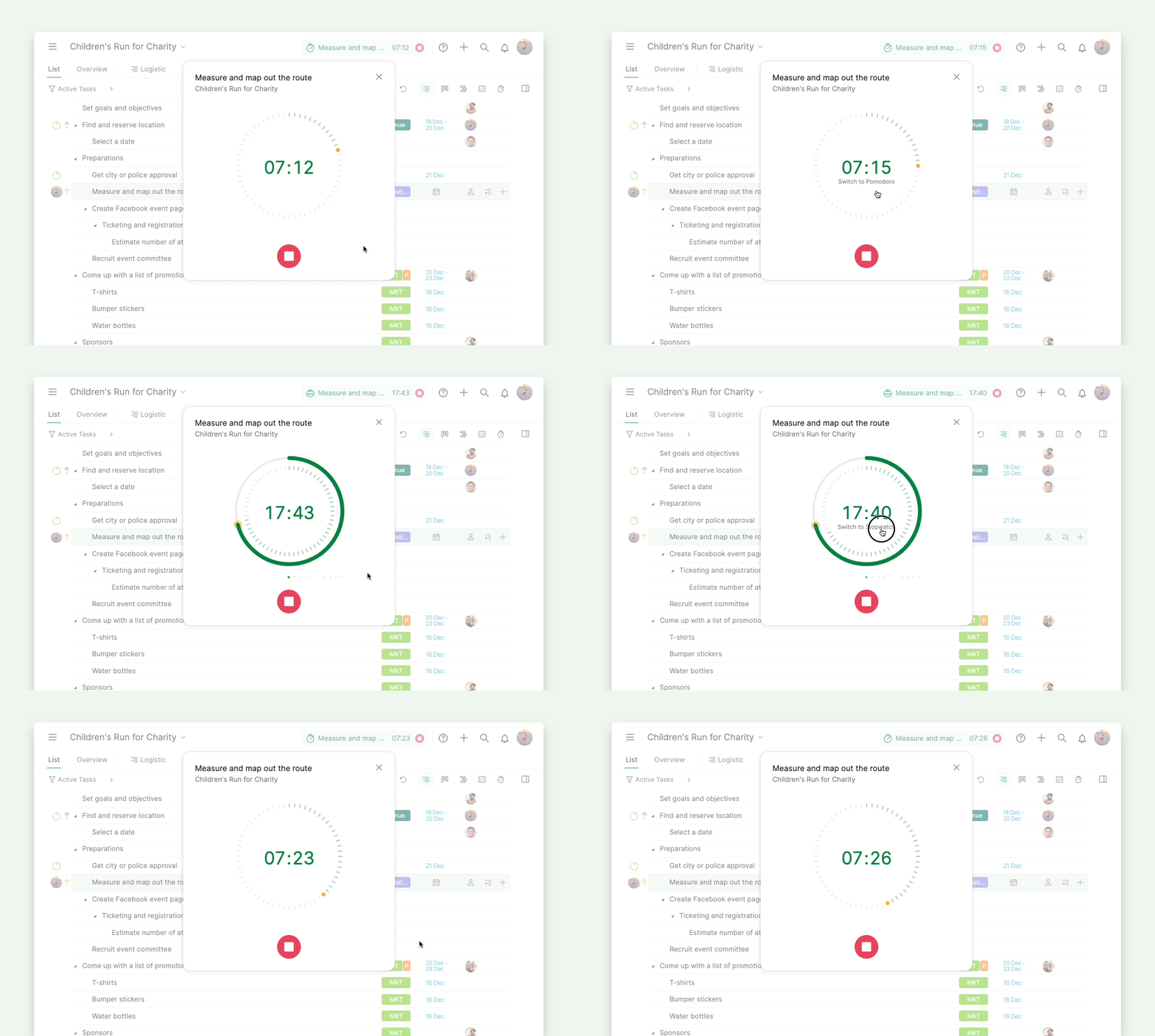
Most of the time trackers or project management software only offers a traditional yet effective way to track time: a stopwatch. It’s an old-fashioned way when you hit a button and it starts tracking the time.
Stopwatches lets you measure how much time you spent on a certain task and it’s such a neat way to manage the billable hours. With only two commands: start and stop, the stopwatch gives you an exact time tracking on tasks.
However, for dynamic teams, a stopwatch isn’t enough. With a stopwatch, there’s no certain ending and there’s no way to get focus. On the other hand, Pomodoro works on the principle of 25-minute time blocks, followed by a 5-minute break.
For example, a GCSE online tutor can run 25-minute lesson blocks between short breaks, or a designer can edit one photo per session. The idea is simple - you get to focus for 25 minutes then get a quick break as a reward for your hardworking.
With the Pomodoro method, your finite working hours will be divided into measurable time chunks. In contrast to the Stopwatches, which lets you think your time is infinite, Pomodoro method neatly divided your day into a structured way. You can map out your tasks and decide how many tasks can be fit into a 25-minute chunk.
Also, Pomodoro and stopwatches are good for reporting. Each entry is automatically recorded in a timelog. The managers and team leaders can access the overview and see the precise record of the tracked time.
Realizing the importance of Pomodoro method to teams’ productivity, Quire is one of the very few project management software that offers Pomodoro. Various studies found that long time intervals might stress out, so dividing time into structured time intervals helps users with their productivity.
Tracking time is one piece of the puzzle. For the strategies that go with it, see Quire's guide to mastering time management in project management.
How do Quire's detailed reports work?
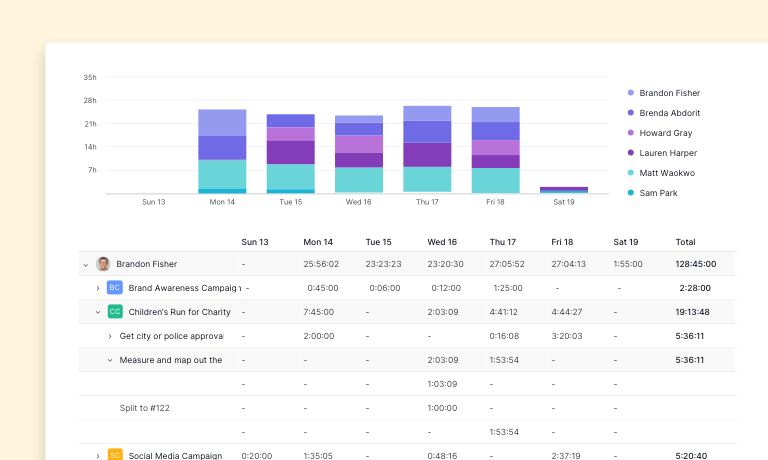
In Quire, all the tracked time is recorded in a time-tracking report, or timesheet. The time tracking reports share with you how much time was spent on your projects, or during a specific time range. You can even compare the actual time spent and the estimates.
There are two reports that you can find in Quire: time report and timesheet. The time report is a detailed time log that is ordered by a clear timeline.
You can group the tasks by projects, members, or by billable hours to create a customized report that suits your need the most.
A time report provides an accurate report for you to bill your clients for your time, or you can make sure your employees’ wages are fairly compensated.
A timesheet is suitable for internal management: all of the tasks are grouped by members per week. The working hours of each member are presented in detail which can help managers supervise their employees and their working time. At the manager level, a timesheet helps decision-makers better manage the resources in the team.
Timesheet is exclusively made for Premium and Enterprise subscription plans. More information can be found on our Pricing page.
Ready to track your team's time inside Quire?
Everyone got 24 hours a day. You need to distribute your time wisely to make the most out of your 24 hours. We hope that with Quire’s time tracking feature, now you already have your own ideas on how to use them. Maybe you find the idea to track time helpful in your projects? Maybe you use Pomodoro to help you focus better?
For a detailed guide on how to track your time, please visit our Guide for Time Tracking Report.

Frequently Asked Questions
What is Quire's Time Tracking feature?
It's a built-in time tracker that records time on each task via stopwatch, Pomodoro timer, or manual entry. Because it attaches to the task itself, you get billable hours and workload data without a separate app.
What is the difference between Stopwatch and Pomodoro time tracking in Quire?
Stopwatch tracks elapsed time with a simple start and stop, good for billable hours and exact records. Pomodoro divides work into 25-minute focused blocks with breaks, better for protecting focus.
Can you generate time reports from Quire?
Yes, two types. The Time Report is a detailed log groupable by project, member, or billable status, good for billing. The Timesheet groups by member per week for internal management, and it's Premium and Enterprise only.
How does Quire's Time Tracking compare to standalone time tracking apps?
Standalone apps like Toggl or Harvest are often richer on reporting and integrations. Quire's edge is that tracking lives on the task itself, so you skip the context switch between two apps.
Is Quire Time Tracking available on the free plan?
Core time tracking (Stopwatch, Pomodoro, manual entry, Time Report) is available on most Quire plans. The Timesheet report is Premium and Enterprise only.