features · Dec 8, 2021
Introducing Nested Kanban Board: Task Bundle is Here
Last updated: September 10, 2026
Quire's Nested Kanban Board keeps subtasks grouped under their parent task on the board instead of scattering them as loose cards. The feature is called Task Bundle. Toggle it on to preserve your hierarchy in card view, toggle it off for a flat board. Available on Professional and higher plans.
For a long time, Quire users asked for one thing over and over: let the nested task list meet the Kanban Board.
You'd build a beautiful tree of tasks in the list, switch to the board to run the work, and watch the structure flatten into a pile of cards. The relationships you'd carefully set up just vanished from view. Now they don't.

What is a Nested Kanban Board?
If you've touched agile project management, you already know Kanban. A traditional board visualizes a project as cards in columns, where each column is a stage and you drag cards rightward as work moves along. It's simple, visual, and it works.
The discipline underneath it is older than the software. According to David J. Anderson's book Kanban, which adapted the method from Toyota's factory floor for knowledge work, the habit that actually makes a board useful is limiting how much sits in progress at once, so the eye can follow the flow.
That works well when every card is a peer.
It breaks down the moment your work has parents and children. A flat board has no way to show that "write API docs" and "review API docs" both belong under "API launch." They float as three unrelated cards, and the context you built in the list is gone.
Quire is known for its infinite nested task list, which gives a project far more context than a flat to-do list ever could. The Nested Kanban Board carries that same hierarchy onto the board, so switching views no longer means losing the shape of your project.
Related: Best 15 Project Management Software with Kanban Board (2026) — see how Quire's board stacks up against the rest of the field.
How do you turn on Task Bundle in Quire?
Task Bundle is the toggle that does the work. Turn it on and Quire groups subtasks under their parent task as a single "bundle," so you never lose track of which task belongs to which.
Task Bundle is available on the Professional, Premium, and Enterprise plans. The flat Kanban Board itself is free on every plan. Full details are on the pricing page.
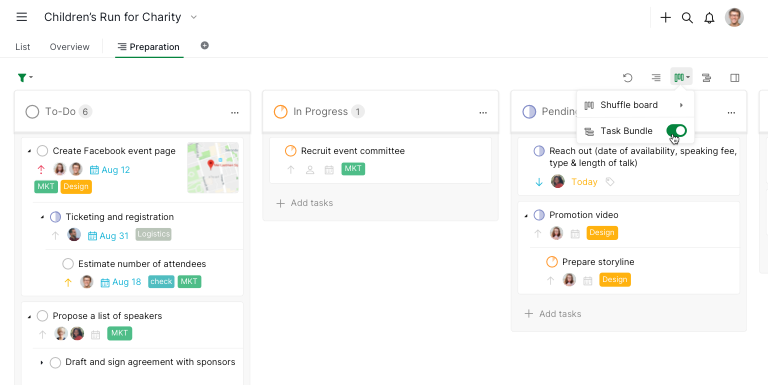
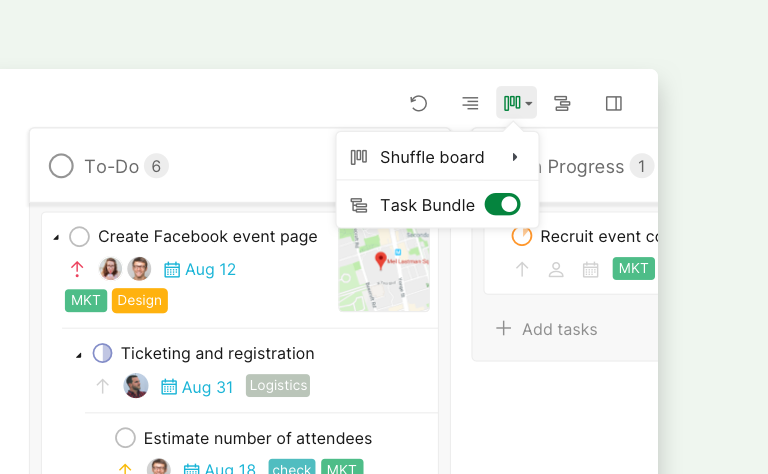
Toggle on the Task Bundle option in the Board icon dropdown menu, and every task regroups inside its own node. Instead of detaching subtasks from their parents, the board now shows the relationships between them. You keep working exactly the way you would in the List view, just with cards.
When you drag a task bundle to another column, the whole bundle moves together. Only the first-level task picks up the new column property by default. To apply it to the entire bundle, hold the Alt key while you drag.
When you're done with the nested view, toggle Task Bundle off and your board regroups into a flat layout. Nothing about your data changes underneath; only the way the board renders it.

Nesting fixes the cards. For the columns they sit in, read kanban boards for project management past three columns.
When should you keep the board flat instead?
Task Bundle isn't always the right call. Sometimes a flat board is genuinely better.
For work where each task stands on its own and its individual status is what matters, the flat Quire Kanban Board is the cleaner read.
A content pipeline where every article moves through the same stages, or a support queue where each ticket is independent, doesn't gain much from bundling. The parent-child relationship just isn't the important thing there.
Use Task Bundle when the work is a real tree, where a subtask only makes sense next to its parent. Use a flat board when the work is a set of peers marching through the same stages.
The toggle exists precisely so you don't have to commit to one forever. (If you want the longer argument for keeping hierarchy across every view, we made it in the Nested Concept post.)

Ready to bundle your board?
Open a project that has real subtasks, switch to the Board view, and toggle on Task Bundle. The difference usually clicks within the first minute, because you can finally see which cards belong together instead of guessing. For the full walkthrough, visit the Quire Guide.
Let us know if you love bundling your task list as much as we do. Share your thoughts in the comments or tweet us at @quire_io.
Still deciding between a board and a timeline for this project? Read which project view fits the shape of the work first.
Frequently Asked Questions
What is a Nested Kanban Board in Quire?
A board that keeps subtasks grouped under their parent task instead of scattering them as loose cards. Quire calls the feature Task Bundle.
How do you turn on Task Bundle?
Open the Board view, click the Board icon dropdown, and toggle Task Bundle on. Toggle it off to return to a flat board.
Which plan includes Task Bundle on the board?
Professional, Premium, and Enterprise. The flat Kanban Board is free on every plan.
What happens when you drag a bundle to a new column?
The whole bundle moves together, and only the parent takes the new property unless you hold Alt to apply it to every task in the bundle.
When is a flat board better?
When each task is independent and its own status matters more than its parent, like a support queue or a single-stage pipeline.