project management · May 6, 2026
Stakeholder Updates Without the Status Meeting

Last updated: September 22, 2026
Async stakeholder updates replace the weekly status meeting with a five-section written format: headline, what shipped, what's blocked or at risk, what we need from you, and what's next. Reading time stays under five minutes, cadence is biweekly for most projects and weekly for launch-critical phases. Meetings remain useful for ambiguous decisions, strategic alignment, and kickoffs. Give the written format four cycles before evaluating.
- What Stakeholders Actually Need (vs. What They Ask For)
- Why the Status Meeting Is the Wrong Format
- What Is the Async Update Pattern?
- What Does the Async Update Template Look Like?
- When Is a Meeting Still the Right Call?
- What About the "Stakeholders Want Face Time" Objection?
- When Won't the Async Update Work (Yet)?
- Can AI write the status update for you?
- Key Takeaways
- Frequently Asked Questions
Every project has at least one meeting nobody on the project wants to attend. The stakeholder doesn't really want to attend it either. It gets rescheduled twice, finally happens, and during the half hour the stakeholder looks at their phone while somebody reads a status report out loud. At the end, the stakeholder says "thanks, keep me posted." That's the weekly status meeting.
What's uncomfortable is that everyone knows it isn't working, and nobody cancels it, because canceling it feels like hiding the ball. Stakeholders read "no meeting this week" as "something's going wrong." So the ritual persists, nobody enjoys it, and the team burns an hour a week proving the work is still happening.
There's a better way, and it isn't more meetings. It's better writing. This post covers what stakeholder communication actually needs to do, why the meeting is the wrong tool for it, and the async update pattern that replaces it. We've also pinned the same five-section template inside Quire's cross-functional template so you don't have to rebuild it every project.
What Stakeholders Actually Need (vs. What They Ask For)
Stakeholders don't want more information about your project. They want less ambiguity about whether the project is going to land. Those are two different things, and most status updates confuse them.
When a VP asks for "regular updates," they're not asking for a recitation of every task. They're asking for the minimum amount of information that lets them stop wondering. If your update tells them everything is on track, they don't need the details. If something is off-track, they'll ask for the details themselves. The job isn't to prove the work is happening; it's to signal where their attention is actually needed.
The reason most status meetings fail is that they're built around the idea that stakeholders need to be "kept in the loop." They don't. They need to be kept out of the loop until something requires their input. Getting this backwards is what turns stakeholder communication into theater.
Why the Status Meeting Is the Wrong Format
Meetings are optimized for one thing: real-time decision-making when opinions differ. Status updates are the opposite. There's no decision to make, and the information is already decided by the time the meeting happens. Using a meeting for status is like using a scalpel to butter toast.
Three specific failure modes make the status meeting especially bad at its job.
It compresses information into the wrong shape. A written update can be scanned in five minutes. The same content, read aloud, takes thirty. Stakeholders who could have absorbed the whole thing in the time it takes to drink a coffee are instead trapped in a half-hour meeting.
It encourages performance over honesty. When a team prepares to present status to leadership, they rehearse the framing. Problems get softened. Risks get reframed as "things we're monitoring." Writing has fewer of these incentives, because the words stay on the page; there's less room to hide behind tone and body language.
It confuses attendance with alignment. Everyone was at the meeting, so everyone is assumed to be aligned. But half the attendees were half-listening, and the other half agreed silently because disagreeing in the meeting felt expensive. Written updates force real acknowledgment. "Read and acknowledged" is a more honest signal than "attended."
The same written-first discipline works one level down, inside the team's daily coordination: a daily standup template that survives a real team, with an async three-line format that replaces the daily call.
What Is the Async Update Pattern?
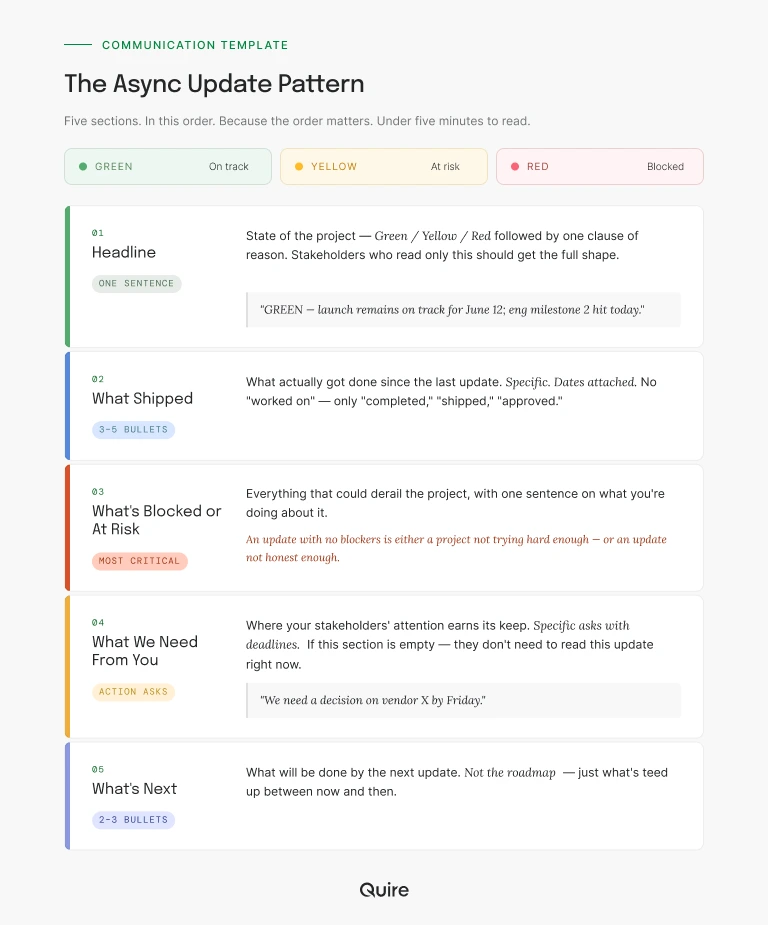
Here's the structure. Five sections, in this order, because the order matters.
1. What Goes in the Headline?
One sentence. What is the state of the project? Green, yellow, or red, followed by a one-clause reason.
Example: "GREEN. Launch remains on track for June 12; eng milestone 2 hit today."
Stakeholders who read only this should get the shape of the project without opening the rest.
2. What Goes in "What Shipped"?
Three to five bullets of what actually got done since the last update. Specific. Dates attached. No verbs like "worked on." Only "completed," "shipped," "approved."
3. How Do You Flag What's Blocked or At Risk?
This is the most important section, and the one most teams underinvest in. Everything that could derail the project, with one sentence on what you're doing about it.
If this section is empty, your update is suspicious. Real projects have real risks. An update with no blockers is either a project that isn't trying hard enough, or an update that isn't honest enough.
4. How Do You Ask "What We Need From You"?
The action asks. "We need a decision on vendor X by Friday." "We need budget approval for the QA contractor." "We need you to tell the CFO that the timeline changed."
This is where your stakeholders' attention actually earns its keep. If there's nothing in this section, they don't need to do anything. That's the same as saying they don't need to be looking at the update at all right now.
5. How Do You Set "What's Next"?
Two or three bullets of what will be done by the next update. Not the whole roadmap. Just what's teed up between now and then.
Total reading time, when you get this right: under five minutes. Frequency: biweekly for most projects, weekly for the launch-critical phase.
Working one level up, at the formal project level? The same five-section discipline becomes a project status report template you can generate from live data instead of hand-building every Friday.
Once the update goes to more than one audience, the cadence needs a home of its own. Quire's communication plan guide builds the matrix behind it: who hears what, how often, on which channel, and who signs it off before it leaves the building.
What Does the Async Update Template Look Like?
PROJECT: [name]
WEEK OF: [date]
STATUS: GREEN / YELLOW / RED, [one clause why]

✅ SHIPPED THIS PERIOD
• [specific, dated, completed item]
• [specific, dated, completed item]
• [specific, dated, completed item]

⚠️ BLOCKED OR AT RISK
• [risk]: [what we're doing about it]
• [risk]: [what we're doing about it]

🙋 WHAT WE NEED FROM YOU
• [action ask, with deadline]
• [action ask, with deadline]

📅 NEXT PERIOD
• [what will be done by next update]
• [what will be done by next update]

Questions? Reply here or @-mention me in the project.
Here is the same template filled in, using a made-up project so you can see the shape of a real update. This is an illustrative sample, not a real customer:
PROJECT: Checkout Redesign
WEEK OF: June 2

STATUS: YELLOW, launch date holds but payment vendor integration is behind

✅ SHIPPED THIS PERIOD
• Completed new checkout UI, merged to staging (May 28)
• Approved final copy with legal (May 30)
• Shipped address-autocomplete API to production (June 1)

⚠️ BLOCKED OR AT RISK
• Payment vendor sandbox is returning intermittent 500s: opened a ticket, escalated to their support lead, expecting a fix by June 5
• QA contractor start date slipped one week: covering the gap with two internal testers in the meantime

🙋 WHAT WE NEED FROM YOU
• Decision on fallback payment vendor by Friday June 6, in case the primary integration isn't stable
• Budget approval for the QA contractor (confirmed in last update, still pending sign-off)

📅 NEXT PERIOD
• Resolve payment sandbox errors and finish end-to-end integration test
• Begin QA on the full checkout flow

Questions? Reply here or @-mention me in the project.
Notice what the filled version does: the headline names the one thing that isn't green, the risks each carry a next action, and the two asks have owners and dates. A stakeholder can read it in under two minutes and know exactly where their attention is needed.
Paste this into whatever tool your stakeholders actually read: email, a dedicated channel, or a pinned doc. If you're already using a PM tool, the update should live as a recurring task or a pinned comment on the project, so stakeholders can click through to the real work if they want details.
In Quire specifically, we set this up as a recurring task at the project root with the template pre-filled in the description. Each cycle, the assignee duplicates the task, fills it in, and publishes a comment.
A recurring root task anchors production work too: in a social media workflow built in Quire, a Monday planning task walks next week's slots and chases stale approvals before they turn into a late post.
Stakeholders without a paid seat get a read-only project link and can see the same data without logging in. That last piece matters more than it sounds. If your stakeholders need an account to read the update, half of them won't.
Related: Agentic Project Management: How AI Agents Change Where Coordination Lives — where async reporting is headed once AI agents start drafting the update itself.
When Is a Meeting Still the Right Call?
Meetings aren't obsolete. They're just poorly-used. There are three situations where a meeting is actively better than a written update.
Debating ambiguous decisions. If there's real disagreement about what to do, or nobody's clear on who actually owns the decision, writing extends the conversation across days. A 30-minute meeting resolves it in one sitting.
Strategic alignment when opinions genuinely differ. If the exec team disagrees on which market segment the launch should target, a document will produce three side-by-side paragraphs of unresolved opinion. A meeting will produce a decision.
Kickoffs and major shifts. At the start of a project, and at any moment the scope or direction changes materially, the trust-building of a shared meeting is worth the hour. Once the project is in motion, the trust has been banked and writing can carry the load.
Notice what's not on the list: status, information sharing, reading the tracker out loud. If the meeting could be an email, make it an email. If it could be a document, make it a document. Save the meetings for the work they're actually good at.
What About the "Stakeholders Want Face Time" Objection?
The objection you'll hear is: "But our stakeholders don't read written updates." Sometimes true. Usually not. What's more often true is that your stakeholders got trained to skim updates because past updates weren't worth reading. They were too long, too vague, or buried the action asks.
A tight five-section update, sent on a predictable cadence, with clear asks, gets read. The first three updates may feel like they're disappearing into the void. By the fourth, stakeholders start responding to the action asks, because they've realized the update is actually worth their attention. By the eighth, they'll defend the written format if anyone tries to replace it with a meeting.
This is worth seeing through. Most teams give up after two updates and go back to meetings, which is exactly what we cover in the coordination tax. It's the hidden cost of coordination work that compounds when you can't break the meeting habit.
When Won't the Async Update Work (Yet)?
Worth being honest about a few cases where this pattern fails on contact:
If your stakeholder is the kind of executive who will not read anything that isn't presented to them, an async update will land in their inbox and die. Schedule a 15-minute monthly review and use the same five-section doc as the agenda, instead of dropping the meeting cold.
If your team's PM tool has no shared, link-shareable view, the update becomes another disconnected document. Tools like Asana and Monday make stakeholder views a paid-seat decision, which is part of why agencies and cost-conscious teams often end up doing this in Quire. The free tier keeps read-only links unrestricted.
If the project is in genuine crisis (real risk to the launch date, contract, or team), don't lead with a written update. Get the hard conversation done synchronously first, then put the new plan in writing.
Can AI write the status update for you?
Increasingly, yes. Because Quire ships a first-party MCP server, an assistant like Claude can read the live project (tasks, statuses, due dates) and draft the stakeholder update from real data, which you then edit for judgment calls rather than assemble from scratch. See project management tools with MCP for how teams set this up.
Key Takeaways
Status meetings are a bad format for status. Stakeholders don't want more information; they want less ambiguity.
The async update pattern replaces the weekly meeting with a five-section written update that takes under five minutes to read: headline, what shipped, what's at risk, what we need from you, what's next. Meetings stay useful for debate, alignment, and kickoffs. Everything else can be writing.
The biggest challenge isn't the format; it's unlearning the ritual. Give the written update four cycles before you evaluate whether it's working.
For the bigger picture of how stakeholder communication fits into cross-functional project management, this is one pattern inside the broader operating model. And for why status meetings are so culturally sticky, see our post on the coordination tax.

Frequently Asked Questions
What is async stakeholder communication?
Async stakeholder communication is the practice of keeping people informed through written updates they can read on their own time, instead of scheduled meetings. A good async update answers the same questions a status meeting would (what shipped, what's blocked, what's at risk) in about five minutes.
Why do most project status meetings fail to actually inform stakeholders?
They produce a performance of being informed, not actual information transfer. Stakeholders zone out, the team rehearses the update in advance instead of surfacing real issues, and decisions rarely happen because half the room is waiting for "any other business."
What should a written stakeholder update include?
Five sections: headline (one-sentence status), what shipped since the last update, what's blocked or at risk, what we need from you, and what's next. Reading time under five minutes. Most important thing at the top. What changed, what is at risk and what you need from them, in that order. Most of it can be read straight off the project rather than composed, which is why status belongs on the Quire task.
When is a status meeting actually the right call?
For three things: debating ambiguous decisions, aligning on strategy when opinions genuinely differ, and building trust at kickoff or after a major shift. Not for status updates or reading the tracker out loud. If the meeting could be an email, make it an email.
How often should stakeholders get project updates?
Biweekly for most projects. Weekly for launch-critical phases. More often than weekly becomes noise; less than biweekly means you're hearing about issues too late to help.
Ready to cancel the standing status meeting and run updates the way you actually want them read?
Quire's free tier ships with the recurring stakeholder-update task structure, read-only project links for non-seat stakeholders, and the cross-functional template that wraps it all together.
Start free at quire.io/signup. No credit card, full access, 30 days. Set up your first async update in the time you'd have spent in this week's status meeting.