project management · Apr 29, 2026
The Handoff Gap: Where Cross-Team Projects Actually Break

Last updated: September 8, 2026
Most cross-team timeline slippage comes from silent handoffs, the sender thinks it's done, the receiver doesn't know it's their turn. Fix it by treating every handoff as a first-class task with one named receiver, a shared definition of done, a timestamp, and an explicit acknowledgment.
- What Is a Silent Handoff in Cross-Team Work?
- Where Do Handoffs Actually Break?
- What Is the Four-Question Handoff Test?
- What Does a Good Handoff Look Like?
- What Tooling Do Reliable Handoffs Need?
- How Does Quire Make Handoffs First-Class?
- The Handoff Checklist You Can Copy
- Key Takeaways
- Frequently Asked Questions
Here's a recurring scene in cross-team projects: design finishes on a Thursday afternoon. Engineering "has it from here", everyone nods.
Monday morning, someone asks where the work is, and it turns out nobody picked it up, because design considered it handed off and engineering was waiting for the ticket they assumed was coming. Three days gone. No meeting scheduled. No Slack thread to scroll back through. Just a quiet gap where the handoff was supposed to happen.
Most missed deadlines in cross-functional projects don't come from the hard parts of the work. They come from that gap. The gap comes from treating handoffs as events instead of deliverables. Laziness and bad culture get the blame, and they are almost never the cause. That gap is one of the biggest hidden line items in the coordination tax growing teams pay without ever measuring it.
What Is a Silent Handoff in Cross-Team Work?
Silent handoff: a moment when work transfers from one person or team to another without an explicit acknowledgment that the transfer happened.
The sender believes it's done. The receiver either hasn't noticed or isn't sure it's their turn. On a dashboard, the task looks like it's in motion. In reality, it's parked somewhere between two people, and nobody's quite sure whose garage it's in.
Silent handoffs are the single most common cause of timeline slippage in cross-team projects, and the hardest to see coming. A missed deadline on a coded feature is visible. A blocker from engineering is visible. A task that's technically "in progress" but nobody is actually working on is almost invisible, until you look at it a week later and realize nobody has touched it since the handoff that never happened.
Where Do Handoffs Actually Break?
Cross-team handoffs break at four predictable seams: design → engineering, engineering → QA, product → marketing, and internal → customer-facing teams. There's a pattern to where they fail, and it repeats across industries, company sizes, and tools.
Design → Engineering. The most classic one. Design ships a spec. Engineering has questions that weren't in the spec. Nobody books the meeting to resolve them because everyone assumes the other side will. Two weeks later, the feature is half-built and nobody's happy.
Engineering → QA. The build is "done," but the QA team hasn't been told how to reproduce the edge cases. QA raises a ticket. The engineer sees it as "bug," not "spec clarification," and pushes back. The ticket sits.
Product → Marketing. The feature ships. Marketing was supposed to know two weeks in advance. They didn't, because the PM was "planning to loop them in" and then the launch date moved. The announcement goes out three days late, half-baked.
Internal → Customer-Facing. The change has been made. Support doesn't know it's been made. A customer calls with a question. Support gives the old answer. The customer notices. The PM finds out on Twitter.
In all four cases, no individual did anything wrong. The handoff itself was the failure mode, because it was treated as a moment rather than an object.
Read more on choosing an ownership framework like RACI, DACI, or RAPID if the deeper issue on your team is that roles were never assigned in the first place.
What Is the Four-Question Handoff Test?
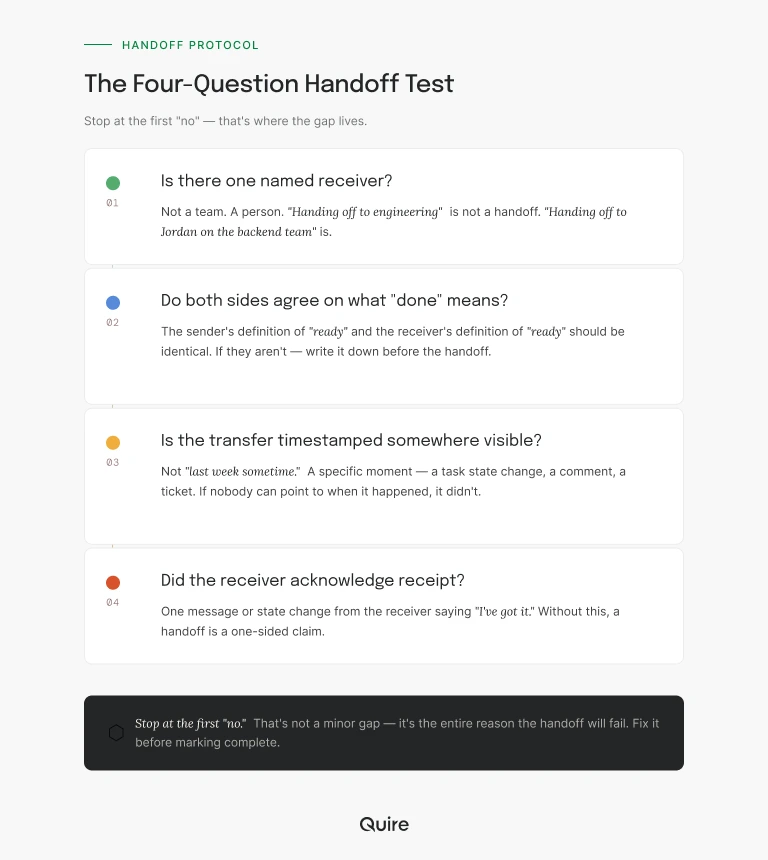
The four-question handoff test catches silent handoffs before they break a timeline: Is there one named receiver? Do both sides agree on what "done" means? Is the transfer timestamped? Did the receiver acknowledge receipt? Run every handoff through these four questions before marking it complete. Stop at the first "no", that's where the gap lives.
- Is there one named receiver? Not a team. A person. "Handing off to engineering" is not a handoff. "Handing off to Jordan on the backend team" is.
- Do both sides agree on what "done" means for this handoff? The sender's definition of "ready for engineering" and the receiver's definition of "ready for engineering" should be the same. If they aren't, write it down before the handoff. Scrum has a name for this. According to the 2020 Scrum Guide, the Definition of Done is "a formal description of the state of the Increment when it meets the quality measures required for the product." A handoff needs the same thing at a smaller scale: one written line both sides signed.
- Is the transfer timestamped somewhere anyone can see? Not "last week sometime." A specific moment, a task state change, a comment, a ticket. If nobody can point to when the handoff happened, it didn't.
- Did the receiver acknowledge receipt? One message or state change from the receiver saying "I've got it." Without this, a handoff is a one-sided claim.
Most teams fail question one or two. A few make it past those and fail question four. Question three is the sneakiest, teams think they timestamped the handoff because they mentioned it in a meeting, but nothing persistent got recorded.
Read more on the four-layer operating model for cross-functional projects, where handoffs are layer three.
What Does a Good Handoff Look Like?
Here's what a handoff should look like when it's working. Copy this as a template.
| Field | What goes in it | Example |
|---|---|---|
| Handoff title | "Design → Engineering, [feature name]", descriptive, not "Ready for Dev" | Design → Engineering, checkout redesign |
| Sender | The named person handing off | The design lead, by name |
| Receiver | The named person receiving (not a team) | Jordan, backend |
| Definition of done | What "handed off" means for this specific transfer. 3–5 bullets max. | Figma final, copy approved, edge cases listed |
| Attachments / links | Everything the receiver needs to start, linked from the task. | Figma link, copy doc, tracking ticket |
| Receiver acknowledgment | A state change or comment from the receiver confirming they've got it. | Jordan moves the task to In progress |
| Deadline for acknowledgment | When does the receiver need to confirm by? (Usually within 24 hours.) | Friday, 5pm |
Two notes. First, this is a task, not a comment on another task, not an email, not a Slack message. It lives in your PM tool with a state, a due date, and a history. Second, the receiver's acknowledgment isn't "thanks." It's the state change that says the handoff is now their responsibility.
If this feels heavy for a small project, it is, and you can trim it. But on any project where three or more teams touch the work, the heaviness of the ritual is worth less than the hours it saves later.
Read more on what matters in cross-functional PM software when handoffs are the failure point.
What Tooling Do Reliable Handoffs Need?
Reliable cross-team handoffs need three tooling capabilities: explicit reassignment with acknowledgment, nested task hierarchy, and visible state transitions. The reason most handoffs fail isn't that your team is disorganized, it's that the tool they're using doesn't make handoffs a first-class object. If your PM tool treats a handoff as "a comment on a task that got reassigned," it's going to feel like work to track, and nobody will do it.
Three capabilities matter for handoff-heavy cross-team work:
- Explicit reassignment with acknowledgment. When a task moves between people, the receiver should see it in a way that requires an action, not just an email notification they can miss.
- Nested tasks. A handoff often includes two or three sub-deliverables that move together. Tools that flatten this into one task lose the structure.
- Visible state transitions. "In progress → Handed off → Received" should be a state on the task that anyone can see without opening it. If the only signal that a handoff happened is buried in a comment thread, it will get missed.
The nested task hierarchy in Quire was built partly around this, not because handoffs are unique to Quire, but because they break so often in tools where the hierarchy is flat and the handoff lives implicitly between siblings.
How Does Quire Make Handoffs First-Class?
Most of the patterns above are tool-agnostic. But the gap between "in theory" and "in practice" is where tooling matters. Here's exactly how a clean cross-team handoff lives in Quire:
- The handoff is its own task, a top-level task titled
Design → Engineering, [feature name], not a comment buried under another task. It has its own URL, its own activity log, and shows up in everyone's filters. - One named receiver, Quire's assignee field requires a person, not a team. You can't fudge a "team handoff" because the field won't let you.
- Definition of done as nested subtasks, the three or four things the receiver needs become checkable subtasks under the parent. The parent doesn't close until the children do.
- Acknowledgment as a visible status change, the receiver moves the task from
Awaiting Receipt→Receivedon the Kanban board. The state change is visible to everyone, instantly, without anyone needing to open the task. - Acknowledgment deadline as a due date, if the receiver doesn't move the task within 24 hours, it shows up red on the board and in the sender's My Tasks view. The "I forgot" failure mode disappears.
Related: Stakeholder Updates Without the Status Meeting — the same principle of making status visible without anyone needing to ask.
Once you set up one project this way, the next handoff takes thirty seconds, not because Quire is magic, but because the structure becomes a task template you reuse. Most teams build templates for their most common handoff types (design → engineering, engineering → QA, product → marketing) and never write the structure from scratch again.
If you've already connected Quire MCP to Claude or ChatGPT, you can automate handoff creation with a single prompt, "Create a handoff task from Sarah to Jordan for the new pricing page, due tomorrow, with these definition-of-done items…" The AI builds the task, sets the assignee, adds the subtasks, and applies the deadline. The whole ritual collapses into one sentence.
The Handoff Checklist You Can Copy
Before any cross-team handoff, walk through this list:
- The handoff is its own task, not a comment on another task.
- There is exactly one named receiver.
- The definition of done is written, not assumed.
- The receiver has a deadline to acknowledge.
- The task has a visible state that signals "your turn."
- Links and attachments the receiver needs are on the task.
- The receiver has confirmed, in writing, that they have it.
Seven items. Thirty seconds of friction on the front end. Every handoff that goes through this list saves you the meeting you would have had next week to figure out why the work stalled.
Launches are the handoff-densest projects most teams run. How to launch a marketing campaign walks the same discipline across five functions and one public date, gate by gate.
Key Takeaways
Handoffs fail because they're treated as events instead of deliverables. A silent handoff, one that happened without acknowledgment, is where most cross-team slippage lives. The four-question test catches it: one named receiver, shared definition of done, timestamp, acknowledgment.
Good handoffs are tasks with their own state, not comments on someone else's task. And the reason this matters for growing teams isn't that handoffs are new, it's that the consequences compound at scale. A handoff missed at ten people is a bad week. Missed at fifty people, it's a failed launch.
For the broader context of how handoffs fit into the overall system, see our complete playbook on cross-functional project management, this post is one piece of that larger operating model.
Frequently Asked Questions
What is a silent handoff?
A silent handoff is when work moves between people without an explicit acknowledgment that the transfer happened. The sender thinks it's done; the receiver isn't sure it's their turn. The task looks fine on a dashboard, but nobody is actually working on it.
Why do cross-team handoffs fail so often?
They fail because they're treated as events ("design is done, engineering starts") instead of deliverables with an owner, a definition of done, and a timestamp. No explicit receiver, no shared definition of "complete", that's the gap where slippage lives.
What should a good handoff include?
Four things, an explicit receiver (a person, not a team), a definition of done both sides agree on, a timestamp anyone can point to, and an acknowledgment from the receiver. Miss any one and the handoff is either ambiguous or invisible.
All of it fits on one task record, which is the practical reason to keep handoffs there. A Quire task holds the owner, the date, what is being passed and the thread where the receiving side asks questions.
How do you prevent handoff failures in cross-functional projects?
Treat every handoff as a first-class task with its own owner, due date, and definition of done. Track handoffs where you track work. Require an explicit acknowledgment from the receiver before marking the handoff complete. The structural fix is refusing to let a handoff be an implication. Make it a real task in Quire, owned by the receiving side with its own due date, and the transfer has a name, a date and someone answerable.
Who's responsible for a handoff going wrong?
Nobody specifically, which is why they go wrong. Responsibility splits between the sender (who thought it was done) and the receiver (who didn't know it was theirs yet). Naming the receiver before the handoff turns diffuse responsibility into clear ownership.
Stop losing days to silent handoffs.
In Quire, every cross-team handoff has a named receiver, a definition of done as nested subtasks, a visible status, and an acknowledgment deadline, built into the task model, not bolted on with comments. Set up your first handoff template in five minutes.
Start a free Quire trial →, no credit card, full access, 30 days.