project management · May 11, 2026
RACI, DACI, RAPID: Which Ownership Framework Fits Your Team

Last updated: September 3, 2026
RACI is for work. DACI is for decisions inside a project. RAPID is for the rare cross-organizational decision with multiple veto-holders. Most teams cargo-cult one framework for every situation. Pick by the kind of ambiguity you're resolving (work or decision, and how many veto-holders), keep the matrices small, and put the roles on the task itself so the agreement actually gets used.
- Why Do Ownership Frameworks Matter?
- What Is RACI For? (Work, Not Decisions)
- What Does a RACI Matrix Template Look Like?
- What Is DACI For? (Decisions, Not Work)
- What Is RAPID For? (Cross-Organizational Decisions)
- RAPID vs RACI: What's the Difference?
- How Do RACI, DACI, and RAPID Compare Side-by-Side?
- How Do You Pick the Right Framework?
- What Are the Common Failure Modes?
- Where Should the Ownership Framework Actually Live?
- How This Connects to Cross-Functional Work
- Key Takeaways
- Frequently Asked Questions
There's a version of RACI cargo-culting that happens in almost every growing company. Somebody reads a McKinsey article. A RACI matrix template gets pasted into a Google Sheet. Everyone fills it out. The sheet is saved, filed, and never opened again. Six weeks later, the same ownership confusion shows up in a different project, and nobody remembers the matrix exists.
The issue isn't RACI. RACI works fine when it's used for the thing it's designed for. The issue is that RACI gets used for everything (work, decisions, handoffs, approvals, cross-org escalations) when at least three of those problems have their own framework that fits better. DACI exists. RAPID exists. And choosing between them depends on one question most teams skip: what kind of ambiguity am I actually trying to resolve?
This post is the comparison that usually isn't written. What each framework actually does, where it fits, where it breaks down, and a decision tree for picking the right one. And because a matrix that lives in a spreadsheet nobody opens is the most common failure mode, we've also included how to make the framework live where the work lives, on the task itself in your PM tool, where it's visible the moment ownership matters.
Why Do Ownership Frameworks Matter?
Ownership ambiguity is the silent killer of cross-team projects. Someone thinks they're deciding; someone else thinks they're recommending; a third person thinks they're supposed to just be informed but has been replying to every thread as if they have veto power. Three weeks in, the project is stuck and nobody can point to whose call it was.
Ownership frameworks exist to prevent that confusion. They give you a vocabulary for who-does-what before the work starts, so that when something goes sideways, you don't spend the first meeting arguing about whose job it was to prevent this.
Here's where most teams trip: different frameworks are built for different types of ambiguity. Using RACI to clarify a decision is like using a measuring tape to time a race. It might work technically, but you're using the wrong tool and you'll get a worse answer than if you'd used the right one.
What Is RACI For? (Work, Not Decisions)
RACI stands for Responsible, Accountable, Consulted, Informed. It answers "who's doing what" on a task or a deliverable.
- Responsible: the person who does the work.
- Accountable: the person who owns the outcome. One name, not three. If the task fails, this is who's on the hook.
- Consulted: people whose input is needed before the work is done.
- Informed: people who need to be told when the work is complete.
Where RACI shines: execution work with multiple contributors across functions. A website redesign. A migration project. A customer-facing launch. Anything where multiple people have hands on the work and somebody needs to make sure the seams don't show.
Where RACI fails: decisions. If you try to fit a decision into RACI, you end up with "Accountable" doing double duty as "Decider" and "Reporter," which confuses both roles. Decisions have a different shape; they need a driver, not an accountable party.
The practical use: five-minute conversation at project kickoff. Map the 4 to 6 most important deliverables to RACI. Write it somewhere everyone can see. Revisit once, halfway through, to catch any drift. Don't build a 40-row spreadsheet. The detail is what makes it unread.
What Does a RACI Matrix Template Look Like?
A RACI matrix template is a grid you can reuse for any project. Tasks run down the side, the people doing them run across the top, and a single letter sits in each cell to mark who's Responsible, Accountable, Consulted, or Informed. That's the whole thing. No add-on, no plugin, no 40-tab workbook.
Here's the blank version. Copy it, swap in your own deliverables and names, and you've got a working matrix in about the time it takes your coffee to cool.
| Task / Deliverable | Project Lead | Designer | Developer | Stakeholder |
|---|---|---|---|---|
| Deliverable 1 | ||||
| Deliverable 2 | ||||
| Deliverable 3 | ||||
| Deliverable 4 |
R = Responsible, A = Accountable, C = Consulted, I = Informed.
And here's the same grid filled in for a website redesign, so you can see what a real one looks like.
| Task / Deliverable | Project Lead | Designer | Developer | Stakeholder |
|---|---|---|---|---|
| Wireframes | A | R | C | I |
| Visual design | A | R | C | I |
| Front-end build | A | C | R | I |
| Content load-in | R | C | C | I |
| Launch sign-off | R | C | C | A |
Notice that every row has exactly one A. That's the rule that does the most work. The moment a task carries two Accountable names, nobody is actually accountable, and you're right back in the meeting where everyone assumed someone else had it.
How do you fill out a RACI matrix in five minutes?
- List your key deliverables. Write the four to six deliverables that actually matter down the left column. Skip the granular subtasks. If your list runs past ten rows, you're documenting, not clarifying.
- Add the roles across the top. Put each person or role across the top as a column. Use role names, not just individuals, so the matrix survives someone changing teams.
- Give every task one Accountable owner. For each row, mark exactly one person as Accountable (A). That's the single name on the hook if the deliverable slips. One A per row, never two.
- Fill in Responsible, Consulted, and Informed. Mark who does the work (R), whose input you need first (C), and who only needs the outcome (I). Keep Consulted short, three names at most.
- Put the grid where the work lives. Move the finished matrix onto the tasks themselves in your PM tool, so the roles are visible the moment someone opens the work instead of buried in a tab nobody reopens.
That last step is the one most templates skip, and it decides whether the matrix survives past week one. More on that below.
What Is DACI For? (Decisions, Not Work)
DACI: DACI stands for Driver, Approver, Contributors, Informed. It is a decision-making framework that names one person to run the decision process (the Driver), one person to make the final call (the Approver), the people whose input shapes the choice (Contributors), and everyone who hears the outcome (Informed).
DACI is built for one thing: making a decision that involves more than one person.
The DACI vs RACI distinction is the one teams get wrong most often. RACI maps who does the work. DACI maps who makes the call. Same project, two different questions.
- Driver: the person running the decision process. Sets the timeline, gathers input, synthesizes options, presents the recommendation.
- Approver: the person (usually one, sometimes two) with the final call. Can reject, but usually doesn't if the Driver has done their job.
- Contributors: people whose input genuinely shapes the decision.
- Informed: everyone who needs to know the outcome but doesn't shape it.
Where DACI shines: any significant decision inside a project. Vendor selection. Technical architecture choices. Brand decisions. Scope tradeoffs. Anything where the wrong call has consequences and multiple people have legitimate input.
Where DACI fails: operational work where the "decision" is really just execution. If you're running a recurring process (publishing a blog post, running a campaign, shipping a release), DACI is overkill. You don't need a Driver to publish a blog post; you need a RACI.
The practical use: one-page decision doc. Driver writes the recommendation. Contributors add input inline. Approver signs off. The whole thing gets archived. Time to run: 2 to 3 days for medium decisions, up to a week for big ones. Better than a series of meetings.
What does a DACI matrix look like?
A DACI matrix is smaller than a RACI matrix, because it maps decisions instead of deliverables. Decisions run down the rows, roles run across the top, and every row gets exactly one Driver and one Approver. Here's one filled in for a product launch.
| Decision | Product Manager | Head of Product | Eng Lead | Marketing Lead |
|---|---|---|---|---|
| Pick the launch date | D | A | C | C |
| Cut scope for the launch build | D | A | C | I |
| Choose the announcement channel mix | C | A | I | D |
| Approve the launch pricing change | D | A | I | C |
D = Driver, A = Approver, C = Contributors, I = Informed.
One reading rule: if a row seems to need two Approvers, that decision has outgrown DACI. Multiple parties with real sign-off power is exactly the situation RAPID exists for, covered next.
Related: The Decision Log: The Cross-Functional Doc Most Teams Skip and Then Regret, the one-page doc where each DACI row's recommendation, input, and sign-off actually get recorded.
What Is RAPID For? (Cross-Organizational Decisions)
RAPID stands for Recommend, Agree, Perform, Input, Decide. Created by Bain, designed for large-organization decisions where multiple functions have real veto power.
- Recommend: the person or group that proposes a course of action.
- Agree: people whose sign-off is required (e.g., legal, compliance, security).
- Perform: the team that executes the decision.
- Input: people whose input is valuable but non-binding.
- Decide: the person or group with final authority.
Where RAPID shines: decisions that cross functional boundaries in larger organizations. A contract renewal that involves legal, finance, and the business owner. A compliance-sensitive product change. A cross-regional pricing decision. Situations where an "Approver" model isn't enough because multiple parties have real veto.
Where RAPID fails: small teams. If your company has fewer than 50 people, RAPID is almost always more process than the decision warrants. DACI handles the same territory with half the steps.
The practical use: reserved for the 2 to 3 decisions per quarter that genuinely cross boundaries. Not the everyday. If you're applying RAPID weekly, your decision process has too much friction and somebody is going to start making decisions in Slack to avoid it.
RAPID vs RACI: What's the Difference?
RACI assigns roles for doing work; RAPID assigns roles for making one high-stakes decision. RACI gives a deliverable one Accountable owner plus the people doing, advising, and watching it. RAPID splits a cross-functional decision among people who Recommend, Agree, Perform, give Input, and Decide. They answer different questions, so they don't compete.
The comparison gets searched as if you have to pick one, but mature teams run both on the same project. RACI runs the workstreams week to week. RAPID comes out for the two or three calls a quarter where several functions hold real veto power, a pricing change, a compliance-sensitive launch, a contract renewal.
How Do RACI, DACI, and RAPID Compare Side-by-Side?
| Framework | Best for | Team size | Typical time | When it fails |
|---|---|---|---|---|
| RACI | Execution work, deliverables | Any | 5-min conversation | Used for decisions |
| DACI | Significant decisions | 10+ | 2 to 7 days per decision | Used for execution work |
| RAPID | Cross-functional/cross-org decisions | 50+ | 1 to 4 weeks per decision | Used weekly or for small decisions |
How Do You Pick the Right Framework?
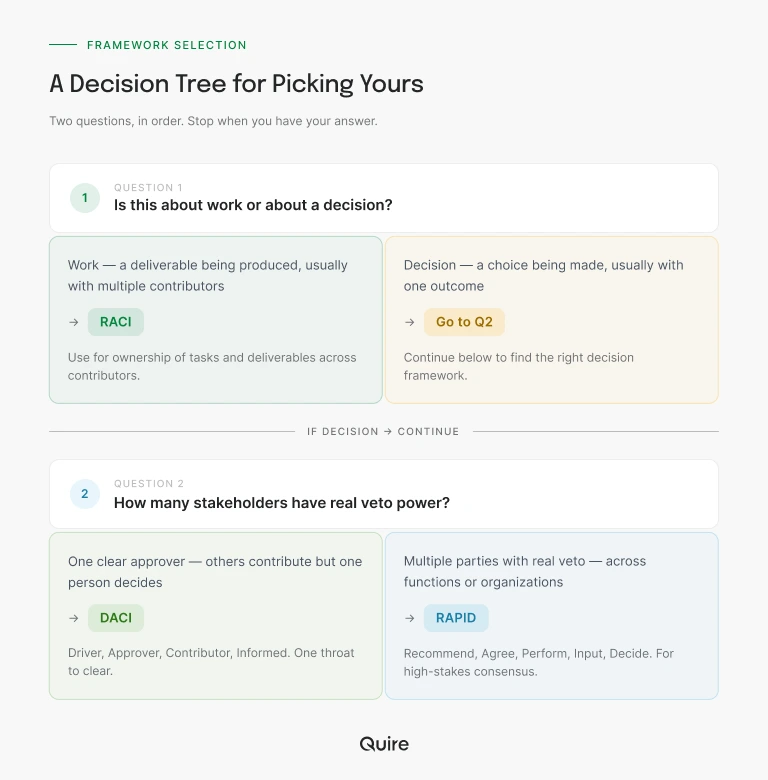
Two questions, in order.
Question 1: Is this about work or about a decision?
- Work (a deliverable getting produced, usually with multiple contributors) → RACI.
- Decision (a choice being made, usually with one outcome) → go to question 2.
Question 2: How many stakeholders have real veto power?
- One clear approver, others contribute → DACI.
- Multiple parties with real veto across functions or organizations → RAPID.
Most of the time, the answer is RACI or DACI. RAPID is a specific tool for a specific situation. Don't force it into everyday work.
What Are the Common Failure Modes?
A few patterns kill these frameworks in practice.
Using the framework as documentation instead of clarification. If the output of a RACI is a spreadsheet that nobody opens again, you built a filing cabinet, not an agreement. The point is the conversation, not the artifact.
Over-filling the matrix. Six roles per row is too many. If "Consulted" has 12 names, you don't actually need 12 people consulted; you're just afraid to exclude anyone. Cut it to the three who actually have useful input.
Mixing frameworks silently. Teams sometimes use "Accountable" in a RACI to mean "Approver" in a DACI. The words look similar. They do different things. Accountable owns the outcome (success/failure). Approver signs off on a specific decision. If you mix them, the person with the word next to their name doesn't know what their actual job is.
Skipping the handoffs. Even with a perfect RACI, cross-team work breaks at the seams. Read the handoffs between Responsible parties post for the specific failure pattern. Ownership frameworks describe static roles, handoffs describe motion, and you need both.
Forcing a framework on every task. Not every piece of work needs a RACI. Not every decision needs a DACI. For tasks with one clear owner and no cross-team dependency, the framework adds friction without adding clarity. Save them for the moments ambiguity actually exists.
Where Should the Ownership Framework Actually Live?
The single biggest determinant of whether a RACI or DACI sticks isn't how well you fill it out. It's where it lives.
A matrix in a Google Sheet decays. A matrix in a slide deck stays in the deck. A matrix attached to the task itself, with the Responsible and Accountable names visible the moment anyone opens the work, is the version that survives.
In Quire, we set this up using custom fields on tasks: Responsible, Accountable, and Consulted as named-person fields, Informed as a tag. The fields show up inline in every list view, every Kanban card, every timeline bar. When somebody opens a task and sees "Accountable: Sara" next to the title, they don't have to dig for ownership. It's just there.
Try ownership-on-the-task in Quire free →, no credit card, full access, 30 days.
This isn't a Quire-specific point. Whatever PM tool you use, the rule is the same: if your ownership framework requires opening a separate document, it will be ignored. If it lives on the task, it does the job it was supposed to do.
Ownership gets its first real test at kickoff, before anyone has opened a task. Quire's project charter guide covers where scope, roles, and approvers get written down and signed off, so the RACI you build later starts from something the room already agreed to.
How This Connects to Cross-Functional Work
Ownership frameworks are Layer 1 of the broader Cross-Functional Operating Model: Ownership. Without a shared vocabulary for who does what, the other layers (visibility, handoffs, rhythm) fail quietly. But a framework is only useful if you pick the right one for the ambiguity at hand. Using RACI everywhere is like having one tool in the toolbox and calling every problem a nail.
Related: The Coordination Tax: Why Growing Teams Spend More Time Reporting Than Working — what happens when ownership stays fuzzy and reporting fills the gap.
Key Takeaways
RACI, DACI, and RAPID aren't interchangeable. RACI is for work. DACI is for decisions inside a project. RAPID is for the rare cross-functional decision that requires multiple veto-holders. Most teams over-use RACI and under-use DACI. Most large organizations over-use RAPID on decisions too small for it.
The right framework is the one that matches the type of ambiguity, not the one you learned first. Keep the matrices small, treat them as conversations not documents, and revisit them only when the project shape changes.

Frequently Asked Questions
What is a RACI matrix template?
A reusable grid with tasks down the rows and roles across the columns. You drop one letter in each cell, R, A, C, or I, to show who does the work, who owns it, who advises, and who's kept in the loop.
How do I create a RACI matrix?
List your four to six key deliverables, add each role across the top, and assign one letter per cell. One Accountable owner per task. Keep it to a five-minute conversation, not a giant spreadsheet.
What's the difference between RACI and DACI?
RACI is for work. DACI is for decisions. RACI assigns Responsible, Accountable, Consulted, and Informed to a task. DACI assigns Driver, Approver, Contributors, and Informed to a decision. Don't use one for the other.
When should I use RAPID instead of RACI or DACI?
Use RAPID for cross-functional decisions in large organizations where multiple parties have real veto power. Under 50 people, DACI handles the same territory with half the steps.
Can I use multiple ownership frameworks in the same project?
Yes. Most mature teams use RACI for the execution work, DACI for significant decisions inside it, and RAPID only for the rare cross-org call. One framework can't cover every kind of ambiguity.
Why do RACI matrices often fail in practice?
Teams treat them as documentation. The matrix gets filed and never opened again. Treat RACI as a five-minute conversation that produces shared language about who does what, not as a deliverable. The usual failure is a matrix that lives somewhere the work does not. Put the Accountable person on the task as its single assignee, the way Quire does, and add the Consulted as followers.
How do I pick the right ownership framework?
Two questions. Is this about work or a decision? If work, RACI. If a decision, count veto-holders. One clear approver points to DACI. Multiple cross-functional veto-holders point to RAPID. Whichever you pick, it survives only if it is recorded against real tasks. A custom field in Quire can carry the role on each task, so it stays queryable in the table view rather than ageing in a separate doc.
What does DACI stand for?
Driver, Approver, Contributors, Informed. The Driver runs the decision process, the Approver makes the final call, Contributors shape the choice, and Informed hears the outcome.
What's the difference between RAPID and RACI?
RACI assigns roles for doing work; RAPID assigns roles for making one high-stakes, cross-functional decision. Use RACI to run deliverables and RAPID for the rare cross-organizational call.
Start a free Quire trial →, no credit card, full access, 30 days.