project management · Apr 22, 2026
Cross-Functional Project Management: The Complete Playbook

Last updated: October 21, 2026
Cross-functional project management fails when coordination is treated as a side effect of the work rather than a designed system. The fix is a four-layer operating model, ownership (one named person per task), visibility (task state is the status, not a weekly slide deck), handoffs (treated as deliverables with explicit receivers, not events), and rhythm (matched to decision cadence, not calendar inertia), applied in that order, with tooling as the last layer rather than the first. The single best health metric is median time between a blocker appearing and being resolved.
- What Does Cross-Functional Project Management Actually Mean?
- Why Do Cross-Functional Projects Actually Fail?
- What Is the Cross-Functional Operating Model?
- Which Roles and Ownership Patterns Survive Contact?
- Which Communication Rhythms Actually Scale?
- What Does Your Tooling Actually Need to Do?
- How Do You Measure Whether Any of This Is Working?
- What Traps Kill Cross-Functional Work?
- Where does AI fit into cross-functional project management?
- Key Takeaways
- Frequently Asked Questions
Here's a question for anyone who's ever run a project that needed design, engineering, marketing, and legal all working in the same direction: how many of the delays on your last launch came from somebody doing the wrong work, and how many came from the twelve-hour gap where nobody was quite sure whose turn it was?
If most of them came from the gap, welcome. That gap is the reason cross-functional project management exists as a discipline, and the reason most of it doesn't work.
What Does Cross-Functional Project Management Actually Mean?
Cross-functional project management is how a project ships when design, engineering, marketing and legal each own a piece and nobody owns the whole. The work lives in four layers: one named owner per task, task state as the status, handoffs tracked as deliverables, and a meeting rhythm matched to real decisions. Tools come last.
Cross-functional project management: the coordinated execution of a single outcome across teams that don't share a reporting line, toolset, or cadence, where success depends on aligning ownership, visibility, and handoffs as deliberately as the work itself.
That's the working definition. Notice what's not in it: timelines, Gantt charts, status reports. Those are outputs. The job is upstream of them.
Most definitions you'll find online describe cross-functional PM as "managing projects with people from multiple departments." That's technically correct the way "driving" means "operating a vehicle." It skips the interesting part, which is what happens when those departments have different incentives, different tools, and different definitions of "done", which is always.
A cross-functional project is any project where no single team owns the full outcome. Product launches. Feature rollouts. Rebrands. Process migrations. Anything that touches legal or security review. If more than one team has to do real work for the project to ship, you're in cross-functional territory, whether your org chart calls it that or not.
The usual response to a cross-functional project going sideways is to add a weekly status meeting, buy a more sophisticated project management tool, or hire a PM. Sometimes one of those helps. Often none of them do, because the real problem was never scheduling, tooling, or headcount. It was that coordination was treated as a side effect of the work instead of a designed system.
Read more on what matters in cross-functional PM software.
This post is the playbook we wish every team running a cross-functional project had before the kickoff. It's structured as an operating model, four layers, in the order they depend on each other, because no tool fixes a system that hasn't been designed yet.
Why Do Cross-Functional Projects Actually Fail?
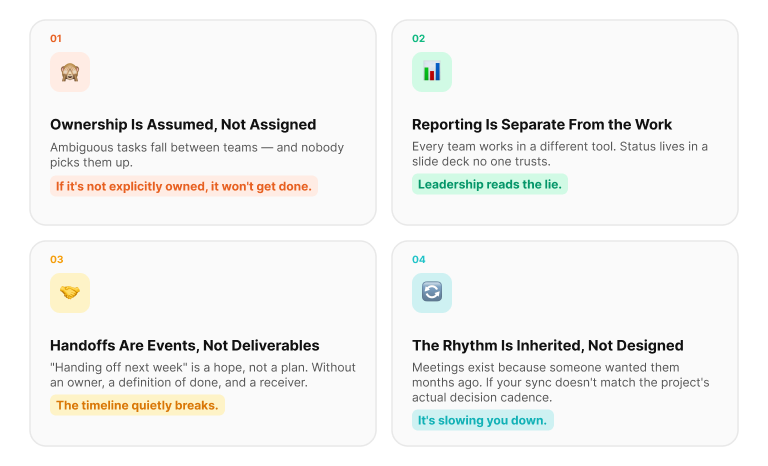
There are dozens of symptoms, missed deadlines, surprise blockers, the "who approved this?" meeting, but they trace back to four root causes. Fix these and the symptoms mostly stop stacking.
Behnam Tabrizi's 2015 study for Harvard Business Review put the scale in its title: 75% of cross-functional teams are dysfunctional. A failure rate that high is a setup problem, and these four root causes are the setup.
1. Ownership Is Assumed, Not Assigned
Every cross-functional project has tasks that live in the ambiguity zone between teams. Who writes the customer-facing announcement, product or marketing? Who tests the edge case, QA, or the engineer who built the thing? When ownership is assumed, the ambiguous tasks fall through, and they're almost always the ones that matter.
2. The Reporting Layer Is Separate From the Working Layer
Design works in one tool. Engineering works in another. Marketing lives in a third. Status lives in a weekly slide deck that somebody manually reconciles from all three. The moment any of those teams ships something the deck doesn't reflect, the deck is lying, and the deck is usually what leadership reads.
Read more on the coordination tax, and why growing teams end up reporting more than working.
3. Handoffs Are Events, Not Deliverables
"Design is handing off to engineering next week" is not a plan. It's a hope. A handoff is a deliverable in its own right, it needs an owner, a definition of done, and a receiver who acknowledges it. When handoffs are implicit, they're where cross-team projects quietly break.
4. The Rhythm Is Inherited, Not Designed
If the Tuesday cross-functional sync exists because the VP of marketing wanted visibility six months ago, and nobody has asked whether it's still earning its keep, the rhythm is wrong. Rhythms should match the actual decision cadence of the project, not the calendar inertia of the organization. The meeting that was essential in March might be the reason July's launch is behind.
What Is the Cross-Functional Operating Model?
Here's the framework. Four layers, in order, because each one depends on the one above it. Skip a layer and everything below it fails quietly.
Layer 1: Ownership
Every piece of work has exactly one owner. Not a team, not a group, a name. Teams own outcomes; individuals own work. If you can't point to one person per task, you haven't defined the task yet.
The practical test: if a blocker appears at 4pm on a Friday, who gets the Slack message? If the answer is "the team" or "whoever's around," ownership is undefined. Fix it before the project ships, not after.
Ownership also needs to separate doing, deciding, and being informed. These are not the same role, and the people in each one should know which one they're in. That's the job of ownership frameworks for cross-functional work like RACI, DACI, and RAPID, although picking the right one for your decision matters more than picking one at all.
Layer 2: Visibility
Visibility is whether anyone who needs to know the current state of work can see it, in real time, without asking a human. Most cross-functional teams fail here because their visibility is built on summaries, weekly reports, standup notes, status decks, that decay the moment they're produced.
The working principle: task state is the status. If a designer moves a card to "done," that's the update. No separate report. No reconciliation meeting. If your status process requires a person to translate work into words once a week, your status is always a few days behind what's actually happening, and everyone knows it but nobody says it.
This is why cross-functional projects need a single surface where ownership and state live together, which brings us to the third layer.
Layer 3: Handoffs
A handoff is a moment when ownership transfers from one person (or team) to another. It's always a failure point, and it's always worth treating as a first-class deliverable.
A good handoff has four properties:
- An explicit receiver. Not "engineering", a person on the engineering team.
- A definition of done. The sender knows what "handed off" means. The receiver knows what "received" means. These match.
- A timestamp. When did it happen? If you can't answer that, it didn't.
- A visible state change. The task doesn't sit in a hybrid state where the sender thinks it's done and the receiver hasn't noticed.
Most handoff failures aren't the result of laziness. They're the result of treating handoffs as implicit, as moments rather than objects. Make them objects. Track them like any other task.
Creative teams meet this one daily. A design request that arrives as a chat message is a handoff with no object at all, which is why a working design approval process starts by turning each request into a task before anyone opens a design file.
Layer 4: Rhythm
Rhythm is the cadence at which the cross-functional team syncs, decides, and unblocks. Most teams over-invest here because meetings feel productive, and under-invest in the three layers above.
A healthy rhythm has three components: a short, task-oriented weekly sync; an async daily surface where blockers get raised without waiting for a meeting; and a decision log that persists past the conversation. You don't need a meeting to make a decision. You need a place where decisions get recorded and referenced.
If your cross-functional rhythm is mostly meetings, the rhythm is too heavy. Meetings should be reserved for the things meetings actually do well, debate, alignment on ambiguity, trust-building. Status updates are not one of those things, which is why running stakeholder updates without the status meeting tends to beat the default.
For the four layers applied end to end on one deadline, see how to launch a marketing campaign: six phases, four gates, and the launch-day checklist that catches the unowned task.
The same layers on a weekly loop rather than one deadline: a social media workflow that shows the caption, asset and approval work, not just the publish date, with approval as an owned task.
Which Roles and Ownership Patterns Survive Contact?
Cross-functional projects need three named roles, no more. Adding a fourth usually means the first three aren't doing their job.
| Role | What they own | What they don't own |
|---|---|---|
| Project lead | The outcome. Timeline. Scope decisions. Escalation. | The individual work. |
| Functional owners | The deliverables inside their function. Staffing. Quality. | The cross-team dependencies. |
| Executive sponsor | Budget. Strategic tradeoffs. Unblocking at the org level. | Day-to-day execution. |
Everyone else is either doing work or being informed. The distinction matters because most project confusion comes from people who think they're deciders but are actually informed, or vice versa.
One counterintuitive rule: the project lead should not be the strongest individual contributor on the project. If they are, they will do the work instead of leading the coordination, and the project will still miss because the coordination job was never filled. Coordination is a full job, not a secondary one.
Which Communication Rhythms Actually Scale?
The question isn't "how often should we meet?" It's "what decision is this meeting making, and could it be made somewhere else?" If a meeting exists to share information, kill it and replace it with a written surface. If it exists to make a decision, schedule it, make the decision, and document what was decided.
Three rhythms are usually enough:
Weekly project sync (30 min). Surface blockers and unresolved decisions. Not a status update, status should already be visible. If people spend 20 minutes taking turns narrating their own status, the sync has drifted from its purpose.
Daily async check-in (written). Flag blockers within 24 hours of them appearing. One line each: what I shipped, what's blocked, what I need. Async. Searchable. Takes two minutes a day per person.
Biweekly stakeholder update (written). Keep people who aren't in the project informed without turning them into meeting attendees. Short. Honest. Includes what's gone wrong, not just what's gone right.
Notice what's missing: no kickoff ritual, no weekly all-hands, no "let's walk the roadmap together" session. Those aren't bad, they're just not load-bearing. Add them only if they earn their keep. Don't inherit them by default.
What Does Your Tooling Actually Need to Do?
Tooling is the last layer, not the first. If you haven't defined ownership, visibility, handoffs, and rhythm, no tool will fix your cross-functional project, and most tools will give you the false confidence that it's fixed while the underlying problems quietly persist.
When you do evaluate tools, four capabilities matter for cross-functional work:
- Nested task hierarchy, because cross-team projects have cross-team subprojects, and they have to coexist without fragmenting into separate tools.
- Shared state across teams, everyone sees the same task, the same status, the same due date. No per-team views that drift apart.
- Explicit handoff tracking, assign, reassign, and acknowledge in one motion.
- Readable by non-users, stakeholders who won't log in need a way to see the state.
We've written a separate piece on what to look for in cross-functional software that goes deeper, including the red flags that make certain tools quietly wrong for this kind of work.
Once you've narrowed to a shortlist, how to evaluate a PM tool without a 6-month trial covers the two-week sprint method for testing real fit.
Quire was built around the nested task structure specifically because cross-functional work is rarely flat, a marketing launch nests under a product launch nests under a quarterly goal, and flattening that into a single list loses the thing that made the project coherent to begin with. You can see how the nested task hierarchy handles this and decide whether it fits your team's shape.
How Do You Measure Whether Any of This Is Working?
Most cross-functional project metrics are vanity. "We hit the deadline" tells you the timeline didn't slip; it doesn't tell you whether the team paid a 30% coordination tax to get there. Three metrics actually matter:
Percent of handoffs acknowledged within 24 hours. If this drops below 80%, handoffs are slipping silently. It's an early-warning metric, it moves before your timeline does.
Number of decisions made async vs. in meetings. A healthy cross-functional project makes more than half of its decisions in writing. If every decision requires a meeting, coordination overhead is eating the project alive.
Median time between a blocker appearing and the blocker being resolved. Medians, not means, means get skewed by one ancient blocker that nobody closed. If this number is trending up, the visibility or rhythm layer is failing. Fix upstream, not with another meeting.
Track these through the project, not at the end. End-of-project retros catch failures that have already cost you the launch.
For a primer on the collaboration side of this discipline, see what cross-functional collaboration means and how it differs from simply working near each other.
What Traps Kill Cross-Functional Work?
A few failure modes show up often enough that they're worth naming.
The "one more meeting" trap. Every time cross-team communication breaks, the default response is to add a meeting. Over a year, this accretes into a calendar made of meetings about meetings. Before adding one, ask: is this solving a rhythm problem or a visibility problem? If it's visibility, a meeting will mask the symptom and make the root cause harder to see.
The tool-first trap. Spending three months evaluating and migrating to a new PM tool to fix a cross-functional problem that was actually an ownership problem. The tool didn't fix it. The ownership conversation you avoided did.
The "we'll figure it out as we go" trap. The most common one, and the hardest to argue against because it sounds pragmatic. It's not. Cross-functional projects have predictable failure modes, and figuring it out as you go means rediscovering every one of them the hard way, every time.
The false-consensus trap. Everyone nodded in the kickoff. Nobody disagreed. You think you have alignment. You don't, you have a group of people who didn't feel safe disagreeing. Build a habit of asking "what's the strongest objection to this plan?" before the kickoff ends. The silence before the first answer is usually where the real problem lives.
Where does AI fit into cross-functional project management?
The newest lever is letting an AI assistant work your project data directly. Quire ships a first-party MCP server, so an MCP-capable client like Claude can read and update tasks across the same shared project every function already works in. In cross-functional terms, that means status questions get answered from live data instead of another sync meeting. If that sounds useful, start with our guide to project management tools with MCP.
Key Takeaways
Cross-functional project management fails because coordination is treated as a side effect of the work rather than a designed system. The Cross-Functional Operating Model names the four layers coordination actually lives in, ownership, visibility, handoffs, and rhythm, in the order they depend on each other.
Tools are the last layer, not the first. Handoffs are deliverables, not events. Meetings are for debate and alignment, not status.
And the single best metric for a healthy cross-functional project is how quickly a blocker raised today gets unblocked, because that's what the whole system is trying to optimize for.
Before you add a tool or a meeting to your next cross-functional project, ask which layer of the operating model is actually broken. Most teams fix the wrong layer and wonder why the symptoms keep coming back.

Frequently Asked Questions
What is cross-functional project management?
Cross-functional project management is the coordinated execution of a single outcome across teams that don't share a reporting line, toolset, or cadence. It's distinct from single-team project management because the coordination work between teams is the work, not a support function around it. The job is upstream of timelines and status reports.
Why do cross-functional projects fail more often than single-team projects?
They fail because ownership is assumed rather than assigned, the reporting layer is disconnected from the working layer, handoffs between teams are treated as events rather than deliverables, and meeting rhythms are inherited instead of designed.
Fix those four root causes and most of the visible symptoms, missed deadlines, surprise blockers, confused stakeholders, stop stacking on top of each other. The extra failure mode is the seam between teams, not the work inside them.
Making every handoff a real Quire task, owned by the receiving side with a due date, puts a name and a date on the part that has neither.
What's the difference between a project manager and a cross-functional project lead?
A traditional project manager usually owns execution inside a known team structure. A cross-functional lead owns the outcome across teams that don't share a process, which means the job is mostly coordination design, deciding who owns what, who decides what, how work transfers, and how the teams sync. Leads who try to also do individual contributor work tend to drop the coordination job, which is the one nobody else will pick up.
How many people should be on a cross-functional project team?
The team doing the work can be any size, but the decision-making circle should stay small, ideally three to five named owners plus an executive sponsor. Past about seven deciders, every decision starts needing a meeting and coordination cost grows faster than throughput. Add contributors freely; add deciders reluctantly.
Do we need a dedicated tool for cross-functional project management?
You need a tool that supports shared state across teams, nested task hierarchy, and explicit handoff tracking, but more importantly, you need one tool, not three. Cross-functional projects break when each team works in its own system and someone has to reconcile them manually every week. Standardizing on a single workspace where team collaboration is the default removes the reconciliation tax that usually eats the PM's Fridays.
Ready to run a cross-functional project without the coordination tax?
Start your free trial at quire.io/signup, no credit card, full access, 30 days. You need one workspace both sides will actually open, which is a lower bar than a dedicated category. Quire's Smart Folders show one combined view of the separate departmental projects, so each team keeps its own board.