features · Apr 26, 2016
Type it while you think it, with @, #, <> and more.
Last updated: July 20, 2026
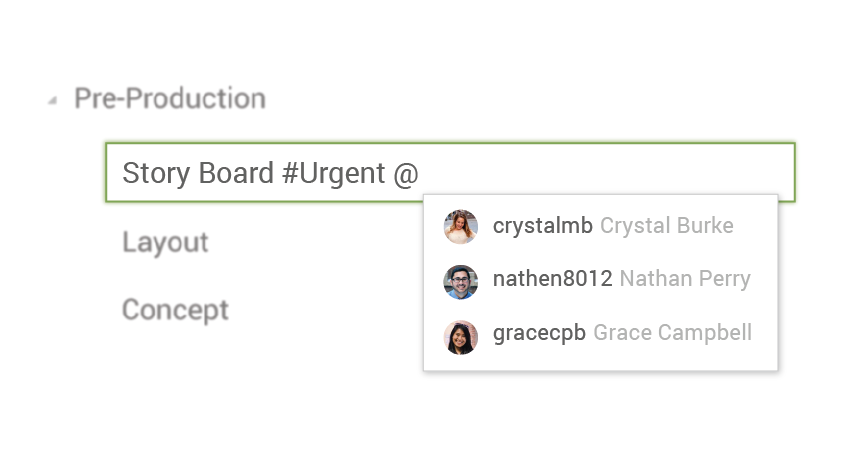
Quire's inline keyboard shortcuts let you add assignee (@), tag (#), date (<>), and priority (!) in the same line as the task name. One typing flow, no mouse, no switching. Each shortcut auto-completes as you type. Available on every plan.
Today, you're bound to have a Q-shaped smile on your face, because we've got special productivity-boosting tips for everyone, especially those who're addicted to keeping your hands on the keyboard! Now, you no longer need to switch between keyboard and mouse while adding and prepping your task. (New to Quire? Quire 101 covers the basics before you dive into shortcuts.)
So what are they? They're smart keyboard shortcuts. They can help you add assignees (with @), tags (with #), start and due dates (with <>) and priority (with !) quickly, and more naturally in a single line.
The case for keyboard-driven workflows is well-documented. Jakob Nielsen's research on expert users shows that keyboard accelerators let power users work faster than menu equivalents, and the gap widens as task volume grows. Fitts's Law explains why mechanically: moving the cursor to a menu and back costs time proportional to distance, and that cost compounds across hundreds of tasks per week.
How do you use inline shortcuts when adding a new task?
You may want to get David to write an article that’s urgent and is related to marketing by Oct. 2nd.
Simply add a task, and type “Write the article **@David !1 #Marketing <10/2>” and press Enter.
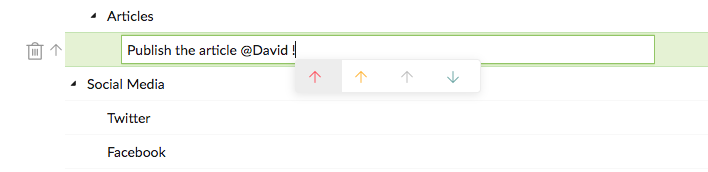
Your task would, of course, be automatically assigned to David, have a priority of Urgent, a due date of Oct. 2nd and the tag Marketing.
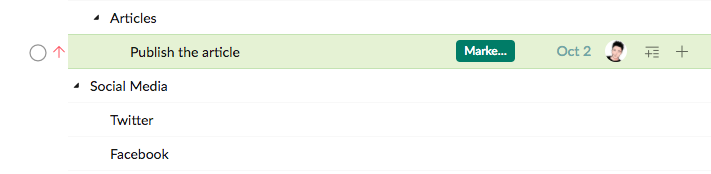
If you want to set a start date as well, simply type "Publish the article @David #Marketing <9/20; 10/2>" and press Enter.
Obviously, when you type @, # or <> (with or without ;), you can use the Up or Down arrow key to select the assignee, tag or start/due date you want.
You can see all the input date formats allowed here.
Note: Priority from high to low is !1, !2, !3 and !4.
How do inline shortcuts work when you edit a task?
You may want to add or change the assignee, tag and due date of an existing task.
It’s like what you’d do when you’re adding a new task. For example, you can type “Write the article @Kevin @Megan <+7d>” (counting from today) and press Enter.
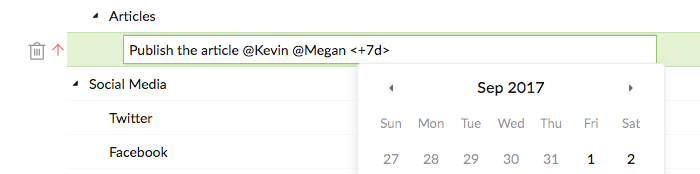
What happens is that this task would be assigned to both Kevin and Megan instead, and has a new due date of Sept. 30th. (Assigning a task to more than one person is a deliberate design choice, not a shortcut around picking one owner: here's when multiple assignees actually make sense.)
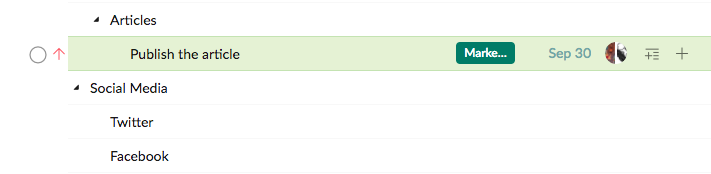
You may also want to add or remove assignees and tags from a task, without having to type them all over again.
To add one more assignee or tag to a task, type +@assignee or +#tag in the task name.
To remove an existing assignee or tag from a task, type -@assignee or -#tag instead.
How do inline shortcuts work when you search for tasks?
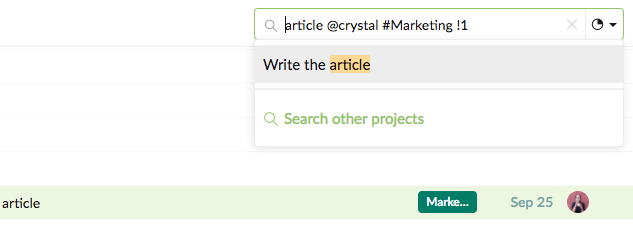
You can type keywords, assignees (with @), tags (with #) and priority (with !) to search a specific task or more.
You can also hover a task in the search results to highlight it in the tree list.
What other keyboard shortcuts make Quire faster?
There might be a couple extra useful shortcuts you're not aware of.
To add a task, you can simply press Ctrl+Enter. You can even press Tab or Shift+Tab to make it a subtask (indent) or task (unindent) while you're typing the task name. That's the same nested task structure at work, just built with keyboard shortcuts instead of drag-and-drop.
After you've added a task, you can still move it horizontally by pressing Ctrl+Left or Ctrl+Right. To move it vertically, press Ctrl+Up or Ctrl+Down.
To delete a task? Like you might have guessed, press Ctrl+Delete.
We're bringing you the smart shortcuts because it's natural that when you're adding a task, you already have an idea who should do it, what priority it should have, and when it should be done. So, instead of choosing them after you add a task, you can now do them all together with @, # and <>.
There are also a whole other shortcuts in store you can check out.
Ready to drop the mouse for task entry?
Open Quire, hit the new-task field, and try one inline shortcut on your next ten tasks. Most users settle into the pattern within an afternoon and don't go back. Inline shortcuts are free on every Quire plan. These shortcuts are just the start; see 20 Hidden Quire Features You Should Know for more you might be missing.
Frequently Asked Questions
What are Quire's inline keyboard shortcuts for task fields?
Four shortcuts live inside the task name field: @ for assignee, # for tag, <> for date, and ! for priority. Chain them in one line to set everything at once.
Why do inline shortcuts matter for productivity?
Switching between keyboard and mouse breaks your focus. Inline shortcuts skip that round trip so the task is fully set up before you hit Enter.
Do the inline shortcuts work everywhere in Quire?
@, #, and <> work when adding or editing a task, and ! works when adding one. # and @ also work in global search.
What are the priority shortcut levels in Quire?
!1 is urgent, !2 is high, !3 is medium, and !4 is low, so you can set priority in two keystrokes.
Are inline shortcuts available on all Quire plans?
Yes. They're part of every Quire plan, including the free plan, so every team member can use them from day one.