project management · Aug 25, 2026
Will AI Replace Project Managers? A Job-by-Task Answer

Last updated: September 3, 2026
Will AI replace project managers? No, but it will replace parts of the job. AI already does the low-judgment coordination work, status, triage, meeting notes, dependency checks, and it's good at it. The judgment work, priorities, negotiation, scope, accountability, stays human. The job doesn't disappear; it gets denser, and the PMs who win are the ones who learn to run the agents.
- Will AI replace project managers? The short answer
- Which project management tasks can AI actually do?
- What does the coordination handoff look like in practice?
- Will AI replace project managers on the tasks that need judgment?
- What does the replacement fear get right?
- What does "PM plus agents" actually look like?
- How do you become the PM who runs the agents?
- Key takeaways
- Frequently Asked Questions
The question shows up in every project manager's group chat eventually, usually phrased with a nervous laugh. Someone saw a demo where an AI ran a whole sprint, and now they're wondering if the title on their business card has an expiry date.
It's a fair worry and it deserves a straight answer, not a motivational poster. So here it is, and then the reasoning behind it: the role is safe, but the job description is being rewritten in real time, and pretending otherwise helps no one.
The useful way to answer "will AI replace project managers" isn't to argue about the role in the abstract. It's to break the job into its actual tasks and ask which ones a machine can do in 2026 and which ones it can't.
That's the whole post: a task-by-task audit, with the work shown running inside a real project. No hype, no doom.
Will AI replace project managers? The short answer
Will AI replace project managers? No. AI is absorbing the coordination half of the job, which is status reporting, triage and chasing updates, while the judgment half, which is priorities, negotiation and accountability for the outcome, stays with a person.
That distinction matters more than the headline. "Will AI replace project managers" is really two questions wearing one coat. Will it absorb some tasks? Obviously, and it already has.
Will it own the outcome of a project, answer to a stakeholder, or decide what to cut when everything's on fire? Not remotely close.
Microsoft's 2025 Work Trend Index found that 82% of leaders expect digital labor to expand what their workforce can take on within roughly a year and a half. Read that carefully: expand capacity, not replace people.
The pattern leaders are actually betting on is augmentation, giving each person more reach, not a smaller org chart.
Which project management tasks can AI actually do?
Here's the honest audit. Twelve real tasks that fill a PM's week, split by who does each one in 2026.
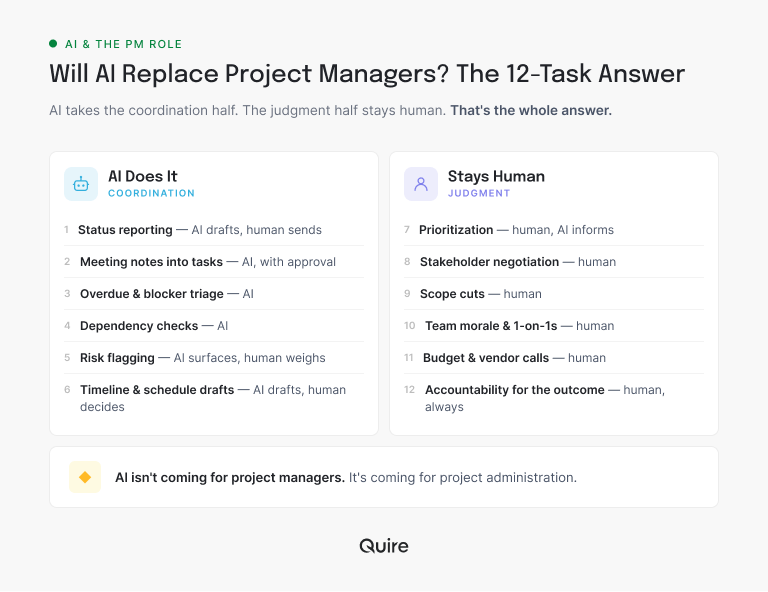
Count the rows. Six tasks the AI can carry today, six it can't, and the six it can't are the ones that were always the actual job.
What unites the left column is that every item is a reading, sorting, or rephrasing job. The data already exists somewhere in your project. Nobody has to make a call to produce the answer, they just have to go and look, and going to look is exactly what software is for.
What unites the right column is that each one turns on something the project data does not contain. A stakeholder's mood. A budget conversation from last quarter. Which fire will spread if you leave it.
For the wider view of where this is heading, see the complete AI project management guide.
What does the coordination handoff look like in practice?
It looks like the agent reading your live project and drafting the answer, while you keep the send button. The catch is that this only works when the agent can see real tasks. An assistant working from a pasted summary is guessing, and a guessing agent is worse than no agent.
That's the whole reason MCP matters. Quire runs an MCP server, so you connect Claude to your workspace once and the agent works against the actual task tree: projects, nested subtasks, assignees, due dates, custom fields, comments.
| The coordination job | What the agent does with live project data | What you still decide | Where it starts in Quire |
|---|---|---|---|
| Weekly status | Reads the task tree and lists what moved, what slipped, and by how many days | Which slip the exec hears about first, and how you frame it | Ask for the state of one project since Friday |
| Meeting notes into tasks | Writes each decision out as a task, named owner, dated | Whether that owner actually agreed to it in the room | Paste the notes and name the project |
| Overdue triage | Sorts what's past due by how much it blocks work downstream | Which ones you chase and which you quietly re-date | Ask what's overdue and what it blocks |
| Dependency and date check | Walks the tree and flags dates that can't both be true | Which date moves, and who finds out before the client does | Ask whether the current dates still hold |
| Risk flagging | Surfaces tasks that stalled or lost their owner | Whether that's a real risk or just a quiet week | Ask what hasn't moved in ten days |
Read the middle column again. Not one of those decisions leaves the person.
A real Friday, before and after
Take a status report on the Website Redesign project. The old version: you message six people for updates, paste their replies into a template, reformat it for the exec who likes bullet points, and send it at 4:45 with a sigh. Ninety minutes.
The agent version: you ask for the state of the project. It walks the tree, and comes back with the thing you'd have found by hand.
Migrate blog templates, owned by Lena, due Thursday, three of seven subtasks closed, Stage still sitting on "In review". Two items downstream of it inherit that date. Nothing has moved on it since the 19th.
Then you do the part that is actually yours. You know Lena was out sick Tuesday, so the slip isn't a performance problem and shouldn't read like one. You add that sentence, cut a paragraph the exec won't care about, and send it in ten minutes.
Same report, same accuracy, eighty minutes back, and every judgment call still made by you. That's the trade, and it's a good one.
The receipts, with timings from our own week: 5 project management workflows that changed the day we got an MCP server.
Trying this costs an afternoon, not a migration. Put one live project in Quire, connect Claude, and ask which tasks are past due. If the answer matches your own read of the board, you have found your first handoff.

Will AI replace project managers on the tasks that need judgment?
No, and it's worth being specific about why rather than waving at "the human touch".
Prioritization looks like a data problem until you've done it. The real inputs are a CEO's offhand comment, a client's mood, a rumor about a competitor, and a gut read on which fire will spread. An agent sees the tasks. It does not sit in the rooms where priority is actually set.
Negotiation and scope cuts are pure judgment plus relationships. Telling a stakeholder they can't have the feature by Friday is a conversation with history and trust in it. An agent that "optimized" that call on metrics alone would be correct on paper and quietly damaging in practice.
And accountability cannot be delegated to software. When a project slips, a person answers for it, explains it, and decides what changes. That responsibility is the spine of the role, and no serious organization would try to hand it to a tool.
What the agent can do is make every one of those calls better informed. It arrives with the dependency map already walked and the stalled items already listed, so you spend the meeting deciding instead of assembling.
Why the coordination-versus-judgment split matters so much: the coordination tax, and why teams running several projects at once pay more of it than they think.
What does the replacement fear get right?
More than the reassuring version of this article usually admits. The fear isn't baseless. It's aimed at the wrong target.
Here's the uncomfortable part that's true. If your project management job is only the coordination half, if your week is status pulls, report formatting, and update chasing and very little else, then that job really is at risk.
Not because a robot fires you, but because the tasks that filled your day are the exact ones moving to agents. A role defined entirely by busywork loses its definition when the busywork leaves the building.
The honest reframe is this: AI isn't coming for project managers. It's coming for project administration.
If most of your value is administrative, treat that as an early, friendly warning to grow into the judgment work now, while there's slack to do it. If your value is already in the judgment calls, this is the best thing to happen to your calendar in years.
Either way, the response is the same, and it isn't panic. It's to move up the value chain on purpose, starting this quarter.
What does "PM plus agents" actually look like?
Picture the role a year from now for someone who leaned in. Their Monday doesn't start with two hours of collating status; it starts with reading a draft an agent produced from the live board, then spending those two hours on the launch that's wobbling.
Their meetings turn into tasks with owners attached. Their overdue list arrives sorted by what it blocks. The busywork didn't vanish into thin air; it moved to an agent they supervise, working inside the same project everyone else can see.
What they gained isn't free time in the leisure sense. It's judgment time. More conversations with the people who are stuck, more thinking about what to cut, more of the work that determines whether the project lands.
That's the shift, and it's the same one every tool-driven profession has been through. Spreadsheets didn't replace analysts; they turned analysts who mastered them into people who got promoted. Agents are doing that to project management right now.
For the fuller picture of that shift, see agentic project management and how AI agents change where coordination lives.
How do you become the PM who runs the agents?
Stop competing with the AI on coordination, because that's a race you don't want to win, and start directing it. Four moves, in order.
Audit your week. Mark every recurring task as judgment or coordination. The coordination half is your handoff list, and most PMs are surprised by how long it is.
Connect an agent to real data. Not a chatbot you paste into. Point it at the project management software your team already works in, so it reads live tasks. In Quire that's the MCP connection to Claude, and it takes about five minutes.
Hand off one reversible workflow. The weekly status is the right first one: valuable, easy to check against the board, and harmless if the first draft is wrong.
Learn to review, not redo. When the agent gets something wrong, fix the prompt instead of quietly redoing the work by hand. Reviewing well is the new core skill, and redoing is the habit that eats the time you just saved.
The PMs who do this won't be replaced by AI. They'll be the ones the less-prepared PMs get replaced by.
Working out which agent-ready tool to run this in? Start with the best task management software and task trackers.

Key takeaways
Will AI replace project managers? No, but it's already replaced parts of the job, and it will replace more. The coordination work is going to agents, and that's a gift, because it was never the part that needed a human.
The judgment, negotiation, and accountability that define the role are staying put. So is the send button.
The only version of this that ends badly for a PM is the one where they treat AI as a competitor instead of a team to run. Learn to direct the agents, keep the judgment calls, and the job gets better.
Ignore them, and someone who didn't will be sending the status you used to send. The choice isn't whether AI enters the job; it already has. The choice is whether you're the one holding the controls.
Want to hand off the busywork this week? Start free at quire.io/signup, point Claude at one real project over MCP, and let it draft your next status. Keep the decisions. Give away the chores.
Frequently Asked Questions
Will AI replace project managers?
No. It will replace parts of the job, mainly the low-judgment coordination work like status, triage, and update chasing, but not the role. Judgment, negotiation, and accountability stay human, so the job gets denser, not smaller.
Which project management tasks can AI already do?
Status reporting, meeting notes into tasks, overdue and blocker triage, dependency checks, risk flagging, and first-draft scheduling. All reading, sorting, and drafting jobs, run from live data when your task management software is connected through MCP. The list grows the moment the model can reach the real project. Connected to Quire over MCP, an assistant can pull this week's slipped tasks or draft a status summary from live data rather than a pasted export.
Which project management tasks stay human?
Prioritization, stakeholder negotiation, scope cuts, morale and one-on-ones, budget and vendor calls, and accountability for outcomes. AI can prep the data; the decision and the responsibility stay with the PM.
What will the PM job look like in five years?
Denser and more human. With coordination handed to agents, the role tilts toward judgment: priorities, stakeholders, and steering when things go sideways. The PMs who thrive will direct agents well.
How should project managers prepare for AI?
Learn to run agents instead of fearing them. Connect one to your real project data, hand it a reversible workflow like the weekly status, and build from there. The skill that matters is directing and reviewing AI work.
Does using AI make project managers more productive at work?
Yes. PMs get more productive at work when agents absorb the status pulls and update chases, freeing time for stakeholder and priority work. In Quire, an MCP-connected agent reads the live task tree instead of a pasted summary.