features · Mar 14, 2023
Introducing Single Sign-On: Securely Authenticate Your Workspace
Last updated: September 30, 2026
Single Sign-On (SSO) in Quire lets your team log in with their corporate identity provider (Okta, Microsoft Azure AD, Google Workspace, OneLogin, etc.) through SAML 2.0. One credential set, central IT control, no Quire-specific password to remember or rotate. Available on the Enterprise subscription plan.
We've all been there: having to remember too many passwords. Is there a mechanism that allows you to have only one set of credentials and use it to access any application that you need? Good news, yes, there's a type of authentication called Single Sign-on (SSO) that has been increasingly popular and become the solution for internet security.
The security case has been made for years by authorities in the space. The US National Institute of Standards and Technology's Digital Identity Guidelines (SP 800-63) treats federated identity (the technical name for SSO) as the recommended pattern for enterprise authentication.
According to Verizon's annual Data Breach Investigations Report, stolen and weak passwords are still among the most common ways attackers get in, which is the exact risk SSO takes off the table.
Quire's SAML 2.0 implementation is built against the same OASIS SAML standards the rest of the enterprise SSO ecosystem speaks.
SSO is one layer of account security. See how Quire's ISO certification covers the rest of our data protection commitments.
Why does your organization need SSO?
One of the most significant benefits of SSO is that it reduces the number of passwords that users have to remember. It eliminates the need for users to keep track of multiple usernames and passwords for different applications, making it more convenient and secure.
Also, SSO enables its users to securely authenticate by logging in with only one set of credentials. With SSO, Quire users will be logging in to Quire with a trusted SSO provider (Identity Provider) to verify the credentials of the users. Once the credential is authenticated, the user does not need to re-enter his credentials for subsequent applications.
Another advantage of SSO is that it improves security. With SSO, users only need to authenticate once to access multiple applications. This reduces the risk of password fatigue, where users tend to use the same password for multiple applications, making it easier for hackers to gain access to sensitive information.
Single Sign-On is exclusively made for Enterprise subscription plan. More information can be found on our Pricing page.
What do you need to enable SSO for Quire?
If you want to enable the SSO for your Quire organization, you have to make sure that you are the Organization Admin first, the top of Quire's permissions and roles hierarchy. In the Organization Settings, you can choose to enable the SSO for all of the members or keep an option for them to use the passwords that they’ve set for Quire.
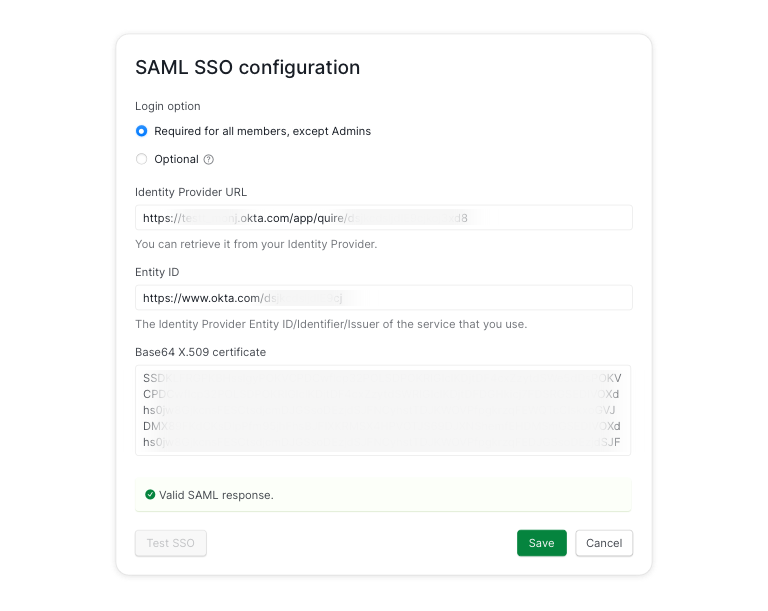
If you are the Organization Admin, you will always login to Quire using passwords instead of SSO.
After successfully configuring the Identity Provider (IdP) by following the steps, you can start using SSO. You can always disable the SSO option at any time if needed.
We recommend you should test different use cases and ask the organization users to test immediately after the SSO is enabled for your Quire organization. If your applications are open to consumers who can register with their emails and social IDs, we also support Microsoft AD B2C.
If you need help choosing the trusted Identity Provider, we recommend some popular ones such as Okta, Google, or Microsoft Azure Active Directory.
For a detailed guide on how to enable SSO for your organization, please visit our guide.
As SSO is becoming increasingly popular, and many organizations are adopting it to improve productivity and security, we hope using SSO with your Quire organization can simplify the login process and at the same time, add another security layer to your account.
When does SSO fit your Quire organization best?
SSO pays off most when three things are already true:
- You run an identity provider. SSO works through an IdP (Okta, Azure AD, Google Workspace at the business tier, etc.) on the Enterprise Quire plan, so the directory you already maintain becomes the front door to Quire.
- External collaborators have a path in. SSO has members authenticate through the IdP, and allowing password fallback for non-employee members keeps contractors and partners who aren't in your directory easy to invite.
- Someone can own the first setup. Configuring SAML the first time means reading the IdP's docs alongside Quire's, so budget a half-day to a day for it.
If that's your setup and you're on the Enterprise plan, enabling SSO is one of the highest-use security improvements you can make in an afternoon.

Frequently Asked Questions
What is Single Sign-On in Quire?
A federated authentication method that lets your team log in to Quire using your corporate identity provider (Okta, Azure AD, Google Workspace, etc.) through SAML 2.0, instead of a Quire-specific password.
Which Quire plan supports SSO?
The Enterprise subscription plan. Lower tiers use Quire's built-in password authentication.
Which identity providers does Quire SSO support?
Any SAML 2.0 provider, including Okta, Microsoft Azure AD, Google Workspace, OneLogin, JumpCloud, and Auth0. Microsoft Azure AD B2C is supported for consumer-facing scenarios.
How do you enable SSO for a Quire organization?
As the Organization Admin, open Organization Settings, find the SSO page, paste your IdP's SAML metadata, then test with a non-admin account. Admins retain password fallback so you can't lock yourself out.
What if the SSO provider goes down?
Quire Organization Admins always retain password login as a fallback. End users depend on SSO when enforced, so most teams configure a secondary admin account as an emergency contact.
Enterprise teams running multiple linked organizations often pair SSO with Master Organization to consolidate login and billing at the same time.
Ready to enable SSO on your Quire organization?
If your company is on the Enterprise Quire plan and uses Okta, Azure AD, Google Workspace, or another SAML 2.0 identity provider, the setup is one Organization Settings configuration away. The full Quire SSO setup guide covers the SAML configuration step by step. Pricing details are on the Quire pricing page.