project management · Oct 15, 2026
Sprint Planning Meetings That Fit the Sprint You Actually Run

Last updated: October 15, 2026
A sprint planning meeting produces three things: a sprint goal, a selection of backlog items, and a plan for the first days. It overruns when sizing sneaks in, so refine the backlog days earlier and select against last sprint's actuals. Below are the two-hour agenda, the capacity math, the pre-work checklist, and the whole ceremony run in Quire.
- What does a sprint planning meeting decide?
- Why does sprint planning always overrun?
- What agenda keeps a sprint planning meeting under two hours?
- How do you plan sprint capacity honestly?
- What pre-work makes a sprint planning meeting short?
- How do you run a sprint planning meeting in Quire?
- Does every team need the full sprint ceremony?
- Key takeaways
- Frequently asked questions
Somewhere in hour two, the team is still debating whether the login fix is a 3 or a 5. Two engineers have quietly opened their laptops. The estimate debate has now outlived several of the tasks it was estimating.
If that's your sprint planning meeting, the problem is rarely the people in the room. It's what the meeting has been asked to do.
A sprint planning meeting has one job: open the sprint with a goal, a selection, and enough of a plan to start. Everything else that has crept into the invite (sizing archaeology, backlog therapy, roadmap relitigation) belongs somewhere else on the calendar.
This post gives planning its job back: the agenda that holds, the capacity math that keeps commitments honest, the pre-work that makes it short, and the whole thing run in Quire.

What does a sprint planning meeting decide?
Three outputs: a sprint goal, a selected set of backlog items, and an initial plan for the first days of work. The goal is the one that predicts whether the sprint will go well.
A selection without a goal is a pile of tasks. When something slips mid-sprint (something always slips), only the goal tells the team what to protect and what to drop.
Sprint planning meeting: the event that opens a sprint, where the team agrees on one sprint goal and selects the backlog items it forecasts it can finish within its real capacity.
The Agile Alliance glossary splits the work the same way. The product owner proposes candidate items and a goal, and the team determines which items it takes on and the initial plan for finishing them.
Notice what neither version includes: estimating. That's not an accident, and it's the single most useful thing to internalize about this meeting. Selection assumes sizes already exist.
The other quiet word in there is forecasts. A sprint commitment is a forecast, not a blood oath, and teams that treat it as a forecast argue less and finish more.
In Quire, all three outputs land in one place. The goal names the sprint's sublist, the selection is the tasks inside it, and the first-days plan is their subtasks, owners and due dates. The sections below build each one in order.
If you'd rather watch the Quire side before reading the mechanics, this 63-minute template walkthrough covers the gallery end to end, and the clip below opens on its Agile and Scrum template chapter.
In this session32:28 Agile & Scrum template walkthrough
Why does sprint planning always overrun?
Because a sizing meeting is hiding inside it. The 3-versus-5 debate is refinement work, and refinement inside planning means the whole team sits through discussions that needed two people and a look at the code. Every backlog item that arrives unsized adds its own private meeting to yours.
The fix is structural: hold a separate refinement session mid-sprint, an hour where upcoming items get clarified and roughly sized while nobody is under commitment pressure. Planning then inherits a backlog of known quantities, and the meeting becomes what it was named for.
There's a second, sneakier overrun cause: relitigating priority. If the backlog arrives unranked, planning becomes a negotiation about importance, which is a product conversation wearing a team meeting's badge.
Ranking is the product owner's homework. The meeting's question is "how far down the list do we get," never "what order is the list in."
Put the usual overruns side by side and each one turns out to be somebody's homework, done at the wrong time:
| What eats the planning hour | Whose homework it is | When it belongs | Where it lives in Quire |
|---|---|---|---|
| The 3-versus-5 sizing debate | The two or three people who know that code | A refinement hour mid-sprint | A Story Points custom field on each backlog task |
| Arguing about what matters most | The product owner | Before planning, ranked alone | Priority on each task, so the backlog opens in order |
| Decoding a ticket filed in March | Whoever filed it | Refinement, with the ticket open | The task description and comments, so context travels with the task |
| Planning every day of week two | Nobody yet | The daily standup, once week one teaches it | Subtasks added the day they're needed |
Only the first row of a planning meeting is ever genuinely the team's. The other three are setup, paid once, somewhere quieter.
You can test the first two rows before your next planning. Copy Quire's Product Backlog template into a free project, size the top ten items in a custom field, set their priority, and watch how short selection gets.
If the roles in this section are fuzzy on your team, start one level up: what a Scrum master does and how Scrum works covers who owns what, ceremony by ceremony.
What agenda keeps a sprint planning meeting under two hours?
For a one-to-two-week sprint, the five blocks below hold. The times assume the pre-work happened; without it, no agenda survives.
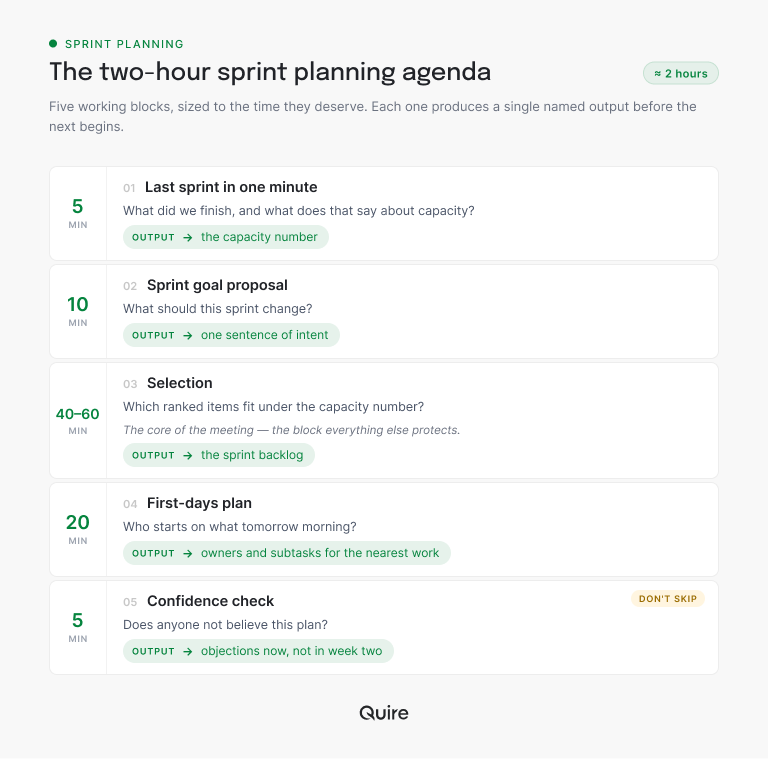
Two hours isn't a number pulled from the air. According to Wikipedia's entry on Scrum, the suggested maximum for sprint planning is two hours for each week in the sprint. Treat that as a ceiling, never a target.
The confidence check earns its five minutes. Someone always knows the plan is optimistic, and the check is the moment that knowledge is allowed to speak before it becomes a retrospective item.
One more rule keeps the agenda honest: plan the first days, not the whole sprint. Breaking every item into day-level detail is planning fiction, because the second week's detail gets rewritten by the first week's reality anyway.
Run the meeting with the Quire project on the shared screen and every output is recorded as it's agreed. The goal becomes the sprint sublist's name, the selection fills it, and the first-days subtasks get owners before anyone leaves the call.
The five minutes on last sprint go faster when the retro already did the reflecting: sprint retrospectives that actually change the next sprint turn the retro's one change into a task that competes for this selection.
How do you plan sprint capacity honestly?
Start from what the team finished last sprint, not from what everyone hopes. Optimism is a wonderful trait in founders and a terrible input to a commitment. Last sprint's actuals already price in your real meeting load, your real interruption rate, and your real Thursday afternoons.
The research on this is blunt. In a study by Roger Buehler, Dale Griffin and Michael Ross, published in the Journal of Personality and Social Psychology, students predicted their theses would take 33.9 days. They took 55.5, and only about 30% finished by their own best guess.
The same paper explains why. People build a forecast from the scenario they imagine for this task and quietly ignore how the last one went. The bias disappeared when participants were asked to connect relevant past experience to their prediction, which is exactly what reading last sprint's actuals does.
Then subtract what you know about the coming sprint: planned time off, a conference, the support rotation, the onboarding buddy duty. What's left is the number the selection has to respect. If the goal needs more than the number allows, shrink the goal now, in the meeting, while it's cheap.
In Quire, last sprint's actuals are already sitting in last sprint's sublist. Count what reached Done and you have the number. The Dashboard view's Tasks Created vs. Completed widget charts the same pace week by week, so the trend is on screen before anyone argues about it.
Dashboard View requires Professional or higher.
Capacity also isn't evenly distributed across people, and pretending otherwise is how the same two names end up on every critical item. The Member Workload widget gives every teammate a health badge next to what's open, done and late, so the imbalance is visible before the selection bakes it in.
That pattern has its own fix: the workload math post covers seeing and rebalancing per-person load before the sprint locks it in.
What pre-work makes a sprint planning meeting short?
Three inputs, prepared before anyone books a room. Each one you skip gets paid for at roughly triple price inside the meeting.
A refined, sized backlog. The refinement session does this. Items arrive understood and roughly sized, with the size in a custom field such as Story Points, so it's on the card when selection starts.
A ranked order. The product owner sets priority on the candidates beforehand, so the backlog opens already in order and selection walks down a list instead of debating one.
A proposed goal. Drafted before the meeting, challenged inside it. Proposing a goal live is asking a room to write a sentence by committee, and rooms write sentences the way they design horses.
Quire's Product Backlog template is built around exactly this pre-work. It ranks every request from raw idea to sprint-ready, so the planning meeting only ever looks at the last stage.
A backlog of one-line titles makes all three inputs harder: how to make your Product Backlog speak the whole story shows what a refinable item looks like.
Daily standups feed this loop more than teams notice. A standup that surfaces blockers keeps refinement honest about what "done last sprint" really meant.
If your standups have drifted into status karaoke, the daily standup template rebuilds them into the fifteen minutes they were meant to be.
How do you run a sprint planning meeting in Quire?
Make the project the backlog, a sublist the sprint, and Board view the sprint in motion. Quire's Agile Project template ships that structure ready to copy, with a sublist per sprint plus Daily Standup and Sprint Retrospective sublists alongside.
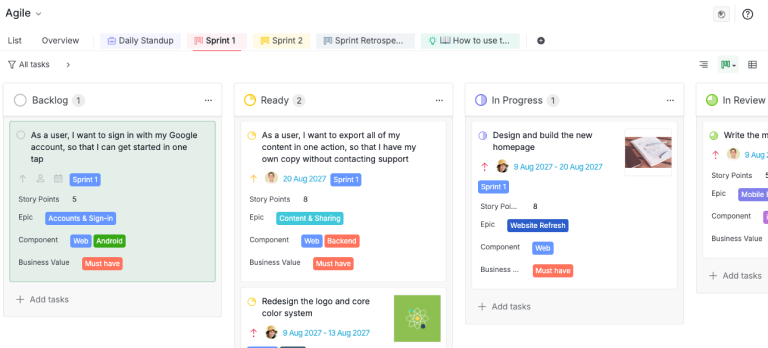
Here's one backlog item going through the meeting. The team is planning Sprint 24, and the product owner has proposed the goal "checkout works on phones."
- Selection. The task "Let shoppers pay with a saved card" already carries Story Points 5 and a High priority from refinement. It goes into the sublist named "Sprint 24: checkout works on phones."
- Owner. Linh is set as the assignee, because Linh touched the payment code last.
- First days. Two subtasks get added: "Add the saved-card picker" for Linh, due Wednesday, and "Write declined-card test cases" for Omar, due Thursday.
- During the sprint. The sublist switches to Board view, and the card moves from Ready to In Progress to In Review as the work does.
When the meeting ends, that's the sprint backlog, owned and dated, with no transcription step. The board everyone opens on the first afternoon reads the same tasks the meeting just chose.
The Dashboard view carries the sprint's progress picture from there. Task Status Distribution shows how much is still in progress, and Blocked Tasks lists anything waiting on a predecessor, which is the daily standup's agenda written for you.
Want to try the mapping this week? Copy the Agile Project template and swap in your own backlog. The Agile Scrum guide walks through the setup step by step, and your next planning meeting can end with the sprint already on the board.
Does every team need the full sprint ceremony?
No, and pretending otherwise wastes real hours. The full agenda earns its keep when a team commits to a fixed-length sprint with a shared goal.
Teams doing continuous, arrival-driven work (support queues, ops, a steady stream of small requests) often do better with a flow model: a ranked queue, work-in-progress limits, and no sprint boundary at all. In Quire, that's the same project in Board view with no sprint sublist in front of it.
That flow model is its own discipline: Kanban principles covers running work by flow instead of by timebox.
The async variant sits between the two. Distributed teams can run selection asynchronously: the goal and ranked candidates go out in the project itself, people raise concerns in each task's comments, and a 30-minute call resolves only the flagged items. The three outputs stay the same; only the room disappears.
Key takeaways
A sprint planning meeting that hurts is usually doing three meetings' work: refinement that belonged mid-sprint, ranking that belonged to the product owner, and planning, the only part it was named for.
Separate those, read capacity from last sprint's actuals, and open with a proposed goal, and the two-hour agenda stops being aspirational. The confidence check at the end catches the optimism the room already knows about.
The tooling's job is to make the plan and the tracking the same object. Run the backlog, the sprint sublist, and the board in one place, and planning ends with the sprint already moving.
Sign up for Quire, copy the Agile Project template, and let your next planning meeting end at the two-hour mark with nothing left to transcribe.
Frequently asked questions
What is a sprint planning meeting?
The event that opens a sprint: the team commits to a goal, selects backlog items against real capacity, and sketches the first days. Three outputs, and the goal is the one that predicts the sprint.
How long should a sprint planning meeting take?
A common ceiling is two hours per sprint week, so about two hours for a one-week sprint and four for two weeks. Consistently hitting the ceiling means refinement is happening inside planning; move it to its own session.
What should be decided before sprint planning starts?
Items sized and understood, the backlog ranked, capacity known from last sprint's actuals, and a draft goal in the product owner's pocket. Then planning is selection, not archaeology.
What is a sprint goal, and do we need one?
One sentence describing what the sprint should change. It's what tells the team what to protect when something slips, and something always slips.
How do you run a sprint planning meeting in Quire?
The project is the ranked backlog, a sublist is the sprint, and Board view runs it. Priorities and a Story Points field carry ranking and size, and subtasks with owners and due dates are the first-days plan. The Agile Project template ships the whole structure.
How do teams stay productive at work during sprint planning weeks?
Keep planning short and self-serve: pre-work done, capacity from actuals, and the plan recorded where the work lives. In Quire the sublist and its board are the plan, so tracking starts when the meeting ends.