project management · Sep 17, 2026
Sprint Retrospectives That Actually Change the Next Sprint
Last updated: September 17, 2026
A sprint retrospective decays when its output is a list of feelings nobody owns. The fix is almost never a new format. Produce exactly one change, give it a name and a date, put it in the next sprint as real work, and open the following retro by saying out loud whether it happened.
- What is a sprint retrospective actually for?
- Why does the retrospective stop working after a few months?
- Will changing the retrospective format fix it?
- What does a retrospective have to produce to be worth the hour?
- What single habit repairs a dead retrospective?
- What is inside Quire's Sprint Retrospective template?
- How do you keep a retrospective action alive in Quire?
- When should you skip a retrospective?
- Key takeaways
- Frequently Asked Questions
There is a specific moment when a team stops believing in its retrospective. Someone raises a problem they raised two sprints ago, the room nods in recognition, and everyone privately notes that nothing happened last time either. Nobody says it. Attendance just gets softer from then on.
That moment is usually diagnosed as a facilitation problem, which is why the internet is full of retro formats. Sailboat. Starfish. Mad, sad, glad. Teams rotate through them looking for the one that will make the meeting feel alive again, and the new format works for about two sessions.
The sprint retrospective is not failing because the questions are stale. It is failing because nothing that comes out of it turns into work. This is about fixing that: what a retro has to produce, why format-shopping is a symptom, and how to make the output land in the next sprint instead of a document.
What is a sprint retrospective actually for?
Sprint retrospective: a meeting that exists to produce a change rather than a conversation. It is not finished until there is one thing that will be different next sprint, a named person responsible for it, and a date when someone will say out loud whether it happened.
That is not an opinion invented for this post. The Scrum Guide, by Ken Schwaber and Jeff Sutherland, says the most impactful improvements are addressed as soon as possible and may even be "added to the Sprint Backlog for the next Sprint". The official definition already treats the output as work items. Most teams treat it as minutes.
That gap is the whole problem. A retro produces a shared understanding, which feels valuable in the room and evaporates within a week, because shared understanding has no owner, no date and no place in the backlog where it would be noticed if it failed to happen.
The structured reflection itself does real work, and it is measurable. In a randomized trial published in BMJ Simulation and Technology Enhanced Learning, Kündig and colleagues found that teams who ran a guided reflection between two attempts at the same task improved by 16.8 percentage points, against 8.6 for teams who simply did it twice.
Roughly double the gain, from the same amount of practice. That is the upside a retro is reaching for, and it is also why a retro that changes nothing is worse than it looks: the team paid for the reflection and kept none of the return.
Why does the retrospective stop working after a few months?
Because people learn from evidence, and the evidence says raising problems does not pay.
Follow one comment through two sprints. Someone points out that code review is where everything stalls. The team agrees. It goes into the notes as "improve review turnaround." Nobody owns it, so nothing changes, so next sprint review is still where everything stalls. The second time it comes up, half the room already knows how this ends.
What decays first is not attendance, it is candor. People keep showing up and start saying safer things, because a real complaint costs social capital and returns nothing. By the time someone suggests skipping the retro to save an hour, the meeting has been empty for a while.
Notice that no format would have caught this. The retro surfaced the right problem on the first try. It just had nowhere to put it.
The same decay pattern hits the other recurring ceremony, and for a related reason: see a daily standup template that survives contact with a real team.
Will changing the retrospective format fix it?
Only if the retro is failing to surface real problems. Formats are not useless; they are the answer to a different question.
A format helps when people are vague, when only the loudest person talks, or when nobody wants to name the thing everyone is thinking. A structure that makes people write before they speak, or that separates observations from blame, genuinely fixes that.
A format does nothing when the team is already naming the right problems and none of them turn into work. If your retros produce accurate, specific, uncomfortable observations and the sprint still looks the same afterwards, switching from starfish to sailboat rearranges a conversation that was already working.
The diagnostic takes ten seconds. Ask whether your last three retros identified real problems. If yes, the fault is downstream of the meeting, and no format will reach it.
Most retro complaints get misdiagnosed in the same direction, toward the meeting and away from what follows it:
| Symptom | Usual diagnosis | What is actually wrong | What fixes it |
|---|---|---|---|
| The retro feels flat | The format is stale | Nothing from it has ever shipped | Open with last time's action item |
| The same problem keeps returning | Weak facilitation | It was never given an owner | One name against one change |
| People say safe things | A psychological safety problem | Candor stopped paying | Make one fix visible to everyone |
| The action list runs to six items | The team is ambitious | None of the six is anyone's job | Cap the output at one |
Every row on the right is cheap. Every row in the middle column is the expensive fix teams reach for first.
What does a retrospective have to produce to be worth the hour?
Three specific artifacts, and the meeting is not over until they exist. Not a document.
One change. Singular on purpose. A list of six improvements is a comfortable way of committing to nothing, because no individual item on it is anyone's problem. Pick the one thing the team has the most control over and let the rest go; they will come back if they matter.
One owner. A name, not a team. "We will improve handoffs" belongs to nobody and will be nobody's fault. The owner does not have to do all the work, but somebody has to be the person the checkpoint asks.
One checkpoint. A date when someone will say out loud whether it happened. Without this, the first two quietly stop mattering, because an owner with no deadline is a volunteer with good intentions.
Those three map onto one object, which is why the fix is usually mechanical rather than cultural. The change is a task title, the owner is its assignee, and the checkpoint is its due date. Written that way it shows up in the sprint alongside everything else.
Where you put that change decides whether it survives the week.
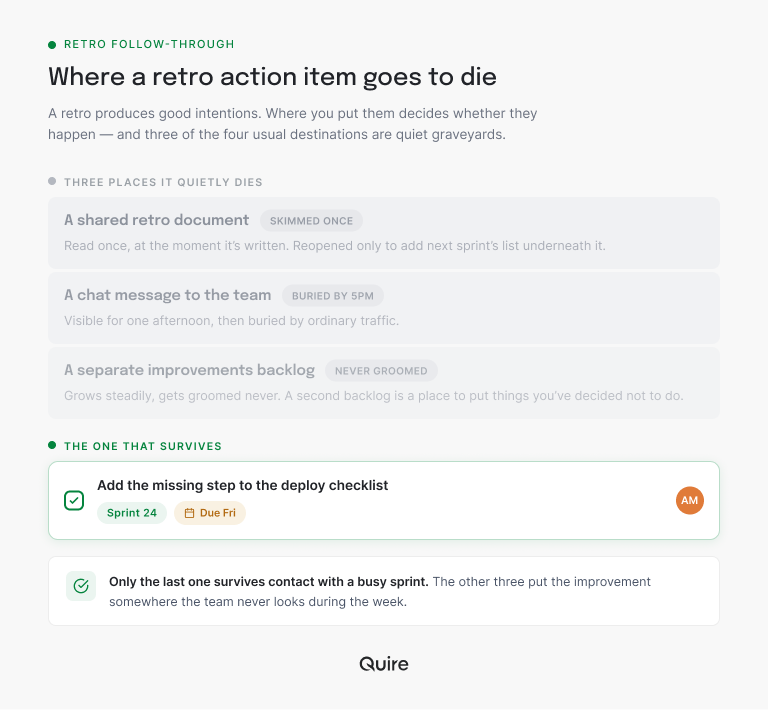
Only the last one survives contact with a busy sprint, and the reason is not motivation. It is that the other three put the improvement somewhere the team does not look between retros.
What single habit repairs a dead retrospective?
Open the retrospective with last time's action item.
Not as a formality. Put the task on screen, say whether it is done, and if it is not, say why in one sentence. Thirty seconds, before anyone collects a single new observation.
This does more work than it looks like. It tells everyone that last session had consequences, which is the only argument for being candid in this one. It makes a quietly abandoned change impossible to abandon quietly.
And it caps the team's own ambition honestly. After two sprints of watching one item at a time land, nobody proposes six.
Teams that adopt only this and change nothing else usually report the retro feeling different within a month. It is the cheapest available fix and almost nobody does it, because it is mildly uncomfortable and no format tells you to.
You can test it this week without changing anything else. Take the one thing your last retro decided and never did, put it in a free Quire project as a task with a name and a Friday on it, and read that task out first next time.
What is inside Quire's Sprint Retrospective template?
A retro board where the follow-through is structural rather than remembered. Copy Quire's Sprint Retrospective template and swap the sample data for yours, instead of assembling the board from scratch.
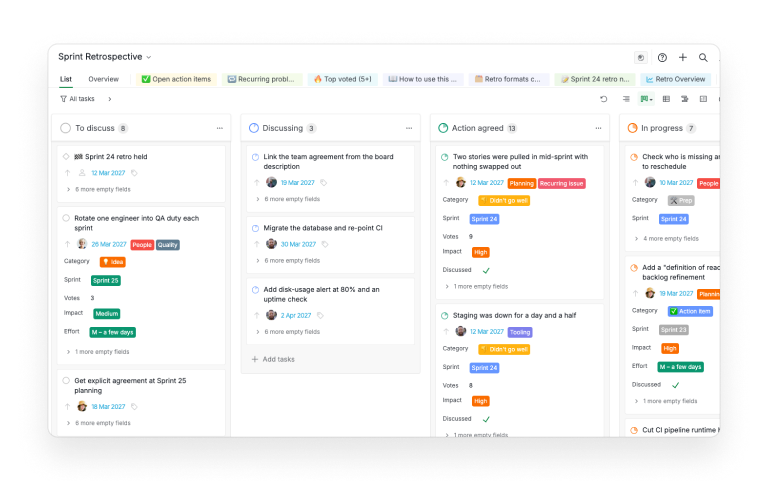
Four things in it earn their place:
- Four columns that track a decision, not a status. To discuss, Discussing, Action agreed, In progress. A card only reaches Action agreed once somebody has agreed to do it, which makes the count of undecided items visible during the meeting.
- A voted agenda. Each card carries a Votes count, so the order comes from the team rather than from whoever spoke first.
- Category, Sprint, Impact and Effort as fields. Order the list by impact with the cost visible next to it, and tag each item as a recurring issue, a tooling problem, a planning miss or an idea.
- Sublists that cut across the board. Open action items, Top voted, Recurring problems and a per-sprint retro note. The first one is the important one.
That Open action items sublist is the habit from the previous section, made structural. Last sprint's unfinished change is already on this sprint's agenda without anybody having to remember it, which is exactly the step teams skip.
The voting and the carry-over sublists are written up step by step in the Sprint Retrospective guide, and the template sits alongside 30-odd others in the roundup of project management templates your team will actually use.
How do you keep a retrospective action alive in Quire?
Make it an ordinary task in the next sprint, not an entry in the retro notes. An assignee, a due date, and a short description of the problem it is meant to fix. That is the whole trick.
It is not in a document. It is in the list the team already opens every morning, so it competes for attention with everything else rather than sitting in a quieter place where it loses by default.
Make the retro itself a recurring task too, so the session shows up on its own cadence and stops depending on somebody remembering to schedule it.
Two small things make the loop hold. Tag the retro actions so you can pull up every one from the last quarter in a few seconds, which turns "are we actually improving" from a feeling into a list you can read.
And put the problem in the task description rather than just the fix, so whoever picks it up two weeks later knows what it was for.
After a quarter of this, filter by that tag and read the list in one go. Teams are usually surprised in both directions, by how much shipped and by which problem kept coming back.
To pair the retro's qualitative read with numbers, see how to track key kanban metrics.
When should you skip a retrospective?
Rarely, and almost never for the reason people give.
"We are too busy this sprint" is the strongest possible argument for holding it. A team under pressure is a team accumulating exactly the friction the retro exists to find, and skipping it during the crunch means the lesson gets collected only after the damage.
There are two honest reasons to skip:
- The sprint was genuinely uneventful and the team has nothing to raise. Run five minutes on last time's action item and give the hour back.
- The team is in the middle of an incident, where a retro would compete with the actual fix. Hold it once things are stable, while the details are still fresh.
What is not a good reason is that the last few felt pointless. That is a signal to fix the follow-through, not to remove the only scheduled moment where the team is allowed to say what is not working.
For the wider set of habits this sits inside, read ten tips for becoming a high performing agile team.
Key takeaways
A sprint retrospective is worth an hour when it produces one change, one owner and one checkpoint. It is worth nothing when it produces a document.
The difference is not the format, the facilitator or the mood in the room. Teams stop being honest in retros because honesty stopped producing results, and that is a follow-through failure wearing a facilitation-shaped disguise.
So make the output real work. Put the single change in the next sprint with a name and a date, tag it so you can look back across a quarter, and open every session by saying whether last time's item actually happened.
That last habit costs thirty seconds. Quire's Sprint Retrospective template does it for you with a carry-over sublist, and a free Quire project is enough to try the loop on a single action item this week.

Frequently Asked Questions
What is a sprint retrospective for?
To produce a change, not a discussion. The Scrum Guide says the most impactful improvements are addressed as soon as possible and may even be added to the Sprint Backlog for the next Sprint, so the output is meant to be work. A retro ending with a shared feeling and no owner skipped the step that made it worth the hour.
Why do retrospectives stop working after a few months?
Because nothing from them visibly changes. People raise a problem twice, watch it survive both times, and conclude that raising it is unpaid work. Candor decays before attendance does. It is almost never the format; it is action items never becoming real work with a name and a date.
How many action items should a retrospective produce?
One you will actually do, not five you will not. A single change with a named owner and a checkpoint beats six improvements pasted into a document. The number teams get wrong is usually too many, because a long list is a comfortable way of committing to nothing.
Should you change the retrospective format?
Only if the current one is failing to surface real problems. Flat retros are far more often a follow-through problem than a facilitation problem. If your last three retros named real issues and nothing changed, the fault is downstream of the meeting and no format will reach it.
Should the whole team attend the retrospective?
The people who do the work, yes, because the value comes from those closest to where things broke. Be more careful about who else joins: a skip-level manager in the room changes what people will say, which turns off the honest half of the meeting.
Is there a sprint retrospective template worth starting from?
Quire ships one, and the part worth copying is the Open action items sublist, which pulls last sprint's unfinished change onto this sprint's agenda on its own. The voted agenda and the impact and effort fields handle the ordering argument.
Do sprint retrospectives make a team more productive at work?
Only the ones that ship a change. One real improvement per sprint compounds across a quarter; a document does nothing. Teams are more productive at work when last time's fix is already in this sprint with an owner. In Quire that action is an ordinary task, owned by one person and dated like any other.