project management · Jul 16, 2026
A Daily Standup Template That Survives Contact With a Real Team

Last updated: September 17, 2026
A daily standup is fifteen minutes, maximum, and its audience is your team, not your manager. Walk the board task by task instead of going person by person, hold each update to three lines (what moved, what's at risk, where you need a hand), and park blockers for the two people they involve. Distributed team? Go async: three written lines a day, posted on the tasks themselves. Both templates, live and written, are below.
- What is a daily standup?
- Why do daily standups turn into 25-minute status meetings?
- What does the daily standup meeting template look like?
- What three questions should every standup answer?
- Should your daily standup be live or async?
- What does the async standup template look like?
- How do you run a daily standup without it drifting?
- What does a good async standup update look like?
- What are the most common standup mistakes?
- Key takeaways
- Frequently asked questions
Nine forty-five on a Tuesday. The standup is eight minutes in and exactly one person has spoken. He's walking the whole team through a caching bug in real time, screen-share and all, while everyone else sits on mute, nodding at a rectangle and editing the update they'll give whenever this ends. Nobody's listening. Everyone's waiting for a turn.
Somewhere back around week six, this quietly stopped being a standup, and no daily standup meeting template survives that on willpower alone. It had become a small daily meeting where people perform progress for whoever outranks them, while the real coordination moved to DMs afterward.
Nobody drifted there on purpose. The default format practically invites it, so a better format fixes more than a firmer resolution ever will. Here's one built to hold its shape, plus the async version that beats a live call the moment your team spreads across time zones.
What is a daily standup?
Daily standup: a short team check-in, fifteen minutes or less, where everyone shares what moved, what's next, and what's in the way. It comes from Scrum, where it's called the Daily Scrum, but you don't need to run Scrum to run one. The audience is the team, not the manager, and the job is alignment and unblocking, full stop.
The name is a hint about the length: it was meant to be brief enough to do on your feet. (Standing is optional. Brief is not.)
The point of keeping it that tight is that a standup is a coordination ritual, not a reporting one. Fifteen people saying what they're up to, so the two who are about to collide find out before they do, and the one who's stuck gets a hand today instead of Thursday.
For where the standup sits inside the wider framework, ceremonies and roles and all: what a Scrum Master actually does, and how Scrum fits together end to end.
Why do daily standups turn into 25-minute status meetings?
They turn into status meetings because two flaws come baked into the default format, and both pull in the same direction.
The first is going person by person. The instant updates happen in a fixed rotation, each one quietly becomes a little performance aimed at the most senior person listening. People stretch thin days into something that sounds busy, they narrate routine work, and they stop talking to each other at all. Nobody chose this. The round-robin chose it for them.
The second is solving blockers on the spot. Someone names a real problem, two people start working it live, and the other seven turn into an audience for a conversation that needed a side room. Do that twice in one call and your fifteen-minute standup is a half-hour, and every calendar in the room feels it.
The real cost is the pile of meetings on top of this one. Harvard Business Review found that executives now spend an average of nearly 23 hours a week in meetings, up from under 10 in the 1960s, and a bloated standup is a daily contribution to exactly that total. The fixes for both flaws are structural, and they're in the template below.
If yours has already crossed all the way over into status-report territory, there's a braver move than patching it: why you should cancel your next meeting, and what to put in its place.
What does the daily standup meeting template look like?
Here's the agenda. It's short on purpose, because a standup you have to consult a document to run is already too complicated.
| Part | Time | What happens |
|---|---|---|
| Open | 30 sec | "Board's up, we're going task by task, blockers get parked." That's the whole opener. |
| Walk the board | 8–10 min | Move across the board task by task, not around the room person by person. Three lines per update, hard limit. |
| Park blockers | as they land | Name the blocker and who owns clearing it. No fixing it live in front of everyone. |
| Close | 60 sec | Confirm who's pairing up with whom right after, then everyone drops off. |
Ten to twelve minutes for a team under ten. Only two moves in that table are doing the real work: walking the board instead of the room, and parking blockers instead of solving them. Get those two right and the rest holds itself together.
What three questions should every standup answer?
The classic three are what did I do, what will I do, and what's blocking me. They work well enough, but notice that all three point at the person, and a format that points at the person is the first nudge back toward performed updates.
A version that points at the work instead:
- What moved toward our goal? Not "what did I do," which invites an activity log nobody needs.
- What's at risk or stuck? The blocker, framed as a shared problem rather than a personal confession.
- Where do I need a hand? A plain, out-loud invitation for someone to step in.
Same clock, completely different meeting. The first set produces people justifying their Tuesday. The second produces a team looking at one goal and clearing whatever stands between them and it.
Here's the gap made concrete. Person-pointed: "Yesterday I was in meetings, then I worked on the report, today's more of the same." Work-pointed: "The report's data section is done, the risk is the Q2 figures still sitting with finance, and I need someone to chase them if they aren't in by noon." The first tells you how a day was spent. The second hands the team something to act on.
Related: The OKR Template Your Team Won't Quietly Abandon by Q2 — for making sure "our goal" in that first question actually points at something real.
Should your daily standup be live or async?
If everyone shares a room and a clock, a live standup is tough to beat: ten fast minutes, high bandwidth, done. The case for async begins the moment your team stops sharing those two things.
An async standup trades the live call for short written updates, posted by a set time each day. No shared slot, nobody setting an alarm for someone else's 9 a.m., and everyone gets a beat to think before they write.
You also end the week with a readable record of it, which no one has ever reconstructed from memory of a call. What you give up is the instant back-and-forth, so async needs one clear rule for flagging the blockers that genuinely need a conversation.
| Live standup | Async standup | |
|---|---|---|
| Best for | One room, one time zone | Distributed or cross-timezone teams |
| Cadence | One fixed 10–15 min slot | Written by a set time, read when you land |
| Bandwidth | High, quick back-and-forth | Lower, so it needs one escalation rule |
| You end up with | Fast unblocking in the moment | A scannable written record of the week |
| Where updates live | The board you walk together | Comments on the task cards themselves |
The usual objection is that async drops the human moment, and that's half right. So don't ask the standup to carry your team's whole social life. Keep one live ritual a week, a demo or a planning call, and let the daily coordination happen in writing. Connection and coordination are two different jobs, and a meeting trying to do both at once tends to do neither well.
The standup is the gentlest place to start working this way, since it's small and it repeats: asynchronous collaboration for distributed teams, and how to tell which mode a given piece of work actually wants.
What does the async standup template look like?
Each person posts three lines by a set time, say 10:00 in their own local morning. Moved, next, blocked. That's the entire format.
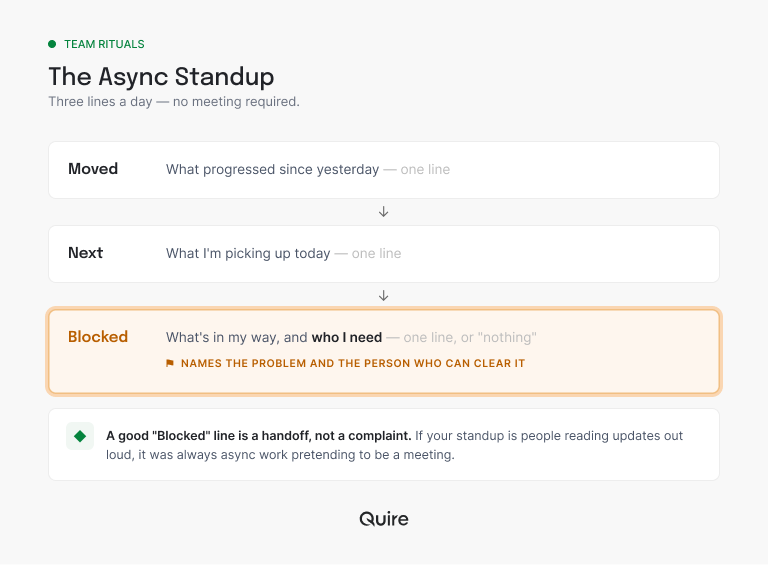
The first line keeps progress visible without anyone having to ask for it. The second surfaces overlaps before two people quietly build the same thing.
The third line does most of the real work, because it forces a name: not "a bit stuck," but what's in the way and who can clear it.
A blocked line is a handoff, not a complaint, and writing it down is what turns the vague worry in your head into something a teammate can pick up in ten seconds.
The same written-update habit scales one level up, to the people who used to demand a meeting for it: stakeholder updates without the status meeting, where a short written cadence retires a recurring call.
How do you run a daily standup without it drifting?
You keep it from drifting by anchoring it to the work instead of to a calendar habit that slowly rots. Habits decay; a task with an owner and a date doesn't.
In Quire, the setup is small. Make the standup itself a recurring task, so it shows up every morning without anyone rescheduling it, and the thing you actually walk is your Kanban board.
Walking the board becomes literal: you move column by column, and the board is already current, because it's the same place the work lives the rest of the day.
Async teams leave their three lines as comments on the task cards themselves, so each update attaches to the work it's about rather than scrolling away in a chat feed no one reopens.
And a parked blocker turns into a real task with an owner and a due date, instead of a spoken promise no one remembers by the afternoon.
The quiet payoff: a manager who wants status just reads the board. There's no separate reporting step to maintain, and removing that step is precisely what lets the standup keep being a standup.
Want the build instead of the theory? Quire's daily standup guide walks through the recurring task and its three subtasks, the parking lot where blockers land, and the sublists that let you read back every standup you've run. There's a ready-made project you can duplicate, so nobody spends Monday morning creating statuses.
The standup template sits in a wider library: see 20+ project management templates your team will actually use for the full list, and the project plan template for the plan a standup is there to keep honest.

What does a good async standup update look like?
Here's one from a mobile developer on a distributed team, posted at 8:58 on a Thursday:
Moved: push-notification opt-in flow is code-complete and in review.
Next: wiring the settings screen to the new preferences endpoint.
Blocked: need a signed test build from Tomas before I can verify opt-in on a real device, ideally by end of day.
Ten seconds to read, and look at what the last line pulled off. It didn't say "kind of blocked on the build." It named the thing (a signed test build), the person (Tomas), and the deadline it threatens (verifying today). Tomas reads it at his own 9:10, kicks off the build, pastes the link onto the task, and the blocker is dead before a live standup three hours later would have reached its second update.
Now run the same day live. The developer waits for the 12:15 call, says "might need a build from Tomas at some point," Tomas is three time zones west and not on the call, and the whole thing rolls to tomorrow. Same team, same blocker, one full day burned for no reason but format.
That's the entire case for writing it down. A spoken "I'm a bit stuck" evaporates the second the call ends; a written "I need X from Y by Thursday" sits on the task with a name attached until someone clears it.
What are the most common standup mistakes?
Most broken standups are broken in one of five familiar ways:
- Going person by person. A fixed rotation turns updates into performances. Walk the board instead, and the format stops rewarding busywork.
- Solving blockers live. Two people work it while the rest watch. Name it, assign it, and take it offline.
- No hard timebox. A standup without a ceiling expands until it's quietly the longest meeting of the day.
- Letting the audience flip. The moment updates start aiming at the boss instead of the team, you're in a status meeting that still calls itself a standup.
- Skipping the quiet days. "Nothing much happened" mornings are exactly where a slow blocker hides longest before anyone names it.
That fourth one is the killer, because it flips without a sound. No one announces that the standup has died. You just notice, one Tuesday, that you've started rehearsing your update the night before, and that's the tell.
A standup is usually the first ritual a team adds the moment "everyone just knows what's happening" stops being true: project management for growing teams is the playbook for every coordination habit that comes after it.
The standup handles today. Its slower counterpart handles the pattern underneath: sprint retrospectives that actually change the next sprint covers why retro actions die, and Quire's sprint retrospective guide covers the retro board, the voting round, and why "we'll do better next sprint" needs an owner and a date before it counts as an action.

Key takeaways
A daily standup is a team talking to each other, for fifteen minutes or less, about what moved, what's at risk, and where someone needs a hand. Walk the board instead of the room, park blockers for the two people they concern, and guard the audience above all: the day updates start pointing at the manager is the day the standup quietly ends and a status meeting takes its seat.
If your team is spread across time zones, don't force the call. Three written lines a day, posted on the tasks themselves, clear blockers faster than the meeting ever did and leave a record you can actually read on Friday.
Ready to retire the 25-minute "standup"? Start free at quire.io/signup, put your team's work on one board, and walk it in ten minutes, live or async.
Frequently asked questions
What is a daily standup?
A short team check-in, fifteen minutes or less, covering what moved, what's next, and what's blocked. The audience is the team, not the manager.
What are the three daily standup questions?
Classically: what did I do, what will I do, what's blocking me. The sharper version points at the work: what moved toward the goal, what's at risk, where do I need a hand.
How long should a daily standup be?
Fifteen minutes at the ceiling, closer to ten for a small team. If it keeps running over, you're solving blockers live instead of parking them.
Can a daily standup be async?
Yes, and distributed teams usually should. Three written lines per person by a set time, posted on the task cards in a tool like Quire, plus one clear rule for escalating a real blocker to a conversation.
What is the difference between a standup and a status meeting?
The audience. A standup is teammates coordinating with each other; a status meeting is people reporting up. Standups decay into status meetings the moment updates start aiming at the boss.
How does a daily standup make a team more productive?
It clears blockers in hours instead of days and folds a scatter of quick syncs into one predictable touchpoint. Run on a shared Quire board, it also drops the reporting step: managers read the board, and the team keeps the hours.