project management · Jul 7, 2026
The OKR Template Your Team Won't Quietly Abandon by Q2

Last updated: October 21, 2026
An OKR pairs one qualitative Objective (where you're going) with 3–5 measurable Key Results (how you'll know you arrived). Set 1–3 Objectives per team per quarter, and write each Key Result as an outcome with a start → target number, not an activity. Keep them where the work lives and review them monthly, or they die by Q2. Fastest start: the free Quire OKR template, pre-filled and copyable in minutes.
- What does a ready-to-use OKR template look like?
- What is an OKR, exactly?
- Why do most OKRs quietly die by Q2?
- How do you write an Objective that's more than a vibe?
- How do you write Key Results that aren't a to-do list?
- What are some OKR examples for different teams?
- How do you use the Quire OKR template?
- How do you keep OKRs alive after week two?
- How are OKRs different from KPIs?
- When does running OKRs in Quire pay off most?
- What are the most common OKR mistakes?
- Key takeaways
- Frequently asked questions
There's a document at most companies that gets written with enormous energy in the first week of the quarter and is never opened again. You know the one. Big ambitious goals, color-coded, maybe a motivational header. By week six it's three tabs deep in someone's browser history, slowly fossilizing.
That document is usually the team's OKRs. This post fixes that, and the free OKR template below is built so it doesn't happen to yours.
OKRs aren't the problem. The way most teams write them is. They set too many, phrase them like wishes instead of outcomes, drop them in a spreadsheet nobody revisits, and then act surprised in the Q2 review when half of them turn out to be "in progress" (the polite word for "we forgot").
Here's what you'll get: what an Objective actually is, what makes a Key Result measurable instead of mushy, how many to set before you tip into self-parody, and how to keep them alive past February. There's a copy-and-use OKR template you can open in Quire and duplicate in about five minutes, and it's built to live where your work already happens, next to the tasks, instead of in a tab you'll abandon.
What does a ready-to-use OKR template look like?
Here's the structure every OKR needs. Steal it, fill it in, and resist the urge to add a tenth Objective.
The OKR format is one Objective, an owner, a timebox, three to five Key Results written as start → target numbers, a confidence score, and the linked work that moves each Key Result. The example column below is a product team's set.
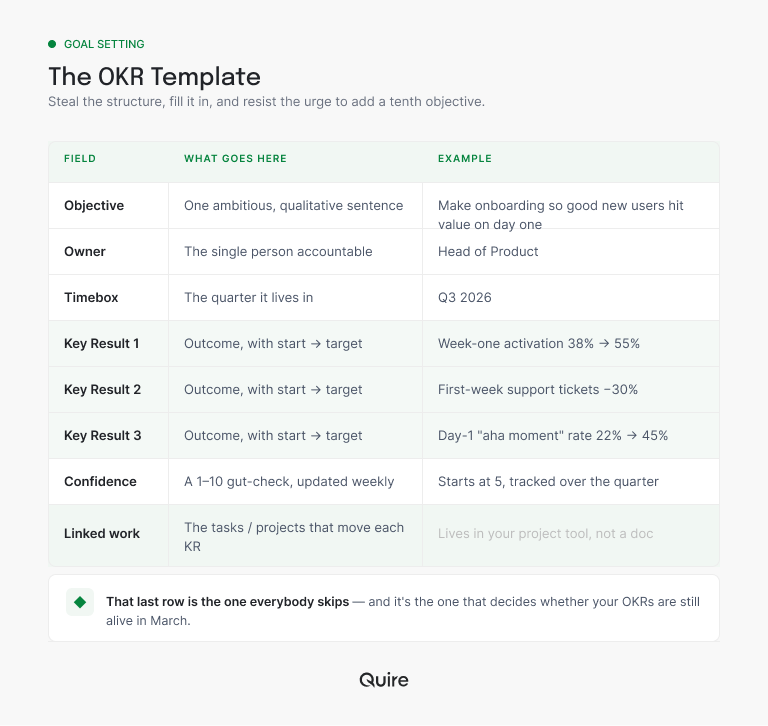
The infographic above is the whole structure. The row everybody skips is the last one, Linked work, and it's the one that decides whether your OKRs are still alive in March.
Grab the template: the free Quire OKR template is already filled in with three sample Objectives (grow team culture, grow the business, and generate more leads) and their Key Results. Every Key Result is a real task with a % progress bar, an owner, and a team tag (HR, Sales, Marketing). Open it, duplicate it into your workspace, and swap the samples for your own goals. You'll have a working OKR board in about five minutes.
Want the full walkthrough? Quire's OKRs guide goes step by step through building the template, tying each Key Result to real tasks, and letting progress roll up on its own. This post is the quick setup; the guide is the manual.
What is an OKR, exactly?
OKR: one Objective paired with three to five Key Results. The Objective is the qualitative thing you want to achieve. The Key Results are the measurable outcomes that prove you achieved it.
Think of the Objective as the destination and the Key Results as the dashboard that tells you you've arrived. "Become the tool small agencies recommend to each other" is an Objective. It's directional, a little ambitious, and you can't measure it on its own. The Key Results give it teeth: referral signups up from 40 to 120 a month, agency-tier retention above 90%, ten public reviews from agency owners.
The split matters because each half does a different job. The Objective is what keeps people motivated when the work gets boring. The Key Results are what keep people honest when everyone wants to claim victory.
OKRs aren't a new management fad, either. The format was developed by Andy Grove at Intel in the 1970s and brought to Google by investor John Doerr in 1999, and it's been Google's goal-setting backbone ever since (the full origin story is on Wikipedia). What's changed isn't the idea, it's that OKRs no longer have to live in a slide deck. They can live in the same place as the work.
Why do most OKRs quietly die by Q2?
They die for the same handful of reasons, every time. And they start from a shaky base: Gallup finds only about half of employees strongly agree they know what's expected of them at work, so a vague Objective just widens a gap that's already there.
They were activities, not outcomes. "Ship the new dashboard" sounds like a goal, but it's a task. You can ship a dashboard nobody uses and technically hit your OKR while moving nothing. Outcomes survive scrutiny. Activities just survive until someone asks "and did it work?"
There were too many of them. A team that sets nine Objectives hasn't set priorities, it's made a wish list and called it strategy. Focus is the entire point. If your OKRs don't force you to say no to something, they're not doing their job.
Struggling to separate what matters from what's merely loud before you commit? The Eisenhower Matrix template sorts urgent from important, so the Objectives you pick are the ones that actually move the needle.
Nobody tracked them. This is the big one. OKRs written in a doc that lives apart from the actual work are OKRs you'll update twice and then never again. Out of sight, out of quarter.
They were sandbagged or fantastical. Set them too easy and the team coasts. Set them so high they're science fiction and people check out by week three, because there's no motivation in a goal you've privately decided is impossible.
How do you write an Objective that's more than a vibe?
An Objective should be short, qualitative, and a little aspirational. You want something a teammate can repeat from memory without squinting at a slide.
Keep it to one sentence. Make it about a meaningful change, not business-as-usual. "Keep the lights on" is not an Objective, it's a Tuesday. "Make onboarding so good that new users hit value on day one" is an Objective, because it points at a real shift.
And write it like a human. If your Objective contains the word "synergize," delete it and start again. The best Objectives sound like something you'd actually say out loud to a colleague over coffee, not something generated by a strategy offsite.
An OKR's Objective is really just a well-formed team goal. For the fundamentals of picking and communicating one, see Shared Team Goals: Why They Matter and How to Set Them, and for how to run that conversation with the whole team, Collaborative Goal Setting: What Teams Should Know.
How do you write Key Results that aren't a to-do list?
This is where most OKRs fall apart, so here's the test: a Key Result is measurable, it's an outcome, and you can't fudge it.
Each one needs a number you're moving from and a number you're moving to. "Improve activation" is a hope. "Lift week-one activation from 38% to 55%" is a Key Result. The start number matters as much as the target, because without it you can't tell progress from noise.
Aim for three to five per Objective. One Key Result is usually too thin to capture real success, and six starts to feel like you're hedging. And keep them outcomes, not tasks. "Run 12 onboarding interviews" is an activity. "Cut first-week support tickets by 30%" is the outcome those interviews were supposed to produce.
One honest scale-down: not every Key Result will be perfectly clean. Some quarters you'll have one that's a little activity-shaped because the outcome is genuinely hard to measure yet. That's fine occasionally. Just don't let the whole set drift into a checklist, because then you've reinvented the to-do list and lost the point.
What are some OKR examples for different teams?
Abstract advice only gets you so far, so here are four OKRs the way real teams write them, one Objective and a single Key Result each (in practice you'd carry three to five). Notice every Key Result is an outcome with a number, never a task.
| Team | Objective | Example Key Result |
|---|---|---|
| Product | Make onboarding effortless enough that new users succeed on day one | Week-one activation 38% → 55% |
| Marketing | Become the tool small agencies recommend to each other | Referral signups 40 → 120 per month |
| Sales | Turn more trials into paying teams, not just more trials | Trial-to-paid conversion 18% → 28% |
| People / HR | Make this a team people don't want to leave | Voluntary attrition 14% → 8% |
Steal the shape, not the numbers. Your start and target figures come from your own baseline, not someone else's.
How do you use the Quire OKR template?
The template isn't a static grid you print and pin to a wall. Each Objective is a section, and each Key Result underneath it is a live task, so the board updates itself as work moves. Here's the five-minute setup:
- Open and duplicate it. Open the Quire OKR template and duplicate the project into your own workspace so you can edit freely.
- Rename the three Objectives to yours. Keep it to one to three. Delete the sample ones you don't need. Restraint is the feature here.
- Rewrite each Key Result as an outcome. Give every KR a start → target number. Assign an owner, add a team tag, and break bigger KRs into sub-tasks of the actual work.
- Let progress roll up. Update the % on each Key Result as it moves, or mark the sub-tasks done and watch the Objective's progress climb on its own.
- Book the review now. Add a recurring monthly task for the OKR check-in while you still believe in the goals.
Because the same tasks show up in Kanban, timeline, and calendar views, the OKRs your leadership reads and the work your team does are literally the same objects, not two systems someone reconciles every Friday.
OKRs are one of Quire's ready-made structures: 20+ project management templates your team will actually use lists every one, grouped by the job it does.
How do you keep OKRs alive after week two?
Two things, and only two: put them where the work is, and review them on a schedule.
The reason a separate OKR spreadsheet dies is mechanical, not motivational. People don't avoid it because they're lazy. They avoid it because updating a second system, by hand, with numbers they have to go dig up, is exactly the kind of coordination overhead that quietly eats a team's week. So nobody does it, and the OKRs drift out of sync with reality until the quarterly review, where everyone reconstructs the truth from memory.
The fix is to stop maintaining a parallel universe. When each Key Result is tied to the real tasks that move it, in the same place your team already plans and tracks work, progress updates itself as the work moves. Mark the onboarding tasks done, and the "ship the new flow" Key Result reflects it without anyone retyping a status.
This is what the Quire template is built around. Each Objective is a goal, its Key Results break into nested lists of the actual work, and progress rolls up live onto a dashboard instead of a slide deck you rebuild every Friday.
Set the quarterly review as a recurring task and the cadence takes care of itself. The OKRs stop being a document and start being a view of what's actually happening, which matters even more as a team grows and memory stops scaling.
OKRs are the quarterly layer of a bigger plan. The annual planning process that survives January shows the whole cascade, from three or four year themes down to the owned tasks that move each Key Result.
How are OKRs different from KPIs?
People mix up OKRs and KPIs constantly, so it's worth being precise. Your KPIs are the always-on health metrics you watch every month no matter what. Your OKRs are the deliberate push to change something this quarter.
| Aspect | OKR | KPI |
|---|---|---|
| Purpose | Change something on purpose | Monitor ongoing health |
| Time frame | Time-boxed (one quarter) | Continuous, always-on |
| Example | Lift activation 38% → 55% this quarter | Weekly active users |
| When you're done | At the end of the quarter | Never, you watch it forever |
A slipping KPI is often where next quarter's OKR comes from. Churn creeps up, so you set an Objective around retention and define Key Results that would move it. If you want the full breakdown of which numbers to watch continuously, that's a separate craft, and we covered it in the guide to defining and tracking KPIs. One is the thermostat; the other is you deciding to renovate.
When does running OKRs in Quire pay off most?
Quire's fit is defined by how your goals connect to your work rather than by how many people you have. If your Key Results only mean anything when they're tied to the tasks that move them, keeping both in one nested task tree beats bolting on a second system you'll forget to update. That's true of a nine-person product team and of a four-hundred-person organization running OKRs per department.
What are the most common OKR mistakes?
A few patterns show up again and again. Worth a quick scan before you finalize.
- Too many Objectives. If you can't recite them from memory, your team definitely can't.
- Activities disguised as Key Results. If hitting it doesn't prove anything changed, rewrite it.
- Set and forget. No cadence means no OKRs, just a document with good intentions.
- Sandbagging. Goals you're sure you'll hit aren't goals, they're forecasts.
- Cascading too rigidly. Company OKRs should inspire team OKRs, not get copy-pasted down five levels until they're meaningless.
That third one is the quiet killer. A team can write flawless OKRs and still fail, simply because they never looked at them again until it was time to grade themselves.
Key takeaways
OKRs are a focusing tool, not a paperwork ritual. The Objective gives you a direction worth caring about. The Key Results keep everyone honest about whether you got there. Write a few, not many. Make the Key Results measurable outcomes with a start and a target, not a checklist of activities.
Above all, put them where the work already lives and review them on a fixed cadence, because an OKR you don't look at is just a wish with a deadline. Set three Objectives this quarter, not nine. Tie each Key Result to real tasks. Book the monthly review now, while you still believe in them.
The shortcut to all of the above is starting from a structure that already works. Open the Quire OKR template, duplicate it, and you're editing your own Objectives instead of building a spreadsheet from scratch.
Frequently asked questions
What is an OKR?
OKR stands for Objectives and Key Results. The Objective is the qualitative thing you want to achieve; the Key Results are three to five measurable outcomes that prove you got there. One sets the direction, the others define success in numbers. The approach was developed by Andy Grove at Intel and brought to Google by John Doerr in 1999.
What's the difference between an OKR and a KPI?
A KPI is an ongoing health metric you watch all the time, like churn or response time. An OKR is a time-boxed push to change something on purpose this quarter. KPIs tell you if the engine runs; OKRs are you deciding to make it faster.
How many OKRs should a team set per quarter?
One to three Objectives, with three to five Key Results each. More than that isn't ambition, it's a to-do list in disguise.
How do you track OKRs so they don't get forgotten?
Put them where the work already happens and review them on a fixed cadence. When each Key Result is tied to real tasks (in Quire, each KR is a task with a live % progress bar), progress updates itself, and a recurring monthly check-in keeps them from fossilizing.
What makes a good Key Result?
It's measurable, it's an outcome rather than an activity, and you can't fake it. If two reasonable people could disagree about whether you hit it, it isn't specific enough yet.
Is there a free OKR template in Quire?
Yes. Quire's free OKR template comes pre-filled with three sample Objectives (grow team culture, grow the business, and generate more leads), each broken into measurable Key Results with a % progress bar, an owner, and a team tag. Open the Quire OKR template, duplicate it into your workspace, and swap the samples for your own goals.
Ready to write OKRs that are still alive in September?
Start free at quire.io/signup, no credit card required, and build your first set from the Quire OKR template, where your team already works. No separate spreadsheet required.