
project management · Oct 29, 2026
How to Build a Strategic Roadmap: 6 Steps and a Template

Last updated: October 29, 2026
A strategic roadmap links three to five objectives to the five to eight initiatives that serve them, each with one owner, two dates and a quarterly gate. Most roadmaps die in a slide deck, because nothing on a slide can be opened or assigned. This guide gives you the six-step build and runs it in Quire's Strategic Roadmap template.
- What is a strategic roadmap?
- What is the difference between a strategic roadmap and a product roadmap?
- Why do most strategic roadmaps die in a slide deck?
- How do you build a strategic roadmap?
- What comes with the Quire Strategic Roadmap template?
- Slide deck, spreadsheet or task management software: where should the roadmap live?
- What does a strategic roadmap look like in Quire, initiative by initiative?
- How often should you review a strategic roadmap?
- Which parts of the template should you replace first?
- Key takeaways
- Frequently asked questions
The January offsite produced a 41-slide deck. It had a vision, six pillars, a page of initiatives per pillar, and a closing slide that said "Let's go." By April, three teams were building toward three different versions of it, and the deck itself lived in a folder nobody could name.
I've presented one of those decks. The applause was real. So was the silence when someone asked, in June, which of the initiatives was still happening.
A strategic roadmap that teams work from needs a different home than a slide. It needs objectives that fit on one screen, initiatives with a name and a date on each, and a place where the roadmap and the work are the same object. This post builds that, then runs it in Quire.
What is a strategic roadmap?
A strategic roadmap is the set of objectives an organization has chosen for the next year or more, plus the initiatives that will serve each one, laid out on a timeline. Every item carries an owner and a gate.
It sits one level below the mission and one level above any single product plan.
Strategic roadmap: a time-sequenced plan that links a few business objectives to the specific initiatives chosen to achieve them, each with a single owner, a start and end date, and a checkpoint where progress is reviewed and the plan re-baselined.
The hard part is the word chosen.
A roadmap that holds everything anyone proposed is a catalog with dates on it.
David Collis and Michael Rukstad of Harvard Business School put two questions to the executives they work with:
- Can you summarize your company's strategy in 35 words or less?
- Would your colleagues put it the same way?
Writing in the Harvard Business Review, they found that very few executives can honestly answer yes to both. Most can't state the objective, scope and advantage of their business in one simple statement.
If the people who set the strategy can't say it in 35 words, the teams below them are guessing. A roadmap is the thing that stops the guessing.
What is the difference between a strategic roadmap and a product roadmap?
Altitude and horizon. The strategic roadmap covers the whole business over a year or more. The product roadmap covers one product over the next few releases. They should link, and they should never be the same document.
| Strategic roadmap | Product roadmap | |
|---|---|---|
| Covers | The whole organization | One product or product line |
| Horizon | One to three years | The next two to four releases |
| Unit of work | An initiative, owned by a department | A feature or theme, owned by a product team |
| Who reads it | Leadership, department heads, finance | Product, engineering, design, support |
| Reviewed | Monthly status, quarterly re-baseline | Every release cycle |
Keep them as two documents joined by a shared name. Every initiative on the strategic roadmap that touches the product should appear as a theme on the product roadmap, called the same thing.
When "Expand into the EU market" is an initiative upstairs, "Localize the product" is a theme downstairs, and both point at each other.
The downstairs half has its own build: product roadmap planning in five stages and three horizons covers the release-level plan this one hands off to.
Why do most strategic roadmaps die in a slide deck?
Because a slide can't be opened, assigned, or moved. The deck captures a decision at the moment it was made and then stops.
The work keeps going, in tools the deck knows nothing about, and the two drift apart from the first week.
Three things are missing from almost every dead roadmap.
An owner per initiative. "Marketing" is not an owner. When an initiative belongs to a department, it belongs to nobody in particular, and the quarterly review becomes a conversation about whose fault that is.
A link to the work. If the initiative is a slide and the work lives as tickets in three other systems, nobody can answer "how is this going" without a meeting. So the meeting gets booked, and from then on the roadmap is something people report on.
A review rhythm. A roadmap with no scheduled re-baseline is a January document forever. By the time anyone compares it with reality, reality has moved too far to reconcile, so the deck is retired and a new offsite is booked.
All three are storage problems, which is good news, because storage is fixable.
If you'd like to see the fixed version before reading the build, open the Strategic Roadmap template in Quire. Every initiative already has an owner, the work sits underneath it, and a review document is waiting for the quarter's end.
How do you build a strategic roadmap?
Vision, objectives, initiatives, owners, timeline, review. In that order, and the order matters. Each step narrows the one before it.
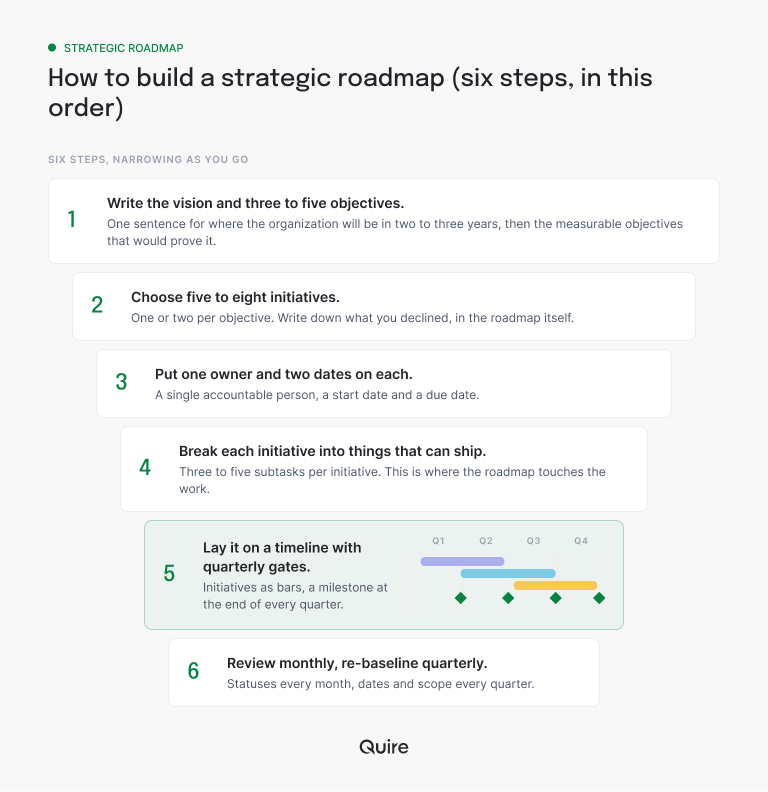
Start with one sentence and three to five objectives
Write where the organization will be in two or three years, in one sentence, with no adjectives doing the work of nouns. Then write the three to five measurable objectives that would prove you got there.
If an objective has no number, it's an initiative wearing an objective's badge.
Two posts help with the numbers: the OKR template your team won't abandon by Q2 for writing objectives that last a quarter, and project management KPIs for picking the metric each one is judged on.
The roadmap usually starts where the yearly plan ends. The annual planning process that survives January covers the year themes that this step turns into objectives.
Choose five to eight initiatives, and say no out loud
For each objective, pick the one or two initiatives most likely to move it. Five to eight across the whole year is the range that stays legible. Then write down what you declined, in the roadmap itself, so the next person who proposes it can see it was considered.
The declined list is the part of the roadmap people thank you for in September.
Put one owner and two dates on each initiative
A single accountable person, a start date and a due date. The owner can delegate everything except being the one who knows the status. Two dates rather than one, because an initiative that starts late is the earliest signal that it will finish late.
In Quire, each initiative is a task, so this step is three fields on it: the assignee, the start date and the due date. Add a tag for the owning department and you can filter the whole roadmap down to one team's share of the year.
Break each initiative into things that can ship
Three to five of them, as subtasks under each initiative. This is where the roadmap touches the work, and it's the step the deck always skips.
An initiative with nothing underneath it is a sentence. Sentences don't slip, which is why nobody notices when they do.
Lay it on a timeline with quarterly gates
Sequence the initiatives across the year so nothing starts all at once, and put a milestone at the end of each quarter. The gate is where the roadmap gets re-baselined against what actually shipped.
How many gates, and what makes one real: project milestones, how to set them and how many you need applies at roadmap scale too.
Schedule the review before you present the plan
Monthly for statuses, quarterly for dates and scope. Book both before the roadmap is shown to anyone. A review that exists only as an intention is the January-document problem again, with better fonts.
What comes with the Quire Strategic Roadmap template?
One project holding the vision, the initiatives, the quarterly milestones, the risks, the budget lines and the communication plan. A sample year is already in it, so the shape is visible before you replace it.
Open the Strategic Roadmap template and the sections are those six, in that order.
The sample initiatives are the useful part to study. Each one carries an assignee, a start and due date, a department tag and three or four subtasks.
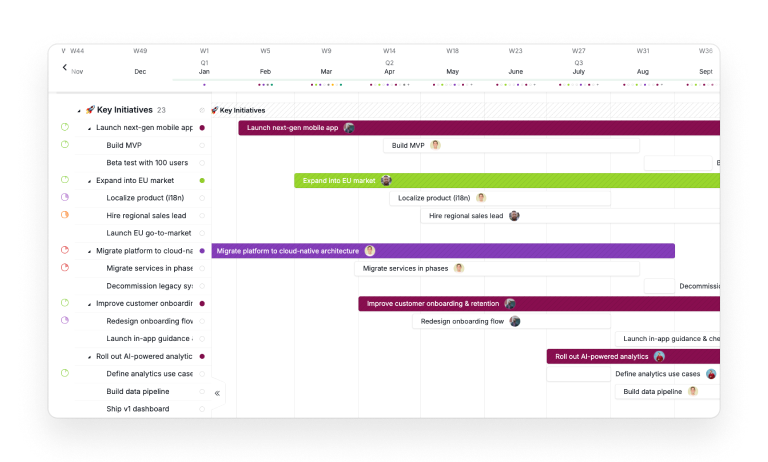
"Expand into EU market" belongs to Sales and runs March to November. Underneath it sit compliance research, localizing the product, hiring a regional sales lead and launching the EU go-to-market. "Achieve SOC 2 Type II compliance" belongs to Operations and breaks into a gap assessment, the security controls and the third-party audit.
Statuses carry the health of every item: To-do, In progress, In Review, At Risk, On Hold, Completed. Department tags (Product, Engineering, Marketing, Sales, Operations, Finance) let you filter the roadmap by who owns what.
Three sublists cut across the sections. Key Milestones, Top Priorities and Needs Attention pull the items that matter together no matter which section they live in.
Switch to Timeline view and the year lays itself out. Initiatives are bars, milestones are diamonds, and dragging a bar reschedules it.
The project's documents hold the rest of the kit: a Strategic Roadmap Charter, a Risk Register, a Stakeholder & Communication Plan, and the Quarterly Business Review template that runs the gate meeting. The template guide walks through each one.
Slide deck, spreadsheet or task management software: where should the roadmap live?
Wherever the initiative, its owner and its status can be one object that teams open without being sent a link. For most organizations that's the task management software the work already runs in.
A roadmap that lives next to the work is the only kind the people doing the work keep updated.
A slide deck is a fine place to present a roadmap. It's a poor place to keep one.
A spreadsheet keeps the dates but not the work underneath them, so "how is this going" still needs a meeting.
In Quire, the initiative is a task. The work under it is subtasks, its status is a status, its department is a tag, and its place in the year is a bar on the Timeline.
When the regional hire slips six weeks, the owner moves the date on the task and the bar moves with it. Everyone reading the roadmap sees the new date the same morning, without a status email.
If the question is broader than roadmaps, the task management software guide compares the tools on what matters once the setup week is over.
What does a strategic roadmap look like in Quire, initiative by initiative?
Each initiative is one task with one owner, a date range and a department tag. The work that delivers it sits underneath as subtasks. Here's how one of them runs through a year in the template.
Say the objective is EU revenue at 20 percent of total by the end of Q4. The initiative serving it is "Expand into EU market": Felipe owns it, it carries the Sales tag, and it runs from March 1 to November 30. Four subtasks carry the work, and every one has a named person and dates of its own:
| Subtask | Runs | Status in the template |
|---|---|---|
| Complete market & compliance research | March to mid-April | Completed |
| Localize product (i18n) | Mid-April to July | In Review |
| Hire regional sales lead | May to September | On Hold |
| Launch EU go-to-market | October to November | To-do |
The risk gets its own row too. In the Dependencies & Risks section, "Dependency: EU launch blocked on regional hire" is a task owned by Felipe, so the risk has a name and a person attached from the day it's spotted.
At the Q3 business review, the hire has slipped. Felipe moves its due date out six weeks, sets the launch to At Risk and adds it to the Needs Attention sublist.
The decision from the room, to start the go-to-market with a contractor while the hire closes, goes in a comment on the launch task.
Four minutes of the review.
The roadmap now says what happened and what was decided, in the place the next review will open first.
Decisions like that one deserve their own trail: the decision log most teams skip and then regret covers keeping them findable across quarters.
How often should you review a strategic roadmap?
Statuses monthly, dates and scope quarterly. The two reviews do different jobs, and merging them is how both get skipped.
The monthly pass is short. Every initiative owner confirms the status, and anything At Risk or On Hold gets a sentence in the task about why. Fifteen minutes if the statuses were kept current, which is the point of keeping them in the tool.
The quarterly review is the gate. Dates get re-baselined against what shipped, initiatives the business no longer needs get retired (visibly, with a reason), and the next quarter's milestone gets its definition. The template's Quarterly Business Review document is the agenda.
Put both on the calendar and the roadmap stays the first page people open when a quarter gets tight.
Which parts of the template should you replace first?
The vision, the initiatives, and the department tags. The structure can stay exactly as it is.
Rewrite the vision and objectives first, in the first section, before touching anything else. Then replace the sample initiatives with your five to eight, keeping the pattern: assignee, start and due date, department tag, the work as subtasks.
Swap the department tags for your real teams if they differ. Keep the statuses; At Risk and On Hold are the two most organizations don't have and need most.
Leave the quarterly milestones where they are unless your planning cycle runs on something other than calendar quarters, in which case move the diamonds and nothing else.
Key takeaways
A strategic roadmap is a set of choices. Three to five objectives, five to eight initiatives with one owner and two dates each, subtasks underneath so the roadmap touches the work, and a quarterly gate where the dates get re-baselined.
Most roadmaps die of storage, and a slide deck is the worst storage there is.
Keep it where the work lives. The Quire Strategic Roadmap template holds the objectives, the initiatives, the milestones, the risks and the review document as one project, readable as a Timeline. Sign up for Quire, duplicate the template, and let the next quarterly review open on a plan that already knows what happened.
Frequently asked questions
What is a strategic roadmap?
A small set of objectives, the initiatives chosen to serve them, and the timeline they run on, with an owner and a gate on every item. In Quire, the Strategic Roadmap template keeps all of it as one project you read in Timeline view.
What is the difference between a strategic roadmap and a product roadmap?
Altitude and horizon. Strategic covers the whole business over a year or more, with initiatives owned by departments. Product covers one product over the next few releases, with features owned by a product team. They link by name, and in Quire both are projects.
How many initiatives should a strategic roadmap have?
Five to eight for the year, each tied to one objective and one owner. More than that and nobody can tell what to protect when a quarter gets tight.
How often should you review a strategic roadmap?
Statuses monthly, dates and scope quarterly. The template's Quarterly Business Review document runs the quarterly gate.
Can you build a strategic roadmap in task management software?
Yes, and it lasts longer there. In Quire each initiative is a task with an assignee, dates, a department tag and a status, its deliverables are subtasks, and the year is a Timeline of bars and diamonds.
How does a strategic roadmap keep teams productive at work?
It tells people what not to work on. With a published set of initiatives, off-roadmap requests are easy to decline and a tight quarter has an order of what to protect.
Teams that keep the roadmap in Quire stay productive at work because the initiative, its owner and its status are one object they can open.
