
project management · Oct 19, 2026
The Annual Planning Process That Survives January

Last updated: October 19, 2026
An annual planning process that survives January runs as a cascade: three or four year themes flow into quarterly objectives, objectives into projects, and projects into owned, dated tasks. Plans die at the first level nobody owns. Below are the four levels, the November-to-December timeline, the review cadence per level, and the whole cascade built in Quire.
- What is an annual planning process?
- Why do annual plans die in Q1?
- What does each level of annual planning produce?
- When should annual planning happen?
- How do you run the annual planning process in Quire?
- What does one goal look like, cascaded from theme to task?
- When is annual planning the wrong tool?
- Key takeaways
- Frequently asked questions
Every January, a 38-slide kickoff deck goes out. It's good. Ambitious themes, a market slide, a phrase like "the year of the customer" that everyone repeats for two weeks.
By February the deck is a file. (Nobody opened it again.)
The gap between that deck and the year the team ends up having is what an annual planning process is supposed to close. Most versions fail the same way: they produce a document when they needed to produce a cascade.
This post is the cascade version. It covers what each level produces, who owns it, and when to build it (October reader, your timing is perfect). Then it builds the whole cascade in Quire, so the plan and the work are the same object.
What is an annual planning process?
An annual planning process turns direction into owned work through four levels: year themes, quarterly objectives, projects, and tasks. Each level has its own artifact, its own owner, and its own review cadence. The output that matters is the bottom of the cascade, tasks with names and dates, because that's the only level where a year actually happens.
Annual planning process: the yearly exercise of setting a small number of directional themes and cascading them into quarterly objectives, projects, and owned tasks, with a review rhythm at each level. The plan is the living cascade, and the kickoff document is only its announcement.
Notice the word small. Three or four themes is a direction. Eight themes is a list wearing a strategy's clothes, and every theme you add dilutes the permission the plan gives people to say no to work that serves none of them.
And that permission is half the value. A real annual plan doubles as the standing answer to "should we take this on?" for the next twelve months.
Why do annual plans die in Q1?
They die at the first level nobody owns, which is almost always one line below the objectives. Leadership owns the themes. Someone puts their name on "grow expansion revenue." And then the cascade stops: no project is attached, no task carries a date, and the objective floats above the actual week like weather.
The research here is blunt.
Reviewing 35 years of goal-setting studies, Edwin Locke and Gary Latham found that specific, difficult goals consistently led to higher performance than urging people to do their best. "The year of the customer" directs nobody's Tuesday. "Cut onboarding time to under a day by March, and Minh owns it" does.
The same review describes a business-game study by Latham and Seijts that reads like an annual plan in miniature. A distant goal on its own did worse than a plain "do your best."
Players who also got near-term goals under that distant one beat both groups, on profit and on confidence. A year theme with no quarterly objectives under it is that lonely distant goal.
The second killer is over-detailing the far quarters. A plan that schedules October's tasks in January is fiction. Once one part of the plan is visibly fiction, people stop trusting the parts that aren't.
Detail the nearest quarter. Sketch the rest.
That trade-off is the real difference between the common ways to plan a year, and each one breaks somewhere different.
| Approach | What gets detailed up front | Where it breaks | Fits work that... |
|---|---|---|---|
| Fully detailed annual plan | All twelve months, down to tasks | By March the far quarters are visibly fiction, and trust in the near ones goes with them | Barely changes all year, like a fixed-scope build with a contract date |
| Annual themes + quarterly cascade | The year's themes, plus Q1 down to owned tasks | At the first level nobody owns, usually just below the objectives | Holds a direction for a year but learns something every quarter |
| Quarterly planning only | The next quarter, with no year level | Quarters drift apart, with no shared direction to say no from | Changes direction month to month, like early exploration or an active pivot |
| Continuous flow | Nothing up front, only a prioritized queue | Improvement work never gets scheduled | Arrives unplanned, like support tickets and incidents |
The affectionate diagnosis, since most of us have lived it: if the strategy doc you last opened in February still says "Q3: TBD," the plan died back in January, the week nobody attached a project to an objective.
What does each level of annual planning produce?
Four levels, four artifacts, four owners, four speeds. The cascade works when every level has a name on it, and it breaks at the first one that doesn't.
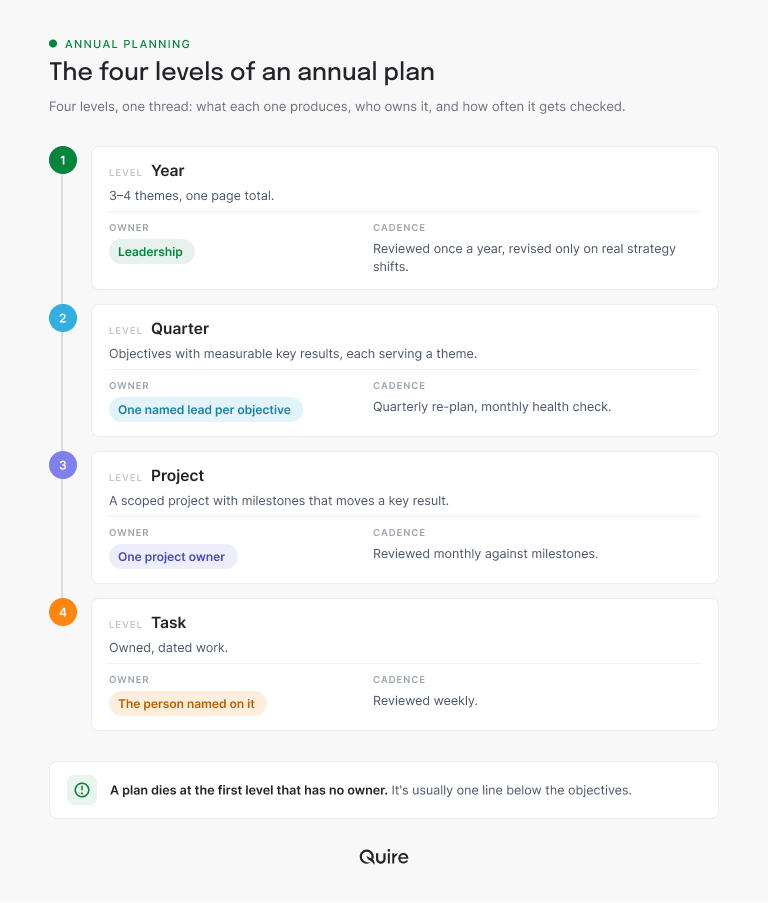
In Quire, all four levels sit in one workspace. Themes and objectives share a single task tree, and projects and tasks are the ordinary kind, so the year's plan and this week's work are one click apart.
Two of these levels have full posts of their own on this blog. The quarterly level is the OKR layer, and writing objectives that make it to March is its own craft.
The quarterly artifact has a full post: the OKR template your team won't quietly abandon by Q2, including how to write key results that measure outcomes instead of activity.
At the project level, milestones are what make the monthly review honest. A project with no milestones can drift for a quarter while reporting "in progress" every month. Project milestones covers how many to set and where.
One boundary is worth drawing here. Deciding which projects deserve to exist when objectives compete for the same people is portfolio territory, one level of judgment above this post.
When that's your real question, start with project portfolio management: selection and governance across the whole project list.
When should annual planning happen?
Draft themes in November, cascade the first quarter in December, and start January already working. That's the whole calendar, and reading this in October means you're early enough to do it without a single late night.
- October. Pick one live goal and run it through all four levels as a rehearsal.
- November. Draft three or four themes and test them against real customer conversations.
- December. Cascade Q1 into objectives, projects, and the first weeks of owned tasks.
- January. Work the plan. Nobody is still writing it.
The sequencing matters more than the dates. A theme that can't survive November's actual customer conversations shouldn't run the year.
And the Q1 cascade needs to exist before the holidays. A plan finished on January 15th spends the year's freshest energy on paperwork.
How often should each level be reviewed?
At the speed each one changes. Tasks get a weekly look, projects a monthly one, objectives a quarterly re-plan, and themes a yearly check.
The quarterly re-plan is where the annual plan earns its name. Score the quarter's objectives, retire what's done, and cascade the next quarter from the same themes.
Only one quarter of the plan is ever detailed, which is exactly why it stays true.
In Quire, each review is a recurring task with an owner: a weekly one inside each project, a monthly milestone check, a quarterly re-plan in the OKR project. The rhythm lands on someone's task list with a due date instead of living in the planner's memory.
The monthly and quarterly reviews need numbers to review, which is where KPIs come in. Each key result should map to a metric someone already tracks, or the quarterly scoring turns into a vibes vote.
Picking those numbers well is its own discipline: project management KPIs covers defining, setting up, and tracking the metrics your reviews will lean on.
How do you run the annual planning process in Quire?
Build it top-down in one sitting, starting from the OKR template and finishing with a Smart Folder on top. Each step below keeps one level attached to the one above it.
- Put themes and objectives in one tree. Duplicate the free Quire OKR template, add each year theme as a top-level task, and nest that quarter's objectives under it. Every key result in it already carries an owner and a % progress bar, so scoring the quarter means reading the bars.
- Give each objective its project. Create one project per initiative and add milestones for the monthly check. Link tasks to a milestone with dependencies, and its progress rolls up as those tasks close.
- Land the first weeks in owned tasks. Break the first few weeks into tasks and subtasks, each with an assignee and a due date. Then stop. February's tasks get written in February.
- Gather the quarter in a Smart Folder. A Smart Folder pulls the OKR project and every initiative's project into one view, grouped by project, so leadership reads the plan as live work.
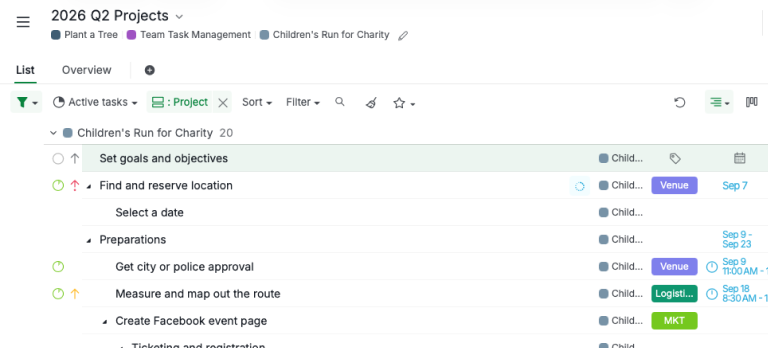
That folder is the year's plan as live work rather than slides. Switch it to Timeline and the quarter's milestones line up side by side.
Switch it to Table and owners and due dates sit in columns, which turns the monthly check into a two-minute scan.
What does one goal look like, cascaded from theme to task?
It looks like one unbroken thread: a theme, one objective, one project, and a handful of tasks, each with a name and a date. Here's a marketing team's version, built in Quire.
- Theme (year). "Win repeat business," a top-level task in the team's OKR project and one of three themes for the year.
- Objective (Q1). "Lift trial-to-paid conversion from 2.1% to 3% by March 31," nested under the theme and assigned to Chi. Two key results sit under it, each with its own owner and progress bar.
- Project. "Onboarding email rebuild," run by Chi, with three milestones: Audit done (Jan 22), New sequence live (Feb 19), and Results read (Mar 26).
- Tasks. The first two weeks, dated. "Pull drop-off data by cohort" goes to Bao, due Jan 8, with two subtasks, one to export the trial cohorts and one to mark the email where each cohort stopped. It links to the Audit done milestone.
Nothing glamorous at the bottom. That's the point.
Read the thread bottom-up and Bao's task can explain why it exists, four levels deep, without a meeting. Read it top-down and the theme knows exactly which work is carrying it this quarter.
When someone proposes a shiny new project in February, the thread doubles as the polite rejection letter. Which theme does it serve?
Want to test the cascade before planning season? Start a free Quire project, add one current goal with two milestones and a week of owned tasks, and run the weekly and monthly reviews on it through November. If the rhythm holds for one goal, it will hold for the year.
When is annual planning the wrong tool?
When the work doesn't hold still long enough to cascade. Support queues, incident response, and a service desk get little from quarterly objectives, because their improvement lever is flow.
That's the continuous-flow row in the table above. The queue runs well on a Quire Board, and the cascade can still hold the one or two improvement projects around it.
A team whose strategy legitimately changes month to month should run quarterly planning on its own and skip the year level. Themes that change monthly are moods.
Which calls does an annual plan leave to people?
Headcount, budgets, and which of two good projects gets the shared designer. Those are judgment calls the cascade will surface but never make.
The process gives the argument a shared surface, and humans still have the argument.

Key takeaways
- Build a cascade. Three or four year themes, quarterly objectives under them, a project per initiative, and owned, dated tasks at the bottom.
- Give every level an owner. Plans die at the first level nobody owns, usually one line below the objectives.
- Detail one quarter at a time. Far-quarter detail is fiction, and visible fiction costs the plan its credibility.
- Plan in Q4. Themes in November, the Q1 cascade in December, work in January.
- Match the review to the level. Tasks weekly, projects monthly, objectives quarterly, themes once a year.
Build it where the work runs and January becomes a working month instead of a writing month. Sign up for Quire, duplicate the OKR template, and cascade one real goal this week as the rehearsal.
Frequently asked questions
What is an annual planning process?
The yearly cascade from three or four themes into quarterly objectives, projects, and owned tasks, with a review rhythm per level. The cascade is the plan, and the kickoff deck is its announcement.
When should annual planning start?
Themes in November, the Q1 cascade in December, execution in January. Planning in January spends the year's best energy on a document.
What is the difference between an annual plan, OKRs, and a roadmap?
They're levels of one cascade. The plan holds themes, OKRs are the quarterly objective layer, and the roadmap is the project layer that moves the key results.
How detailed should an annual plan be?
Detailed for the nearest quarter, placeholders after that. Far-quarter detail is fiction, and visible fiction costs the plan its credibility.
Who owns the annual plan?
Every level has its own owner: leadership for themes, a named lead per objective, one owner per project, a name and date on every task. A plan owned only at the top is a speech.
How do you set up an annual plan in Quire?
Duplicate the free OKR template, add each theme as a top-level task, and nest the quarter's objectives under it. Give each objective a project with milestones, then gather the quarter in a Smart Folder.
How do teams stay productive at work during annual planning season?
Keep it short and anchored to real work: themes in one session, the cascade in another, recorded in Quire as projects, milestones, and owned tasks so January starts with execution, not transcription.
