workstyle · Sep 15, 2026
Product Roadmap Planning: 5 Stages, 3 Horizons, and a Template
Last updated: September 15, 2026
A roadmap drifts because it is a picture of the work rather than the work itself. Fix that by making every roadmap row a real task: five stages from idea to shipped, three horizons instead of invented dates, and release gates as milestones the work has to pass. Quire's Product Roadmap template ships with all of it.
- What is product roadmap planning?
- Why does a product roadmap stop matching reality?
- What are the five stages between an idea and a shipped release?
- What is the difference between a product roadmap and a backlog?
- What is inside Quire's Product Roadmap template?
- How do you decide what goes in the next release?
- How do you answer "what's coming, and when?" from the roadmap itself?
- Should product roadmap planning live in your task management software?
- What do you change first when you copy it?
- Key takeaways
- Frequently asked questions
The roadmap was accurate the morning it was made. By the second week of the release one feature had quietly doubled in size, two were waiting on a decision nobody had written down, and the slide still showed all five arriving in the same tidy row.
Nobody lied. The deck just has no way of finding out anything changed.
Good product roadmap planning is not a better deck. It is closing the gap between the plan and the work, so the plan learns things when everybody else does. Below: the five stages that gap hides in, how to have the ordering argument honestly, and a working Quire project to lift the structure from.
What is product roadmap planning?
Product roadmap planning is deciding what your product will ship and in roughly what order, then keeping that order attached to the tasks that deliver it. The first half is an argument about value. The second half is plumbing, and it is the half that decides whether the argument still means anything in six weeks.
Product roadmap planning is the practice of choosing which features a product will ship, sequencing them across releases, and holding that sequence against the real work so the plan updates when the work does. A roadmap that cannot see its own tasks is a forecast nobody is checking.
Most advice stops at the first half. You get prioritization frameworks, stakeholder templates, a debate about themes versus features. All useful, and none of it touches the thing that actually breaks.
Why does a product roadmap stop matching reality?
A roadmap drifts because it is stored separately from the work it describes. Two artifacts, one truth, no mechanism to keep them agreeing. So they agree for about a week.
That gap costs three specific things.
It costs the honest answer. Someone asks what is coming, and the person who knows has to poll five people and rebuild a slide from the replies. By the time it is presented it describes last Thursday.
It costs the decision trail. A feature slips, the roadmap shows the new date, and nothing records who decided or what got dropped to make room.
It costs the forecast. Kevin Thomas and Cornelius König, writing in Frontiers in Psychology, found that duration predictions landed closer to reality when the task resembled one the estimator had already finished.
Your own shipped history is the best estimating tool you own. A roadmap that archives it the moment a release closes throws that away every quarter.
We ran releases at Quire off a spreadsheet for a while. It worked until the week someone asked it a question it could not answer without a meeting.
The reporting half of this problem has its own fix: stakeholder updates without the status meeting covers the async pattern that reports out of the work instead of out of somebody's memory.
What are the five stages between an idea and a shipped release?
A feature passes through intake, triage, scoping, build and ship, and a conventional roadmap only shows the last two. Enough to draw a chart, nowhere near enough to explain a quarter, because everything interesting happens in the three stages that leave no mark.
Five places a feature actually sits, then, and the bill that arrives when one gets skipped rather than passed. Each stage below names its home in Quire's Product Roadmap template, which this post opens up in full further down.
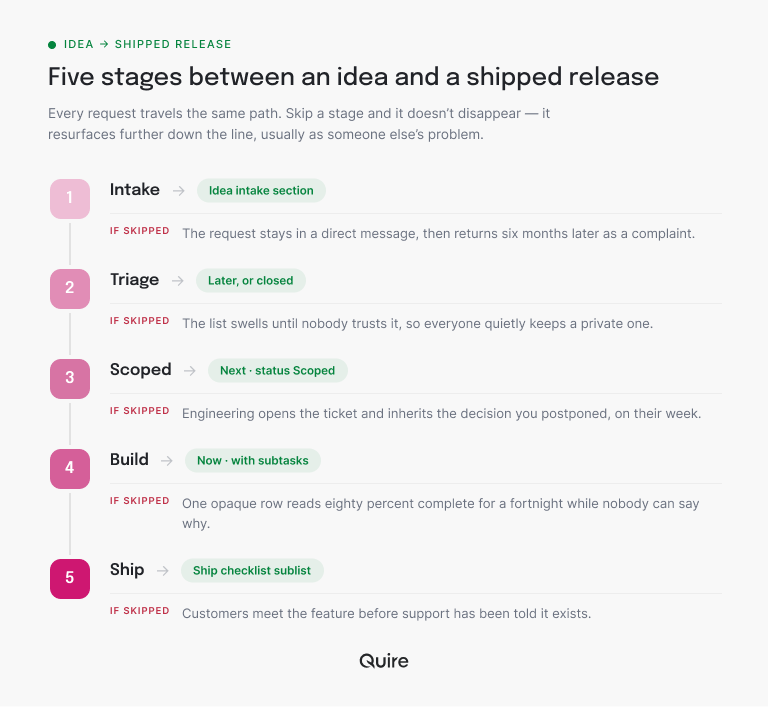
- 1. Intake lives in the Idea intake section. Skip it and the request stays in a direct message, then returns six months later as a complaint.
- 2. Triage ends in Later, or closed. Skip it and the list swells until nobody trusts it, so everyone quietly keeps a private one.
- 3. Scoped lives in Next, at status Scoped. Skip it and engineering opens the ticket and inherits the decision you postponed, on their week.
- 4. Build lives in Now, with subtasks. Skip that nesting and one opaque row reads eighty percent complete for a fortnight while nobody can say why.
- 5. Ship runs off the Ship checklist sublist. Skip it and customers meet the feature before support has been told it exists.
Notice which stages leave a mark. Only the last two show up on a conventional roadmap; the first three happen in inboxes and hallway conversations, which is why the chart always looks calmer than the quarter felt.
What is the difference between a product roadmap and a backlog?
A backlog is everything you might do, in no promised order. A roadmap is the small part you have committed to, with a rough when attached. Teams get into trouble by keeping one list and calling it both, because then every idea in it reads like a promise.
Keep them in one project, in different sections. Same tasks, same fields, different meaning.
| Dimension | Product roadmap | Product backlog | Where it sits in the template |
|---|---|---|---|
| What it holds | Work you have committed to | Everything anyone has suggested | Now and Next vs. Later and Idea intake |
| Order | Deliberate, and argued over once | Loose, re-sorted whenever | Horizon sections vs. an Impact sort |
| Dates | Real for this release, a shape for the next | None at all | Due dates on Now only |
| Who reads it | Stakeholders, support, sales | Product and engineering | The Dashboard tab vs. the task tree |
| What it promises | Something you can be held to | Nothing | Status Scoped or better vs. status Idea |
| How an item moves | Triage, then a scoping decision | Anyone can add a request | Idea intake to Later to Next to Now |
The useful consequence is that promotion becomes an event. Moving a task from Later into Next is a decision somebody made on a date, not a row that drifted upward while nobody was looking.
On keeping that candidate list usable rather than a graveyard: make your product backlog speak the whole story.
What is inside Quire's Product Roadmap template?
It is a working project with the five stages already wired in, free to copy on any plan. The sample data is a fictional v2.0 release, so you can see the shape working before you replace it with yours.
Rather than build that from an empty project, take Quire's Product Roadmap template. Eight things come with it:
- Three horizon sections plus an intake one. Now is the current release with real dates, Next is the following one as a shape, Later is candidates with no dates, and Idea intake is untriaged requests where nothing is a promise.
- A five-step status pipeline: Idea, Scoped, In Progress, In Review, Shipped. Scoped exists on purpose, because "not started" and "nobody has decided what this is" are different problems.
- Six roadmap fields: Release, Impact, Effort, Customer requests, Source, and a Needs release note checkbox.
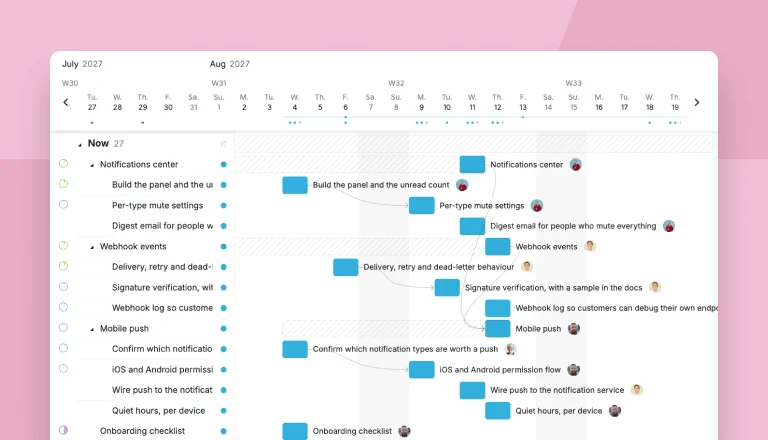
- Features that open into their real work. Notifications center is not one to-do. It is the spec, the design, the panel build, the mute settings and the digest email, each owned and dated.
- Release gates as milestones: feature freeze, code freeze and GA, chained as dependencies so the order they have to happen in is visible.
- Three sublists cutting across the tree: the current release, everything promised to a named customer, and the ship checklist.
- A How we prioritize document, the rubric written down once so you stop re-arguing the method every time you disagree about an item.
- Two reporting tabs: a Dashboard for the weekly read, and Effort by owner, which sums estimated hours per person so you can ask whether the release fits the people on it.
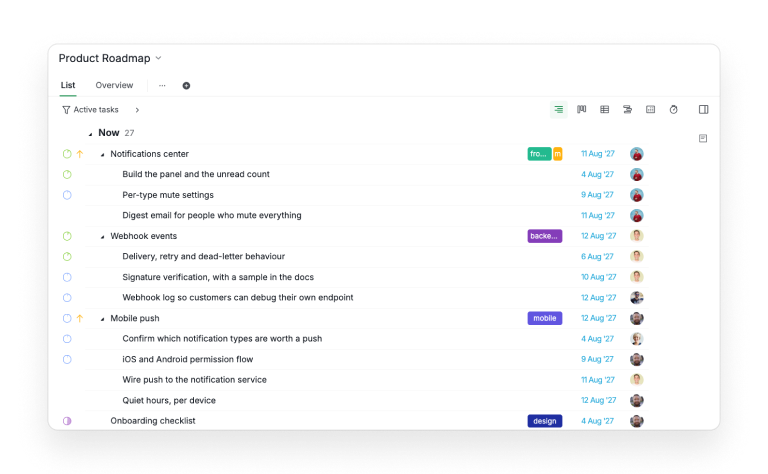
Nesting is how a feature stops reading eighty percent done for two weeks. When Notifications center is five owned subtasks, "eighty percent" becomes "the digest email has not started and Ana is on it".
Steal the ship checklist whether or not you ever touch the rest. Seven questions with a name against each, and the GA milestone will not close until they are all answered:
- Every feature in the release is Shipped, or explicitly cut and moved to the next one.
- Release notes are written for everything with Needs release note ticked.
- Docs and the API reference are updated for every changed surface.
- Support is briefed: known issues, workarounds, what to escalate.
- The migration is tested on a copy of production data and the rollback is rehearsed.
- Feature flags are set for the launch cohort and the defaults are confirmed.
- The status page note and in-app changelog are scheduled for the release hour.
Item five says rehearsed, not documented. A rollback plan nobody has run is a wish with a filename.
Duplicate acts on the whole project, so the tree comes over intact instead of one task at a time. From the dropdown beside the template's title, open More and pick Duplicate.
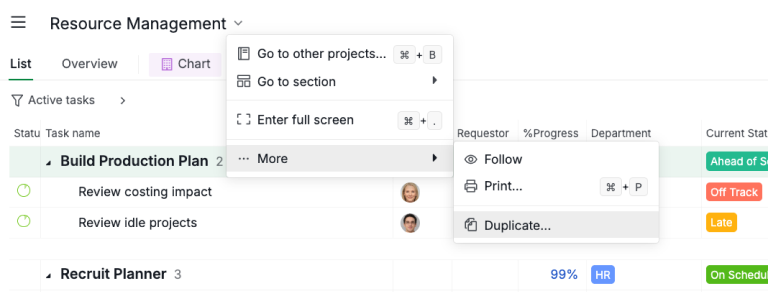
Give the copy a name, choose which organization it belongs in, and hit Create. About a minute, and every level of nesting comes with it, which is the only reason copying beats rebuilding.
Then be ruthless with it. The structure is the useful part; the sample features are scaffolding, and every one you leave in becomes something you feel vaguely guilty about in November.
How do you decide what goes in the next release?
Compare value against cost, and keep the evidence for both on screen instead of blending it away. Prioritization goes wrong in a predictable way: someone builds a scoring formula, the formula produces 7.4, and everyone nods at a number that has quietly buried the disagreement instead of settling it.
Keep the inputs separate and visible. In the template that means three fields on every candidate:
- Impact for what it is worth, High, Medium or Low.
- Effort as a rough S to XL.
- Customer requests as a count of who actually asked.
Sort by Impact, read Effort beside it, and let the count stop the loudest voice being the only input.
Then watch for the mismatch that catches everyone. In the sample data, Dark mode shipped with 47 customer requests and an Impact of Low.
Still a fair call, since it was cheap and it retired a recurring complaint, but nobody should pretend it was a growth bet. The most-requested thing on your list is often not the most valuable, and a single blended score is precisely the instrument that would have hidden that.
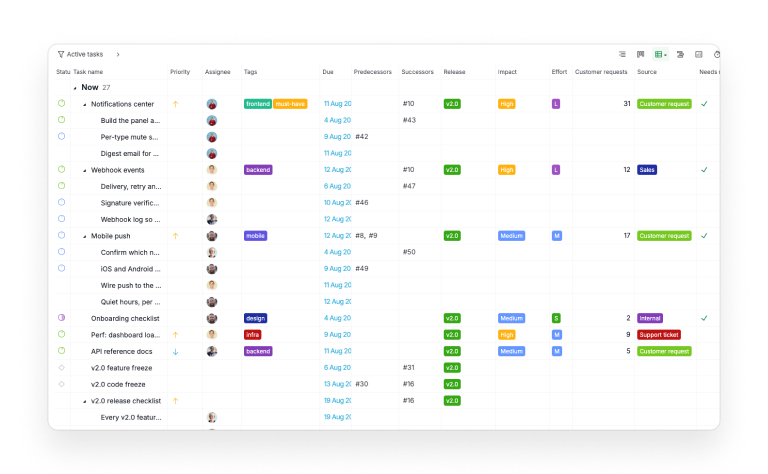
That is the Table view: same tasks, six sortable columns, nothing exported.
Three tests before anything enters Now. Is it Scoped? Does it land before code freeze, not the week of GA? Does it have one named person, not a team? A crowded Now is the same as no Now.
Saying no is the other half, and leaving things in Idea forever is a no nobody has to say out loud. Move them to Later with a one-line reason, or close them. The exception is the Customer-committed sublist: anything a human promised a named customer lives there, so dropping it is a conversation rather than a quiet edit at 11pm.
Try it on the ten candidates your team argues about most. Score them for Impact and Effort in a free Quire project, then sort. Eight of the ten usually settle themselves, and the meeting shrinks to the two that were always the real argument.
How do you answer "what's coming, and when?" from the roadmap itself?
You read it off the horizons, the milestones and the statuses, because all three are already maintained by people doing their jobs. This is the question the deck existed to answer, and the reason it kept going stale.
The horizons answer roughly when. Now has dates because the work is scoped and owned. Next has a release but no daily precision. Later has neither, on purpose. Giving Later a date to look organized is how you acquire a commitment you never agreed to.
The milestones answer what has to be true first. Feature freeze, code freeze and GA are real objects on the Timeline with dependencies between them, not sentences in a document. When a feature slips past freeze, the timeline shows what it collides with.
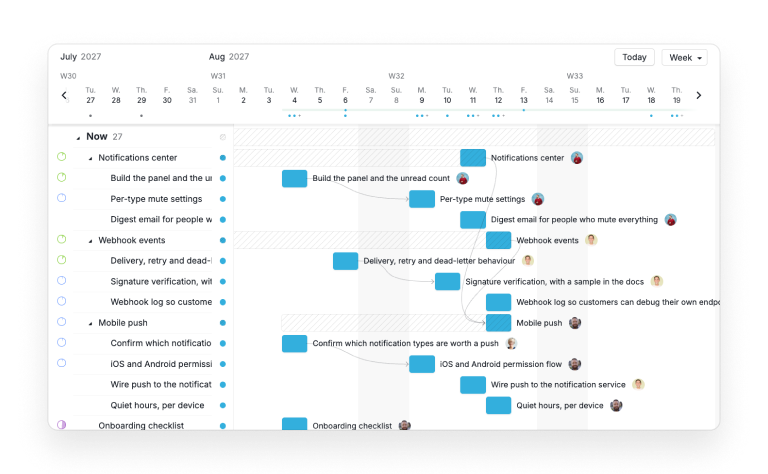
The statuses answer what is happening now. In Review looks different from In Progress, which looks different from Idea. An engineer changing a status updates the roadmap as a side effect of doing their job, which is the only kind of reporting that stays current.
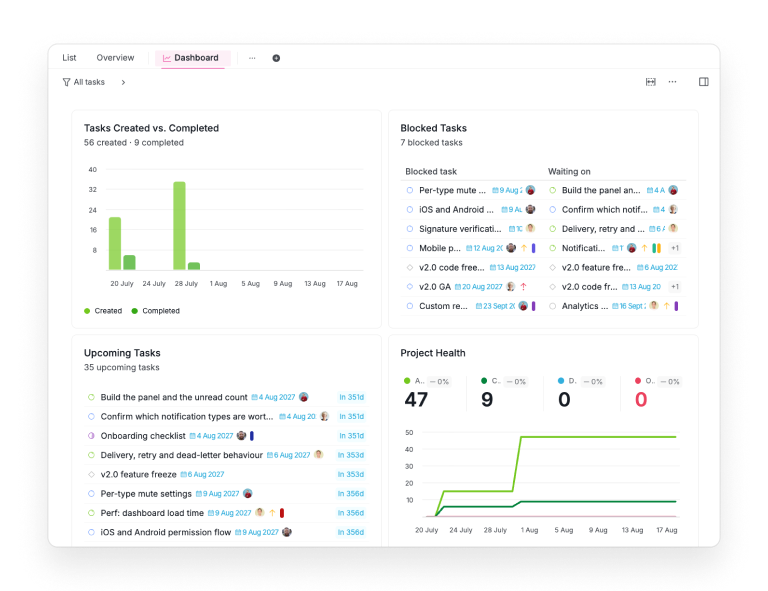
The Dashboard answers it for people who will never open the roadmap. Two widgets earn their place here specifically.
Tasks Created vs. Completed sets the rate work arrives against the rate it leaves. That is the earliest honest signal that a release is swelling rather than progressing.
Blocked Tasks pairs every stalled item with whatever is holding it up, so the standing question of any roadmap review turns up pre-answered.
Each shipped feature in the template also carries what it was estimated at against what it took. The pattern is the one the research above predicts: work resembling something the team had built before came in close, while the genuinely new work ran over by a third.
Two mechanics underneath this are worth reading on their own: how milestones work in Quire and how task dependencies chain work together, which is what makes a slipped freeze visible instead of theoretical.
Should product roadmap planning live in your task management software?
Yes, and the test is whether an engineer closing a ticket updates the roadmap without being asked. If the answer is no, you own two documents and a weekly reconciliation habit you will eventually stop doing.
Slide software and dedicated roadmap tools both produce a clean picture. Neither can tell you the panel build slipped, because neither holds the panel build. Putting the roadmap in the same task management software your team already works in removes the copy, and with it the drift.
If you are still choosing that tool, this walks the field: the best task management software and task trackers, compared on how they handle nested work.
There is one case where this structure is the wrong shape, and it is worth saying out loud. A team still searching for what the product should be has candidates but no committed release. Opening a Now horizon and putting dates on it invents a promise nobody made.
Run Later and Idea intake only until something is genuinely scoped and owned, then open Now that week. The horizons are there to hold commitments, not to look full.
This template is one of a set. The rest are in the roundup of project management templates your team will actually use, including the ones for launches, status reporting and risk.
What do you change first when you copy it?
Start with the dates, because everything hangs off them. Rename the releases and drag the three gates to yours.
Then swap the sample features for real ones, each with a person rather than a squad against it.
Last, cut whatever you are privately certain will never get built. A roadmap only stays useful while every row on it is still true.
Key takeaways
A roadmap goes stale because it lives somewhere the work cannot reach it. Make each row a real task and the drift mostly stops.
That means five stages instead of planned-and-done, three horizons instead of invented dates, release gates as milestones with dependencies, and prioritization fields that show their evidence instead of hiding it in a score.
None of it needs building from scratch. Take a copy of the Product Roadmap template, score your candidates, keep Now short, and the structure is already doing the work.
Sign up for Quire to run it where the tasks already live, so the next time someone asks what is coming, the answer is a link rather than an evening.
Frequently asked questions
What is product roadmap planning?
Deciding what ships, in roughly what order, and being able to show the work behind each promise. In Quire's Product Roadmap template every row is a real task with an owner, a release and its work nested underneath, so plan and execution cannot quietly disagree.
What is the difference between a product roadmap and a backlog?
A backlog is everything you might do. A roadmap is the part you have committed to, with a rough when attached. The template holds both in one project, in different sections.
How far ahead should a product roadmap go?
Real dates for the current release, a shape for the next, nothing beyond. That is what Now, Next and Later are for, because a date invented to fill a slide is the one you get held to later.
How do you prioritize a product roadmap?
Value against cost, with evidence beside both. Quire's template ships Impact, Effort and Customer requests as sortable Table view columns, deliberately not blended into one score, because a single number hides the disagreement worth having.
Should the roadmap live in the same tool as the work?
Yes, or you maintain two truths and reconcile them by hand. Keep it in the task management software your engineers already use, so a status change updates the roadmap without anyone touching a second document.
When does this roadmap structure not work?
When nothing is genuinely committed yet. A team still finding the product's shape has candidates but no release, so a Now horizon with dates invents a promise. Run Later and Idea intake only until something is scoped and owned.
How does planning a roadmap this way help a team be more productive at work?
It deletes the reporting layer: no weekly slide rebuild, no chasing six people before a stakeholder call, no re-asking what got decided. With the roadmap, the gates and the work in one Quire project, that time goes into being productive at work instead of describing the work.