project management · Aug 18, 2026
Agentic AI vs AI Agents vs Copilots: What's the Difference

Last updated: October 21, 2026
In the agentic AI vs AI agents vs copilots debate, the plain distinction is control. A copilot suggests and you apply it. An AI agent does a task itself and reports back. An agentic system owns an outcome across many steps. For project teams, most value today comes from one trustworthy agent, not a fully agentic setup, and anything that acts on your work needs an access layer like MCP.
- Agentic AI vs AI agents vs copilots: what's the difference?
- What does each one look like inside a PM tool?
- Why do the three words keep blurring together?
- Agentic AI vs AI agents: which does your team need?
- Where does MCP fit in all this?
- How do you tell which one a vendor is actually selling?
- When should you not reach for an agentic system?
- Key takeaways
- Frequently Asked Questions
Three words are doing a lot of heavy lifting in software demos this year, and half the time the people using them couldn't tell you which is which. Copilot. Agent. Agentic. They get sprinkled across pricing pages like seasoning, and buyers nod along because admitting you don't know the difference feels worse than overpaying.
Here's the thing: the agentic AI vs AI agents vs copilots difference is real, it's simple, and it changes what you should actually buy. The gap between a copilot and an agent is the gap between advice and action. The gap between an agent and an agentic system is the gap between doing a task and owning a result.
This post settles the agentic AI vs AI agents vs copilots question in plain language, shows what each one looks like inside a real project tool, and gives you a way to tell which one a vendor is quietly selling you. No jargon tax.
Agentic AI vs AI agents vs copilots: what's the difference?
Agentic AI vs copilot comes down to how much the AI does on its own. A copilot suggests a next step and you apply it. Agentic AI owns an outcome across many steps, picks its own route, and pulls you in only for decisions. An AI agent sits between them: it does one task itself, then reports back.
Copilot vs AI agent vs agentic AI: a copilot suggests, an AI agent acts, and an agentic system owns an outcome.
Each step up hands the AI more control and asks more of your guardrails in return.
Anthropic draws the sharpest line in its engineering guidance, defining agents as "systems where LLMs dynamically direct their own processes and tool usage, maintaining control over how they accomplish tasks," as opposed to workflows that run on predefined paths. The more the system decides how to get there on its own, the more agentic it is.
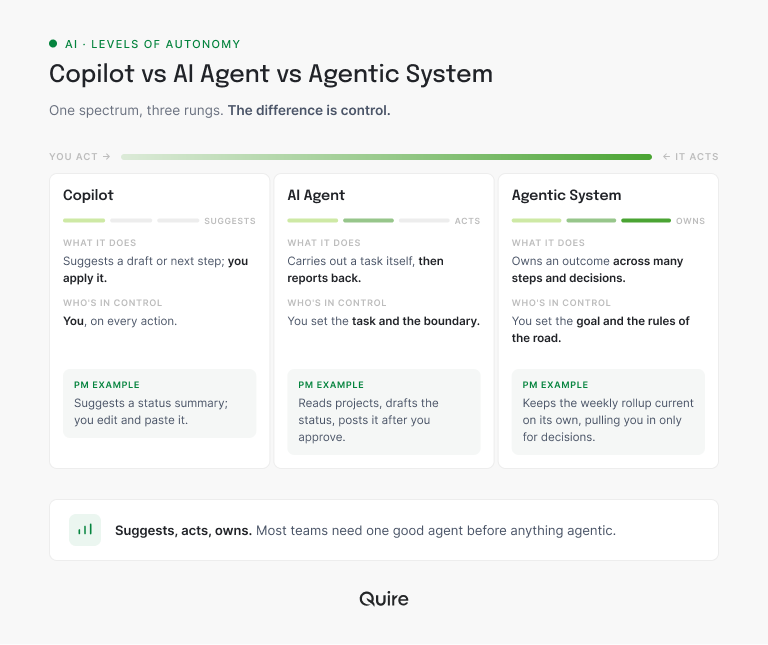
That's the whole spine of it. Everything else is detail hanging off those three rungs.
For the deeper treatment of the top rung, see our pillar on agentic project management and how AI agents change where coordination lives.
The middle rung is the one worth seeing rather than reading about, and there is a 40-minute session where we connect Claude to a live Quire project on camera. This clip opens on that chapter, where the AI stops answering questions and starts changing real tasks.
In this session10:09 Connect Claude to Quire, live proof
What does each one look like inside a PM tool?
Abstract definitions are easy to nod at and hard to use, so here's each term wearing work clothes.
Copilot
You're writing a project update and a panel suggests a summary of the week. It's decent. You edit it and paste it in. The copilot never touched your tasks; it handed you words and you did the moving. Helpful, and also still your afternoon.
AI agent
You ask for the weekly update and the agent reads the actual projects, drafts the status, and posts it after you okay it.
In Quire that runs over the MCP server, and the difference shows up in the detail: the agent opens the Q3 Launch project, walks the task tree, sees that "Ship pricing page" is assigned with Friday's due date and that two of its four subtasks are still open, and reports the slip as a comment on the task rather than a paragraph you have to retype.
It didn't suggest the work. It did the work, inside the tool, and left you the approval. That's the jump most teams feel as "oh, this is different."
Agentic system
The status is never stale because a system keeps it current: it watches for changes, updates a rollup, flags drift, and pulls you in only when a decision needs a person.
In Quire the rollup is itself a task with one subtask per workstream and a Priority custom field, so "current" is a state you can look at rather than a document somebody owns. You stopped asking for the update because the update maintains itself. That's owning an outcome rather than executing a task.
The rungs stack. An agentic system is built from agents; an agent is a copilot that got access and permission. Knowing which rung a feature sits on tells you exactly how much it will actually take off your plate.
If Monday status is the part of the week you dread, that's the cheapest place to test the middle rung. Start a free Quire project, put this week's real tasks in it with owners and due dates, connect Claude through MCP, and ask for the status before you write it yourself. You'll know within one Monday whether the rung is worth climbing.
Why do the three words keep blurring together?
Two reasons, one cynical and one fair.
The cynical one: "agentic" tests better than "assistant." A feature that suggests a due date sounds sleepier than a feature that is "powered by agentic AI," even when they're the same panel. So the biggest word migrates onto the smallest capability, and the spectrum collapses into a buzzword.
The fair one: the rungs genuinely blend at the edges. A copilot that can take one small action starts to look like an agent. An agent that runs on a schedule and chains a few steps starts to look agentic. There's no border guard checking passports between the categories, so reasonable people draw the lines in slightly different spots.
That's why arguing about the label is a trap. Two vendors can both say "AI agent" and mean wildly different amounts of autonomy. The word tells you what the marketing team chose; it doesn't tell you what the software does. The only reliable move is to ignore the noun and test the behavior, which is exactly what the checklist later in this post is for.
Prefer the definition pinned down with real workflows rather than terminology? Read what agentic project management actually means, with five workflows you can run this week.
Agentic AI vs AI agents: which does your team need?
Almost everyone reaching for "agentic" needs a good agent first. It's the least glamorous answer and the correct one.
Start where the risk is lowest and the payoff is fastest: one agent, one reversible workflow, connected to your real data. The weekly status draft is the usual doorway. Get that boring and reliable, then add a second workflow, then a third. Somewhere after the third or fourth, you'll want them coordinated so they don't step on each other, and that coordination is where an agentic setup earns its name.
Doing it the other way around is the expensive mistake. Teams that buy a fully autonomous "agentic platform" before they've trusted a single agent end up with a powerful thing nobody dares turn on. Trust is built one workflow at a time, and no pricing tier sells it to you in advance.
So skip the label and match the rung to the coordination problem you actually have.
| The coordination problem you have | What you actually need | Where it starts in Quire |
|---|---|---|
| Writing status eats your Monday on one project | One agent, one reversible workflow. Not agentic anything. | An MCP-connected agent reads the project and posts the status as a comment for you to approve. |
| Meeting notes never turn into tasks anyone owns | A second agent, added only after the first one earned it. | The agent creates tasks with an assignee and a due date, and subtasks under anything multi-step. |
| Several projects run in parallel and the rollup is always stale | Coordination across agents. This is the first honest case for agentic. | A rollup task with one subtask per workstream, kept current from the underlying projects. |
| Work crosses teams and a wrong edit is expensive to unpick | Guardrails before more autonomy, whatever the rung. | Membership granted project by project, plus the activity trail on every task. |
Read that table downward and you have a sequence, not a menu. Each row is the honest prerequisite for the one below it, and most teams sit on the first row far longer than the marketing suggests they should. The capability doesn't change as you move down; your trust does, and trust is the thing that makes autonomy safe instead of scary.
Want the concrete starter set? Here are 5 project management workflows that changed the day we got an MCP server.
Where does MCP fit in all this?
MCP is the access layer all three depend on the moment they stop talking and start doing. The Model Context Protocol is an open standard that lets an AI read from and write to an outside application, your project tool included, through structured permissions and a record of what it did, rather than a custom integration built per tool.
A pure copilot can skip it, because suggesting text requires no access at all. An agent that sets a date, or an agentic system that maintains a rollup, cannot: both have to read and write your real tasks.
According to Wikipedia's entry on the protocol, Anthropic introduced it in November 2024 and it has since been adopted by other major AI providers including OpenAI and Google DeepMind, which is why it's the connector most agents now expect to find.
Quire's side of that connection is mcp.quire.app, a server the product ships itself, so it isn't an integration somebody on your team has to build first. What it exposes is the part that matters for the rungs above: tasks and their subtasks, projects, assignees, dates, and comments.
That's the difference between an agent that can tell you what a good status update would say and one that can read forty tasks and write the real one.
So the term on the box matters less than one question underneath it: can this thing actually reach my work, safely? A copilot with no access is honest about its limits. An "agent" with no access is a copilot with a costume.
This is also why the access layer, not the model, tends to be the real bottleneck. Models capable of agentic behavior are widely available now. What's scarce is project tools that expose their data cleanly enough for those models to act on it, with the permissions and record that make acting safe. Pick the tool for the access, and the intelligence follows.
Ready to wire it up rather than read about it? Our Quire MCP setup guide walks through connecting an assistant to a live project.
How do you tell which one a vendor is actually selling?
Marketing blurs these three on purpose, because "agentic" sells better than "suggests things." Five quick checks cut through it.
Ask whether it suggests or acts. Check whether it can see your real project through something like MCP. Ask how many steps it runs unattended. Look for the stopping point where a human approves. And confirm you can walk a change back. Run those five and any tool lands on the spectrum honestly, no matter what the headline says.
It's a fair test to run on us too, so here are Quire's answers in the same order:
- It acts, through
mcp.quire.app. - It sees the live task tree rather than a pasted summary.
- It runs the sequence you asked for and stops.
- Approval is yours, because an agent's draft arrives as a comment before anything ships.
- Every change lands in the same task activity trail as everybody else's, with a removed task restorable rather than retyped.
Any vendor should be able to answer those five as plainly.
The pattern to notice: the further right on the copilot-agent-agentic spectrum, the more the boring safeguards matter. Autonomy without permissions, logging, and a way back isn't advanced. It's just unsupervised.
For the rung below this one in practice, see what AI agents actually do in project management tools today, and the wider AI project management guide for how the pieces fit together.

When should you not reach for an agentic system?
When the work has to come out the same way every time, more autonomy is a downgrade, not an upgrade. The whole point of the top rung is that the system decides its own route to the goal. That is exactly what you do not want in the places where the route is the requirement.
Three cases where a copilot, or a plain rule, beats an agent:
The output is audited. Compliance reporting, financial close, anything where somebody may later ask why a number changed. A rule that always fires the same way is defensible in a way that "the model chose these three tasks" is not. Keep the AI on drafting the commentary, not on deciding the figures.
The task is genuinely one step. If the job is "suggest a due date," a copilot does it with less to go wrong. Wrapping one step in an agent adds failure modes without adding capability, and every extra step is another model call, so the slower, more expensive version of the same answer is not a better one.
Your tool cannot show its work. If you cannot scope what the AI reaches, or reconstruct what it changed afterwards, autonomy is a liability no matter how good the model is. That is a property of the tool, not the AI.
In Quire it is the reason membership is granted project by project and every task keeps an activity trail: the agent gets a small blast radius and a readable history, so a bad call is a correction rather than an investigation.
The honest read is that the rungs are not a ranking. A copilot is not an agent that failed to grow up. It is the right choice whenever you want the human to stay on every decision, and plenty of work is like that.
Key takeaways
Copilot, agent, agentic: suggests, acts, owns. That's the whole distinction, and it maps directly onto how much work leaves your plate and how many guardrails you need in return. For project teams in 2026, the honest recommendation is unglamorous: get one agent working on one reversible workflow before you shop for anything agentic.
And whatever the label, ask the plumbing question. If the AI can't reach your real tasks through something like MCP, it can advise but it can't act, no matter how the pricing page spells it.
Want to see the middle rung in action? Start free at quire.io/signup, connect Claude through MCP, and ask an agent to draft this week's status from your real tasks. It's the fastest way to feel the difference between a tool that suggests and one that does.
Frequently Asked Questions
What is the difference between agentic AI and AI agents?
An AI agent is a single program that does a task on its own. Agentic AI is the broader property of a system owning an outcome across many steps. An agent does a task; agentic AI pursues a result. Most teams need one agent long before a fully agentic system.
What is a copilot versus an AI agent?
A copilot suggests and you apply it by hand. An agent has access to your tools and does the step itself, then reports back. A copilot might suggest a due date; an agent sets it and logs the change.
What does agentic AI mean in project management?
A system that owns a coordination outcome end to end, like keeping the weekly status current, rather than answering one question at a time. It usually needs an integration layer like MCP to act on real tasks.
Which one does my team actually need?
Most teams need one good agent before anything agentic. Start with a single reversible workflow run by an agent on your real data, and reach for an agentic setup only once several workflows run well.
Do copilots, agents, and agentic systems all need MCP?
Anything that acts on your project needs a way in, and MCP is the common one. A copilot that only suggests text can live without it; the moment the AI reads tasks or writes updates, it needs structured access like MCP.
When should you not use agentic AI?
Whenever the route matters as much as the result. Audited work wants a rule that fires the same way every time. A one-step job is better served by a copilot. And if you cannot scope what the AI reaches or see what it changed, autonomy is a liability whatever the model.
Does any of this make a team more productive at work?
Yes, but from the work the agent does, not the label. In Quire, an MCP-connected agent handles status, triage, and follow-ups from live tasks, which is where the recovered hours come from.