productivity tips · Jun 29, 2026
How to Be More Productive at Work Without Working More Hours
Last updated: September 8, 2026
Being more productive at work isn't about more hours or more willpower. It's about cutting the friction between you and the work that matters. Make your next task obvious, make priorities visible, protect deep work on purpose, and build a system your whole team can see.
- What does being productive at work actually mean?
- Why does most productivity advice fail?
- The real bottleneck is coordination, not willpower
- How do you cut the cost of finding your next task?
- Why should you make priorities visible to the whole team?
- How do you protect deep work on purpose?
- How do you build a system your team can see, not a private hack?
- How do you measure productivity without gaming it?
- What are the most common productivity traps?
- Key takeaways
- Frequently asked questions
You answered everything. You sat through the meetings. And the one thing you actually wanted to finish is still sitting there at the end of the day, blinking at you.
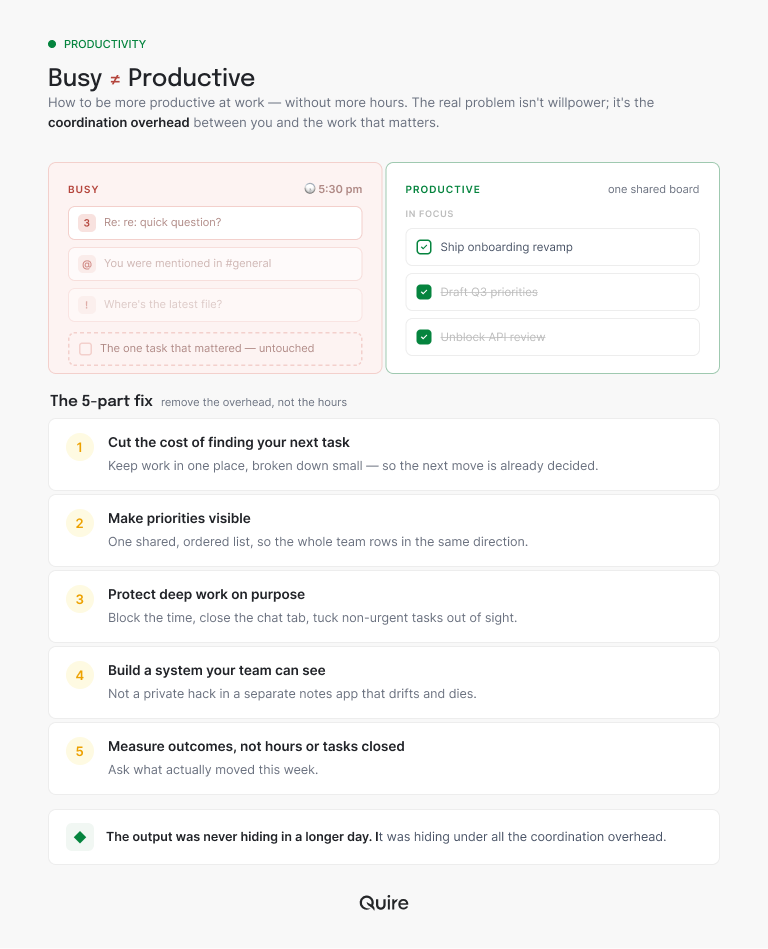
You weren't slacking. You were busy all day, and busy, it turns out, is not the same as productive. So the question is not how to work harder. It's how to be more productive at work when the day keeps getting eaten by everything that is not the work.
Here's the part nobody tells you. Most of the time you "lose" at work was never yours to begin with. It went to hunting for a file, asking who owns the thing, re-deciding a priority you already settled last Tuesday, and switching between six half-finished tasks because none of them ever got a clean run. That's not a willpower problem. That's a friction problem.
So this is not another list telling you to wake up at 5am and drink more water. It's about removing the steps between you and the work that matters, instead of piling on more hours. Let's get into it.
What does being productive at work actually mean?
Productivity at work is how much meaningful output you produce for the time and energy you put in. Not how many hours you sit at your desk, and not how many tasks you tick off. It's whether the work that actually moves a goal got done, with as little wasted effort as possible.
That definition matters because the wrong one is what keeps you stuck. If you measure productivity by hours, you'll just add hours. If you measure it by tasks completed, you'll do a pile of tiny, easy tasks and avoid the big, important one. (We all do this. We all know we're doing it.)
And the hours don't even pay off. A Stanford study of working hours found that output per hour falls sharply once you pass about 50 hours a week, and someone putting in 70 hours gets no more done than someone working 55. Those extra fifteen hours just vanish.
Real productivity is a ratio. Output over effort. And here's the reframe that changes everything: it isn't output over hours, it's output over friction. You can move that ratio two ways, by producing more or by wasting less. For most teams, the bigger and easier win is wasting less.
Why does most productivity advice fail?
Because most of it treats productivity like a personal moral failing. Try harder. Be more disciplined. Stop being lazy. The advice is aimed at your character, when the real problem is usually your environment.
You can be the most disciplined person on the team and still lose two hours a day to a workflow that makes you ask three people where the latest version of a doc lives. Discipline doesn't fix that. Better plumbing does.
The second reason advice fails is that it's built for one person. Read enough of it and you'd think productivity is a solo sport: your morning routine, your focus app, your color-coded list. But work is a team game.
Your output depends on whether your colleague's handoff arrived clean, whether the priority everyone agreed on is still the priority, and whether anyone actually knows what you're working on. A personal hack can't touch any of that.
So the honest answer to "how do I become more productive at work" isn't a habit. It's a systems change. Stick with me, because the fixes get specific from here.
Our team recorded an hour-long session on putting this kind of system together in Quire.
The real bottleneck is coordination, not willpower
Here's the uncomfortable truth at the center of this whole thing. The biggest drain on a working day is rarely the work. It's the coordination around the work.
Think about where your time actually goes on a normal Tuesday. A few minutes finding the right thread. A "quick question" that turns into a fifteen-minute context switch. A meeting that exists only because nobody wrote anything down. A task you redo because you didn't know someone else already did it. None of that is the job. All of it is overhead, and it adds up to a tax you pay all day without noticing.
And context switching costs more than it looks. Research by UC Irvine's Gloria Mark found it takes about 23 minutes to get back to a task after an interruption, so a five-second "quick question" can quietly cost someone the better part of half an hour.
That tax has a name once it scales past a single person.
The team-level version of this drain is worth a read on its own: the coordination tax that growing teams pay, and why it grows faster than headcount.
Once you see productivity as a coordination problem, the questions change. You stop asking "how do I make myself work harder" and start asking "how do I cut the number of steps, questions, and re-decisions between me and the next thing." That second question has much better answers. The rest of this post is the five that matter most.
How do you cut the cost of finding your next task?
The single most expensive moment in a workday is the gap between finishing one thing and starting the next. That gap is where you drift. You finish a task, you look up, and instead of a clear next action you find a wall of notifications and a vague sense of dread. So you check email. Of course you do.
The fix is to make your next action obvious before you need it. Your tasks should live in one place, broken down small enough that "start" is never a research project. When you sit back down, the next move should already be decided, sitting right there waiting for you.
This is also where procrastination quietly wins or loses. A task that says "Launch campaign" is terrifying and gets avoided. A task that says "Write the three subject lines" gets done, because it's small enough to start before your brain can talk you out of it.
If avoidance is the real blocker, the trick isn't more discipline. It's learning to procrastinate properly so the small start happens anyway.
There's an even smaller version of this trick. If the next step takes under two minutes, just do it now instead of filing it for later, because filing it costs more than doing it. That single habit clears a startling amount of clutter off a normal day.
That habit has a name and a surprising amount of research behind it: the 2-minute rule, and why two minutes is the magic threshold.
Breaking work down isn't busywork. It's the difference between a list that paralyzes you and a list you can actually move. Nest the big goal into small next steps, and most of the starting friction just disappears.
Why should you make priorities visible to the whole team?
A priority that lives in one person's head is not a priority. It's a guess everyone else is making.
When nobody can see what matters most this week, every person quietly sorts their own list by their own logic, which is usually "whoever messaged me last." Multiply that across a team and you get five people working hard in slightly different directions, which feels productive and produces surprisingly little.
The fix is boring and powerful. Put the priorities somewhere everyone can see, and keep them current. When the whole team is looking at the same ordered list, you stop having the same "wait, what should I be doing" conversation every Monday. You also stop the slow, invisible leak where two people build the same thing and nobody finds out until it ships twice.
Visibility does something else, too. It kills the status meeting. If anyone can glance at the board and see what's moving, you don't need to gather seven people in a room so each one can say out loud what a single screen already shows. That's team productivity you can feel by Friday.
How do you protect deep work on purpose?
Some work needs a running start. Writing, planning, designing, solving a genuinely hard problem: none of it happens in the ten-minute gaps between meetings. It needs a real block of uninterrupted time, and that block almost never appears on its own. You have to defend it.
The trap is treating focus as something you should just be able to summon. You can't, not in an environment built to interrupt you. Every ping is engineered to pull you out, and once you're out, it costs real minutes to climb back in.
So stop relying on willpower and start changing the environment. Block the time on your calendar like it's a meeting with someone scarier than your boss. Close the chat tab. Silence the phone. Tuck the non-urgent tasks out of sight so they stop tapping you on the shoulder.
For the full method on building and defending that block, here's a guide to deep work and how to reach real focus on purpose.
And mind the unfinished tasks specifically. The half-done thing you left open this morning sits in the back of your head and nibbles at your attention all day. That's a real, named effect, not just a feeling.
There's a name for why the half-done task keeps tapping your shoulder: the Zeigarnik effect, and how unfinished work quietly drains your focus.
So protecting focus is really two moves. Defend the block, and close the loops that would otherwise follow you into it. Do both, and the work that needs a running start finally gets one.
How do you build a system your team can see, not a private hack?
Here's where a lot of well-meaning productivity effort quietly dies. Someone builds a beautiful personal system in their own notes app, separate from where the work actually happens. It works for about a week. Then it drifts out of sync with reality, because nobody keeps two systems aligned for long, and the private system becomes one more thing to maintain.
A system only compounds when it's shared and it lives where the work lives. That's the whole game. One place to capture tasks, one place to see priorities, one place to watch things move. The goal isn't a prettier list. It's a task management system that holds up on a real, messy week instead of a tidy one.
This is the soft-pitch paragraph, and I'll keep it to one. In Quire, the version of this that survives is a Kanban board the whole team can see, with big work broken into nested tasks and Sublists so your next action is always concrete.
Add due dates so scheduled work actually gets a slot, use Peekaboo to tuck non-urgent tasks out of sight until they matter, and you've got a system that holds its shape under pressure instead of melting the first busy Tuesday.
If you haven't settled on one yet, start with a task management method that fits the way your setup is actually failing you, then build the system around it.
How do you measure productivity without gaming it?
Careful here, because the wrong metric makes things worse. Measure hours, and people stay online longer without doing more. Measure tasks closed, and people close a pile of tiny tasks while the important work rots. You get exactly the behavior you reward, every time.
Better signals are about outcomes and flow. Did the work that mattered this week actually ship? How long did a task sit waiting on someone else, doing nothing but aging? Where do things pile up and stall?
Those questions point at the coordination drain, which is the thing worth fixing, instead of pointing at your people, who are mostly doing their best inside a leaky process. A read-only Overview report makes that flow visible without anyone filling out a status update by hand.
Here's a quick way to keep your metrics honest. Measure the left column, not the right.
| Measure this | Not this | Why it matters |
|---|---|---|
| Did the priority work ship? | Hours logged at the desk | Hours reward staying online, not finishing what counts |
| How long tasks waited on someone | Total tasks closed this week | Wait time exposes the coordination drain, not effort |
| Where work piles up and stalls | Messages sent or replied to | Bottlenecks are fixable, busyness is just noise |
| Is the pace sustainable? | Output in a single big week | A great month followed by burnout is expensive, not productive |
That last row is the one teams forget. A team that produces a brilliant month and then runs on fumes for two has not been productive. It's been expensive. Sustainability has a number behind it, too: committed hours against real capacity, per person, which is what team workload management makes visible before the fumes month arrives.
Rest isn't the opposite of output, it's part of the system: productive downtime is the method that beats burnout instead of feeding it.
What are the most common productivity traps?
A few catch almost everyone, and they're worth naming so you can spot them in the wild.
- Mistaking motion for progress. A full calendar feels productive. It usually isn't. Ask what actually moved, not how packed the day looked.
- Optimizing yourself, ignoring the system. You can perfect your morning routine and still lose two hours a day to a broken handoff. Fix the plumbing first.
- Treating focus as a one-time setup. You don't protect deep work once. You rebuild that block most days, because the interruptions come back every day.
- Hoarding the to-do list in your head. If your team can't see your work and you can't see theirs, you're coordinating by guesswork, and guesswork is slow.
That last one is the quiet killer. Most productivity loss on a team isn't dramatic. It's a hundred small re-decisions and double-checks that a shared, visible system would have made unnecessary in the first place.
Key takeaways
Being more productive at work isn't about hours, and it isn't about willpower. It's about removing the friction between you and the work that matters. Cut the cost of finding your next task, make priorities visible so the whole team rows in one direction, protect deep work like it's a real appointment, and build a system everyone can see instead of a private hack that drifts.
Do that, and the extra hours stop being necessary. The output was never hiding in a longer day. It was hiding under all the coordination overhead, waiting for someone to clear it out.
Want to stop running your team on guesswork? Start free at quire.io/signup and put your whole team's work on one board you can actually see.
Frequently asked questions
How can I be more productive at work?
Cut the friction, don't add hours. Make your next task obvious, protect a block of deep work, and keep your tasks somewhere your whole team can see, like a shared Quire board. Most lost time is coordination overhead, not laziness, and that's the part worth fixing.
Why am I busy all day but not productive?
Because busy means the day was full and productive means the right work moved. Reacting to messages and meetings feels like work but rarely moves a goal. Decide what matters before the day starts, and defend time for it.
Does working more hours make you more productive?
No. Past a point, more hours just add mistakes, rework, and burnout, all of which cost time later. The gains come from doing the right work and wasting less, not from staying online longer.
What is the best way to stay focused at work?
Build the environment for it. Pick the one task that matters, block the time, and remove the obvious interruptions during that block. Tucking non-urgent tasks out of sight with Quire's Peekaboo helps. Focus is something you set up, not something you're born with.
How do you measure productivity at work without gaming it?
Measure outcomes and flow, not hours or tasks closed. Look at whether the priority work shipped, how long tasks waited on others, and whether the pace can last. Those signals point at the process, not the people.